Stokes' Law Calculator
Drag force equals six times pi times viscosity times radius times velocity
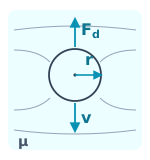
Stokes' Law gives the drag force on a small sphere moving slowly through a viscous fluid: Fd = 6πμrv. It applies when the Reynolds number is low (Re < 1), meaning viscous forces dominate over inertial forces. The drag is proportional to velocity, viscosity, and sphere radius. The terminal velocity equation Vt = gd²(ρp−ρm)/(18μ) calculates the constant speed a spherical particle reaches when drag force balances the net gravitational force. This is widely used in sedimentation analysis and particle settling studies.
A 0.5 mm radius sphere falls through oil (μ = 0.1 Pa·s) at 0.01 m/s. What is the drag force?
Stokes' Law describes the drag force on a small sphere moving slowly through a viscous fluid, valid when the Reynolds number is below 1 (creeping flow regime). Drag is directly proportional to velocity, viscosity, and sphere radius — doubling any one doubles the drag. Terminal velocity occurs when drag equals the net gravitational force on the particle, resulting in constant settling speed. This is the foundation for sedimentation analysis, particle sizing, and viscometry.
Stokes' Law is valid at low Reynolds numbers (Re < 1), which means small, slow-moving spheres in viscous fluids. Examples include sediment settling, fog droplets, and blood cells.
Terminal velocity occurs when drag equals the net gravitational force on the sphere. At that point the sphere falls at constant speed. For a dense sphere in a light fluid, Vt = gd²(ρp − ρm) / (18μ).
It is used to measure fluid viscosity (falling-ball viscometer), determine particle size in sedimentation analysis, and model aerosol behavior in air quality studies.
Fd = 6π × μ × r × v, where μ is the fluid dynamic viscosity, r is the sphere radius, and v is the sphere's velocity relative to the fluid. Drag scales linearly with all three — doubling any one doubles the drag force.
Stokes drag (Fd ∝ v) applies at Re < 1 where viscous forces dominate. Newton drag (Fd ∝ v²) applies at Re > ~1000 where inertial forces dominate. Between these regimes, drag follows a more complex empirical curve and neither simple formula is accurate.
Stokes' Law is exact for rigid spheres in unbounded Newtonian fluids at Re < 0.1, and within a few percent up to Re ≈ 1. Irregular particles, deformable droplets, near-wall effects, and non-Newtonian fluids all require correction factors. For Re > 1, use the full drag-coefficient curve instead.
Terminal velocity scales with the square of diameter (Vt ∝ d²). Halving the particle size cuts terminal velocity to one quarter. That's why clay (~2 μm) takes hours to settle in still water while sand (~200 μm) settles in seconds — even though their densities are similar.
Reference:
Lindeburg, Michael R. 1992. Engineer In Training Reference Manual. Professional Publication, Inc. 8th Edition.
Hematology
A red blood cell has an effective diameter of 7 μm, density of 1100 kg/m³ in plasma of density 1025 kg/m³, and plasma viscosity 0.0014 Pa·s. Use Stokes' law to estimate the terminal settling velocity behind the ESR (erythrocyte sedimentation rate) blood test.
Vt ≈ 1.43×10⁻⁶ m/s (≈ 5.15 mm/hr)
Normal ESR is roughly 0-20 mm/hr; elevated values (>30 mm/hr) suggest inflammation. Stokes' law is the physical basis of the test, although in practice rouleaux formation and hematocrit shift the measured rate.
Environmental Engineering
A 20 μm silt particle (ρp = 2650 kg/m³) settles in still lake water (ρm = 1000 kg/m³, μ = 0.001 Pa·s). What is the terminal settling velocity, and how long would it take to settle through a 10 m water column?
Vt ≈ 3.60×10⁻⁴ m/s (≈ 31 m/day)
A 10 m water column would clear of suspended silt in about 7-8 hours under quiescent conditions — sediment ponds and clarifier basins use exactly this calculation to size their depth and residence time.
Viscometry
A falling-ball viscometer drops a 5 mm radius steel sphere through glycerin (μ = 1.4 Pa·s) at a measured velocity of 0.05 m/s. What is the Stokes drag force on the ball?
Fd ≈ 6.60×10⁻³ N (about 6.6 mN)
Balanced against gravity minus buoyancy, this drag determines the terminal velocity used in the standard ASTM D1343 falling-ball viscosity method. The technique is accurate for Newtonian liquids in the laminar regime (Re < 1).
Stokes' Law describes the drag force on a small sphere moving slowly through a viscous fluid, and the terminal settling velocity it reaches when drag balances gravity:
Where:
These formulas are exact for rigid spheres in unbounded Newtonian fluids at Reynolds number Re < 0.1 and accurate within a few percent up to Re ≈ 1. At higher Re, inertial effects matter and the full drag-coefficient curve must be used. The terminal velocity equation comes from setting drag (6πμrVt) equal to net gravity (volume × density difference × g).
