Reynolds Number Calculator
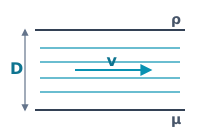
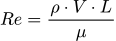
Reynolds number equals density times velocity times characteristic length divided by dynamic viscosity
The Reynolds number is a dimensionless quantity that predicts the flow regime in fluid mechanics. It represents the ratio of inertial forces to viscous forces within a fluid and is used to determine whether flow will be laminar (smooth, orderly) or turbulent (chaotic, mixing). The formula Re = ρVL/μ combines four variables: fluid density (ρ), flow velocity (V), a characteristic length like pipe diameter (L), and dynamic viscosity (μ). For pipe flow, Re below 2,300 indicates laminar flow and Re above 4,000 indicates turbulent flow, with a transitional zone in between.
Water (ρ = 998 kg/m³) flows at 1.5 m/s through a pipe with an inner diameter of 0.05 m. The dynamic viscosity of water at 20°C is approximately 0.001002 Pa·s. What is the Reynolds number, and is the flow laminar or turbulent?
The Reynolds number is named after Osborne Reynolds, who demonstrated the laminar-to-turbulent transition in pipe flow experiments published in 1883. His dimensionless ratio remains one of the most important parameters in all of fluid mechanics.
The Reynolds number represents the ratio of inertial forces (which promote mixing and turbulence) to viscous forces (which resist deformation and maintain orderly flow). Below Re 2,300 in pipe flow, viscous forces dominate and flow is laminar with smooth, parallel streamlines. Above Re 4,000, inertial forces dominate and flow becomes turbulent with chaotic eddies. The transition zone between these values is unstable and sensitive to disturbances. Surface roughness, inlet geometry, and vibrations can all shift the critical Reynolds number.
The Reynolds number tells you whether a fluid flow will be laminar (smooth, orderly layers) or turbulent (chaotic, mixing eddies). It quantifies the ratio of inertial forces that drive mixing to viscous forces that resist it. A low Re means viscous forces dominate and flow stays laminar; a high Re means inertial forces dominate and turbulence develops.
For flow inside a circular pipe, the transition begins around Re = 2,300 and flow is considered fully turbulent above Re = 4,000. The range between 2,300 and 4,000 is the transitional zone where flow may switch between laminar and turbulent. These thresholds differ for other geometries — for example, flow over a flat plate transitions around Re = 500,000.
The Reynolds number is calculated with Re = ρVL/μ, where ρ is the fluid density (kg/m³), V is the flow velocity (m/s), L is a characteristic length such as pipe diameter (m), and μ is the dynamic viscosity (Pa·s). All variables must be in consistent units. For kinematic viscosity (ν = μ/ρ), the formula simplifies to Re = VL/ν.
The characteristic length depends on the geometry. For internal pipe flow, it is the pipe diameter. For flow over a flat plate, it is the distance from the leading edge. For flow around a sphere, it is the sphere diameter. Choosing the correct characteristic length is essential for accurate Reynolds number calculations.
Temperature primarily affects viscosity and, to a lesser extent, density. For liquids, viscosity decreases with increasing temperature, so the Reynolds number increases (flow becomes more turbulent). For gases, viscosity increases with temperature, so the Reynolds number decreases. Always use fluid properties at the actual operating temperature.
Laminar flow moves in smooth, parallel layers with no cross-stream mixing — it occurs at low Reynolds numbers where viscous forces dominate. Turbulent flow is chaotic with swirling eddies that enhance mixing and heat transfer but also increase friction and pressure drop. Turbulent flow requires more pumping energy but is desirable when thorough mixing is needed.
A generalized Reynolds number can be defined for non-Newtonian fluids, but the standard formula Re = ρVL/μ applies only to Newtonian fluids with constant viscosity. For power-law fluids, a modified Reynolds number (the Metzner-Reed Reynolds number) accounts for the shear-rate-dependent viscosity and the power-law index.
Reference:
Tipler, Paul A. 1995. Physics For Scientists and Engineers. Worth Publishers. 3rd ed. — viscous flow and the Reynolds number.
The Reynolds number is a dimensionless quantity that predicts flow regime in fluid mechanics, representing the ratio of inertial forces to viscous forces:
Where:
For pipe flow, Re < 2,300 indicates laminar flow (smooth, parallel streamlines), Re > 4,000 indicates turbulent flow (chaotic eddies and mixing), and the range between is the transitional zone. These thresholds shift for external flows, rough surfaces, and non-circular cross-sections.
Piping Engineering
Water (ρ = 998 kg/m³) flows at 1.5 m/s through a 6-inch (0.1524 m) steel pipe. Dynamic viscosity at 20°C is 0.001002 Pa·s.
At Re > 4,000 the flow is well into the turbulent regime. Engineers must use the Moody chart or Colebrook equation for friction factor when sizing pumps for this system.
Aerospace Engineering
Air at cruise altitude (ρ = 0.4135 kg/m³) flows at 230 m/s over a wing with a chord length of 3.5 m. Dynamic viscosity at −40°C is approximately 1.51 × 10⁻⁵ Pa·s.
Aircraft wings operate at very high Reynolds numbers. Wind tunnel testing must match this Re (or use correction factors) for drag and lift coefficients to be valid at full scale.
Biomedical Engineering
Blood (ρ = 1,060 kg/m³) flows at 0.4 m/s through the aorta (diameter ≈ 0.025 m). Blood's effective dynamic viscosity is approximately 0.0035 Pa·s.
Aortic flow is near the laminar-turbulent transition. During peak systole, velocity increases and Re can exceed 4,000, creating brief turbulent bursts that influence arterial wall shear stress and plaque formation.
Representative density ρ and dynamic viscosity μ for common fluids — the two properties the Reynolds number needs from the fluid itself. Click a fluid to load both its density and viscosity into the calculator; your velocity and characteristic length stay as they are.
| Fluid | Density (kg/m³) | Dynamic viscosity μ (Pa·s) |
|---|---|---|
| Air | 1.2 | 1.81×10⁻⁵ |
| Water | 998 | 0.001 |
| Gasoline | 745 | 6×10⁻⁴ |
| Ethanol | 789 | 0.0012 |
| Blood (37 °C) | 1,060 | 0.0035 |
| Mercury | 13,534 | 0.00153 |
| Olive oil | 915 | 0.081 |
| SAE 30 motor oil | 900 | 0.2 |
| Glycerin | 1,260 | 1.41 |
| Honey | 1,420 | 10 |
Representative values at ~20 °C (blood at body temperature, 37 °C). Dynamic viscosity is strongly temperature-dependent — it falls sharply for liquids and rises for gases as temperature increases — so use the value at your working temperature for precise work. Sources: CRC Handbook of Chemistry and Physics and Engineering ToolBox.