Lightning Distance Calculator
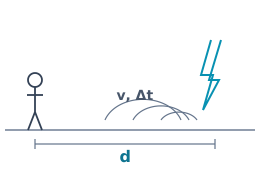
Distance equals speed times time
The distance to a lightning strike equals the speed of sound multiplied by the time between the flash and the thunder. Light arrives almost instantly, so the delay is entirely due to the slower speed of sound (≈343 m/s at 20°C).
d = s × t
Rearranging the distance formula lets you solve for the speed of sound when you know the distance and the time delay. This is useful for estimating the local speed of sound under different temperature conditions.
s = d ÷ t
Solve for the expected time delay between the flash and the thunder when you know the distance and the speed of sound. Useful for verifying observations or planning safety responses.
t = d ÷ s
Light from a lightning flash arrives almost instantly, but thunder travels at about 343 m/s (1,125 ft/s) at 20°C. Multiply the seconds between the flash and the thunder by the speed of sound to get the distance. The classic "5-second rule" says every 5 seconds equals roughly 1 mile (or about 3 seconds per kilometer).
You see lightning and hear thunder 8 seconds later. The air temperature is about 20°C. How far away is the storm?
At 8 seconds the storm is under 3 km away. The 30-30 rule says to seek shelter whenever the flash-to-thunder delay is 30 seconds or less.
Light travels at roughly 300,000 km/s, arriving almost instantly from a lightning strike. Sound travels much slower at about 343 m/s (at 20 degrees C), creating a measurable delay between the flash and the thunder. The speed of sound increases by approximately 0.6 m/s per degree Celsius, so temperature affects accuracy. The classic 5-second rule approximates one mile per five seconds of delay.
Count the seconds between the flash and the thunder, then divide by about 3 to get the distance in kilometers, or divide by 5 for miles. For example, a 9-second delay means the strike was roughly 3 km (1.8 miles) away.
Light travels at about 300,000 km/s — essentially instantaneous over storm distances — while sound travels at only about 343 m/s. The delay you perceive is the time it takes the sound wave (thunder) to cover the distance between the strike and your ears.
Roughly 5 seconds per mile (or 3 seconds per kilometer). If you count 10 seconds between the flash and thunder, the lightning struck about 2 miles away.
Yes. The speed of sound increases by about 0.6 m/s for each degree Celsius. At 0°C it is ~331 m/s; at 35°C it is ~352 m/s. For most purposes the default 343 m/s (20°C) is close enough.
If the flash-to-thunder time is 30 seconds or less (about 6 miles or 10 km), seek shelter immediately. Wait at least 30 minutes after the last thunder before going back outside.
Rarely. Thunder is typically inaudible beyond about 10-15 miles (16-24 km) because the sound wave refracts upward in the atmosphere and dissipates. If you can hear the thunder, the storm is close enough to be a potential danger.
Within about 10% for distances under 15 km, assuming you match the flash to its thunder correctly. Accuracy decreases with wind, temperature gradients, and terrain obstructions. In active storms with multiple bolts, pairing the wrong flash with the wrong thunder is the biggest source of error.
The flash-to-bang method uses the speed of sound to convert the time delay between a lightning flash and the arriving thunder into a distance:
Where:
Light travels at roughly 300,000 km/s, so the flash arrives almost instantly. The entire delay is due to the much slower speed of sound. The formula applies to any distance where sound can travel in a straight line; at very long ranges (>25 km), atmospheric refraction and wind can distort the result.
Outdoor Safety
You see a lightning flash and count 10 seconds before the thunder arrives. The temperature is about 20°C (speed of sound ≈ 343 m/s).
d = 3,430 m (about 2.1 miles)
Under the 30-30 rule, any delay of 30 seconds or less (≤10 km) means you should already be in shelter. At 10 seconds this storm is dangerously close.
Aviation
A ground crew at the airport observes lightning and hears thunder 25 seconds later. Using standard sea-level speed of sound (340 m/s), estimate the storm distance.
d = 8,500 m (8.5 km / 5.3 miles)
Most airports halt ground operations when lightning is within 5 nautical miles (~9.3 km). At 8.5 km this storm is at the threshold — operations may be paused until the storm moves further away.
Science Education
Students know a lightning strike hit a radio tower 2,000 m away. They measure a 6-second delay. What speed of sound does this imply?
v ≈ 333.3 m/s
This is lower than 343 m/s, which suggests the outdoor temperature was below 20°C — consistent with thunderstorm conditions where descending air cools the surface.
