Fraction Addition
To add two fractions, find a common denominator using the LCM, convert each fraction, add the numerators, then simplify the result by dividing by the GCD.
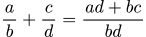
a/b + c/d = (ad + bc) / bd
How It Works
To add two fractions, you first find a common denominator using the Least Common Multiple (LCM). Convert each fraction so both share that denominator, add the numerators, then simplify the result by dividing by the Greatest Common Divisor (GCD). If the numerator ends up larger than the denominator, you can also rewrite the result as a mixed number.
Example Problem
Add 1/4 + 1/3:
- Find the least common denominator: LCM(4, 3) = 12.
- Rewrite 1/4 as 3/12 by multiplying numerator and denominator by 3.
- Rewrite 1/3 as 4/12 by multiplying numerator and denominator by 4.
- Add the numerators: 3 + 4 = 7.
- Keep the common denominator 12, giving 7/12.
- Since 7 and 12 share no common factor greater than 1, the answer is already simplified.
Result: 7/12
Key Concepts
Adding fractions requires a common denominator because fractions represent parts of a whole — you cannot add parts of different-sized wholes directly. The Least Common Multiple (LCM) of the denominators gives the smallest common denominator. After converting and adding numerators, the result is simplified by dividing both numerator and denominator by their Greatest Common Divisor (GCD).
Applications
- Cooking and baking: combining fractional measurements like 1/3 cup and 1/4 cup
- Construction: adding fractional inch measurements for lumber and pipe cuts
- Finance: adding fractional shares or fractional interest rates
- Math education: foundational skill required for algebra, calculus, and probability
Common Mistakes
- Adding numerators and denominators directly — 1/4 + 1/3 is NOT 2/7; you must find a common denominator first
- Using the product of denominators instead of the LCM — this works but produces larger numbers that need more simplification
- Forgetting to simplify the result — always divide by the GCD to reduce to lowest terms
Frequently Asked Questions
How do you add fractions step by step?
Find the least common denominator, rewrite each fraction with that denominator, add the numerators, keep the denominator the same, and then simplify. This is the standard process taught in arithmetic and pre-algebra.
How to add fractions with different denominators?
Find the LCM of the two denominators, rewrite each fraction with that common denominator, then add the numerators. For 2/5 + 1/3, the LCM is 15, giving 6/15 + 5/15 = 11/15.
Do you always need to simplify after adding fractions?
It is standard practice to reduce the result to lowest terms. Divide both the numerator and denominator by their GCD. If the GCD is 1, the fraction is already simplified.
What is a mixed number result?
When the numerator is larger than the denominator, the fraction can be written as a mixed number. For example, 7/4 = 1 3/4. This calculator automatically shows the mixed form when applicable.
What is the formula for adding fractions?
A general formula is a/b + c/d = (ad + bc) / bd. In practice, many teachers prefer the least-common-denominator method because it often produces smaller intermediate numbers.
Why do fractions need a common denominator before adding?
The denominator tells you how large each piece is. You can only add pieces directly when they represent the same size part of a whole, which is why the denominators must match first.
Can you add negative fractions?
Yes. A negative fraction works the same way as a positive one after you rewrite both fractions with a common denominator. Then you add signed numerators and simplify the result.
Reference:
Standard least-common-denominator method for fraction addition taught in arithmetic and pre-algebra.
Fraction Addition Formula
Add fractions by rewriting them with a common denominator and then adding the numerators:
a/b + c/d = (ad + bc) / bd
In practice, the cleanest method is often to use the least common denominator (LCD) instead of multiplying denominators blindly.
Worked Examples
Unlike Denominators
Add 1/4 + 1/3
- LCD of 4 and 3 is 12
- 1/4 = 3/12 and 1/3 = 4/12
- 3/12 + 4/12 = 7/12
7/12
Whole Number Result
Add 1/2 + 1/2
- The denominators already match
- Add numerators: 1 + 1 = 2
- 2/2 simplifies to 1
1
Mixed Number Outcome
Add 5/6 + 3/4
- LCD of 6 and 4 is 12
- 5/6 = 10/12 and 3/4 = 9/12
- 10/12 + 9/12 = 19/12 = 1 7/12
19/12
Related Calculators
- Fraction Subtraction Calculator — subtract fractions with step-by-step work
- Fraction Multiplication Calculator — multiply fractions and simplify
- Simplify Fraction Calculator — reduce a fraction to lowest terms
- Fraction Division Calculator — divide fractions using the reciprocal method
- LCM Calculator — find the least common multiple for unlike denominators
Related Sites
- CameraDOF — Depth of field calculator for photographers
- Percent Off Calculator — Discount and sale price calculator
- Hourly Salaries — Hourly wage to annual salary converter
- InfantChart — Baby and child growth percentile charts
- Dollars Per Hour — Weekly paycheck calculator with overtime
- BOGO Discount — Buy-one-get-one discount calculator