Fluid Pressure Calculator
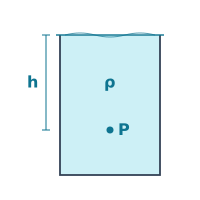
Bottom pressure equals top pressure plus density times gravity times depth
Calculate hydrostatic pressure at the bottom of a fluid column. Pressure increases linearly with depth, density, and gravitational acceleration.
P_bottom = P_top + ρ × g × h
Relate pressure to force and area. Pressure is the force applied per unit area, measured in pascals (N/m²).
P = F ÷ A
Convert between gauge, atmospheric, and absolute pressure.
P_abs = P_gauge + P_atm
Measure a fluid's resistance to compression.
K = ΔP × V₀ ÷ ΔV
Compressibility is the inverse of bulk modulus.
β = 1 ÷ K
This calculator covers five fluid pressure equations. Water Column Pressure computes hydrostatic pressure at the bottom of a fluid column (P = P_top + ρgh). Pressure (P=F/A) relates force and area. Absolute Pressure converts between gauge, atmospheric, and absolute pressure. Bulk Modulus measures a fluid's resistance to compression, and Compressibility is its inverse.
A scuba diver descends to 20 m in seawater (density 1,025 kg/m³) with atmospheric pressure of 101,325 Pa at the surface. What is the absolute pressure at that depth?
Fluid pressure is the force per unit area exerted by a fluid. In a static fluid, pressure increases linearly with depth (P = rho*g*h) and acts equally in all directions (Pascal's law). Gauge pressure measures pressure above atmospheric; absolute pressure includes atmospheric. Bulk modulus quantifies a fluid's resistance to compression — water's bulk modulus of about 2.2 GPa means it is nearly incompressible. Compressibility is the inverse of bulk modulus.
Use the hydrostatic equation P = P_top + ρgh. Multiply density (kg/m³) by gravitational acceleration (9.81 m/s²) by depth (m), then add the surface (top) pressure. Water at 10 m yields 1,000 × 9.81 × 10 = 98,100 Pa of hydrostatic pressure over the surface value.
Pressure is a scalar — it depends only on local depth, fluid density, and gravity. A thin tube and a wide reservoir filled to the same height produce the same bottom pressure. This is the hydrostatic paradox; total weight differs, but pressure (force per unit area) does not.
P_absolute = P_gauge + P_atmospheric. Most field instruments (tire gauges, blood-pressure cuffs, dive computers) read gauge — pressure above the local atmosphere. Absolute pressure is needed for thermodynamic calculations and for working below atmospheric (vacuum) conditions.
Bulk modulus K = ΔP × V₀ / ΔV measures a fluid's resistance to volume compression. Water is ~2.2 GPa, hydraulic oil ~1.5–2.0 GPa, and mercury ~28 GPa. Higher K means the fluid is stiffer and transmits pressure signals more rapidly.
Compressibility β is just the reciprocal: β = 1/K. It expresses the fractional volume change per unit pressure increase (units of 1/Pa). Water's β ≈ 4.6×10⁻¹⁰ Pa⁻¹ — a 1 atm pressure rise compresses water by about 0.0046%.
In a closed hydraulic system, Pascal's law makes pressure uniform — so a small force on a small piston creates a large force on a large piston. F_out = P × A_out lets a 100 N input on a 1 cm² piston lift 10,000 N on a 100 cm² piston, at the cost of moving 100× the distance.
For most engineering depths (less than 1 km of water), the density change is under 0.5% and can be ignored. At Mariana-Trench depths (~11 km), water density rises by about 4–5% due to compression, and the strict P = ρgh assumption breaks down — pressure grows slightly faster than linearly with depth.
Municipal Water Distribution
A 30 m elevated water tower supplies a neighborhood with gravity-fed water. Compute the gauge pressure at the base of the standpipe — the pressure available at street level before any pipe friction is subtracted. Use ρ = 1000 kg/m³ for fresh water and g = 9.81 m/s²; take the top of the tower as gauge-zero (atmospheric).
P_bottom ≈ 294 kPa (≈ 42.7 psi) at the base of the standpipe
AWWA design targets 40–60 psi at residential service connections, so a 30 m water tower lands right in the middle of that range — that's why water towers are sized to roughly 30 m / 100 ft. Each additional 1 m of head adds ~9.81 kPa (1.42 psi) of available pressure.
Hydraulic Press (Industrial)
A small industrial hydraulic press applies a clamping force of 50,000 N (about 11,240 lbf) through a 0.02 m² piston face. Compute the working pressure in the hydraulic line — this is what the pump must develop and what the relief valve must protect against.
P = 2.5 MPa (≈ 363 psi)
Industrial hydraulic systems typically run 7–25 MPa (1000–3600 psi). 2.5 MPa is on the light end — common for benchtop presses, tube benders, and small assembly fixtures. Higher-pressure systems get the same force from a smaller piston, which is the whole point of fluid power.
Subsea Oil & Gas
A subsea production wellhead instrument reads 200 bar of gauge pressure (the pressure above atmospheric). Convert this to absolute pressure for use in equation-of-state PVT calculations, which always require absolute pressure. Use the standard atmospheric reference P_atm = 101,325 Pa.
P_abs ≈ 20.10 MPa (201.0 bar absolute)
At seabed pressures of 100+ bar, the difference between gauge and absolute is only ~0.5%, so engineers often round through that conversion. But for low-pressure systems (vapor recovery, gas-lift surface trees) the 1 atm offset is significant and can flip a calculation from positive to negative gauge — always check whether your correlations expect absolute or gauge.
This calculator covers five related equations that govern pressure in static fluids and compressible media:
Where:
These formulas assume an incompressible Newtonian fluid in static equilibrium (no flow, no acceleration of the fluid as a whole). For flowing fluids, the Bernoulli equation extends P = ρgh with velocity and elevation terms; for high-pressure regimes where compression matters, the bulk modulus and compressibility relations capture the (small) volume changes.
