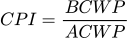
Cost Performance Index
Cost efficiency metric. Above 1.0 = under budget.
CPI = BCWP ÷ ACWP
Schedule Performance Index
Schedule efficiency. Above 1.0 = ahead of schedule.
SPI = BCWP ÷ BCWS
Cost Variance
Positive = under budget.
CV = BCWP − ACWP
Schedule Variance
Positive = ahead of schedule.
SV = BCWP − BCWS
Variance at Completion
Forecasts final budget outcome.
VAC = BAC − EAC
How It Works
Earned Value Management tracks cost and schedule performance by comparing planned work, completed work, and actual spending. CPI, SPI, CV, SV, and VAC indicate budget and schedule health.
Example Problem
BCWP = $50,000 and ACWP = $55,000. What is CPI?
- Identify the knowns. Budgeted Cost of Work Performed (earned value) BCWP = $50,000 and Actual Cost of Work Performed ACWP = $55,000 for the current reporting period.
- Identify what we're solving for. We want the Cost Performance Index (CPI), the dimensionless ratio that tells you how many dollars of earned value the project produced for every dollar actually spent.
- Write the CPI formula in symbolic form: CPI = BCWP / ACWP. Values above 1.0 indicate cost-efficient performance; values below 1.0 signal a budget overrun.
- Substitute the known values: CPI = $50,000 / $55,000.
- Simplify the arithmetic: 50,000 ÷ 55,000 = 0.9091, which rounds to 0.91.
- State the final result with units. **CPI = 0.91 (dimensionless)** — for every $1.00 actually spent, the project earned only $0.91 of value, a ~9% cost overrun that warrants corrective action in the next status meeting.
When to Use Each Variable
- Solve for CPI — when you know BCWP and ACWP and need to assess cost efficiency — e.g., a monthly project health review.
- Solve for SPI — when you know BCWP and BCWS and need to assess schedule efficiency — e.g., determining if a construction project is behind schedule.
- Solve for CV — when you need the dollar amount of budget variance — e.g., reporting cost overruns to stakeholders.
- Solve for SV — when you need the dollar amount of schedule variance — e.g., quantifying how far behind a project is in earned-value terms.
- Solve for VAC — when you have BAC and EAC and need to forecast the final budget outcome — e.g., mid-project budget reforecasting.
Key Concepts
Earned Value Management (EVM) integrates scope, schedule, and cost into a single framework. BCWP (earned value) is the budgeted cost of work actually completed. ACWP is what was actually spent. BCWS is what was planned to be spent by now. Ratios (CPI, SPI) indicate efficiency, while variances (CV, SV, VAC) show dollar amounts of deviation. A CPI or SPI below 1.0 signals trouble; above 1.0 indicates favorable performance.
Applications
- Government contracting: US DoD and federal agencies require EVM reporting on contracts over $20M
- Construction management: tracking cost and schedule performance across multiple subcontractors
- Software development: measuring sprint-level earned value to forecast project completion dates
- Capital projects: oil and gas, infrastructure, and aerospace programs use EVM for portfolio oversight
Common Mistakes
- Confusing BCWP with BCWS — BCWP is what you earned (work completed), BCWS is what you planned to earn by now
- Interpreting SPI as calendar time — SPI measures earned schedule efficiency in dollar terms, not actual days ahead or behind
- Assuming CPI will improve later in the project — historical data shows CPI rarely improves by more than 10% after 20% completion
- Forgetting that VAC is only meaningful when EAC is a credible re-estimate, not just BAC divided by CPI
Frequently Asked Questions
What does a CPI of 0.8 mean?
A Cost Performance Index of 0.8 means the project is earning only $0.80 of planned value for every $1.00 of actual cost — roughly 20% over budget. Historical research shows CPI rarely improves by more than 10% after a project is 20% complete, so a sustained 0.8 typically triggers a formal change-control review.
What is the difference between CPI and SPI?
CPI measures cost efficiency (BCWP / ACWP) and SPI measures schedule efficiency (BCWP / BCWS), both as dimensionless ratios. A project can run under budget (CPI > 1) while still falling behind schedule (SPI < 1) — the two indices are independent and should be tracked together.
When should I use Variance at Completion?
VAC = BAC − EAC is used for mid-project budget forecasting. Positive VAC indicates a projected underrun; negative VAC indicates an overrun. Many manufacturing and construction programs trigger a formal change-control board when |VAC| exceeds 5% of BAC.
How do you calculate Estimate at Completion (EAC)?
The most common formula is EAC = BAC / CPI, which projects the current cost-performance trend through the remainder of the project. More sophisticated formulas weight CPI and SPI together or substitute a re-estimated remaining cost when the cost trend is expected to change.
What is a good CPI and SPI value?
Both indices at or near 1.0 indicate the project is tracking the baseline. Above 1.0 is favorable; below 0.95 is typically a watch threshold and below 0.90 is treated as an exception that requires corrective action. Government contracts under FAR 34.2 often require explicit variance reporting once CPI or SPI deviates by more than 10%.
What's the difference between BCWP, BCWS, and ACWP?
BCWS (Budgeted Cost of Work Scheduled) is what you planned to spend by now. BCWP (Budgeted Cost of Work Performed, also called earned value) is the budgeted cost of work actually completed. ACWP (Actual Cost of Work Performed) is what was actually spent. All three are dollar amounts on the same time axis.
Does Earned Value Management work for Agile or Scrum projects?
Yes — Agile EVM substitutes story points or feature counts for dollar-denominated BCWS / BCWP, and treats the sprint or release as the baseline window. The same CPI / SPI math applies. Critics note that pure Agile teams often value working software over cost variance reporting, so EVM adoption varies by organization.
Worked Examples
Software Development
What's the CPI for a sprint that earned $72k of value at $80k of actual cost?
A two-week Scrum sprint planned $80,000 of story-point work. The team completed stories representing $72,000 of the original baseline value while burning $80,000 in salaries and cloud spend. Use CPI to compare what was earned against what was spent.
- BCWP (earned value) = $72,000
- ACWP (actual cost) = $80,000
- CPI = BCWP / ACWP
- CPI = 72,000 / 80,000
CPI = 0.90 (over budget)
A CPI below 1.0 means the team spent more than the value delivered — every dollar bought only $0.90 of planned scope. CPI ≥ 1.0 is on or under budget; under 0.9 typically triggers a sprint retro on capacity assumptions or scope creep.
Construction Project
How much behind schedule is a build that earned $450k against a $500k plan?
A 12-month commercial build is at month 6 with a planned-value baseline of $500,000 (BCWS) at this checkpoint. The earned-value report shows $450,000 of completed work in place (BCWP). Compute the schedule variance.
- BCWP (earned value) = $450,000
- BCWS (planned value) = $500,000
- SV = BCWP − BCWS
- SV = 450,000 − 500,000
SV = −$50,000 (behind schedule)
A negative SV in dollars means $50,000 of planned scope has not yet been delivered on schedule. Pair with SPI = 450/500 = 0.90 (90% of planned work earned) before deciding whether to recover via overtime, re-sequencing, or schedule extension.
Manufacturing Build
What's the forecast budget variance on a $2M production run trending toward $2.15M?
A factory is mid-way through a $2,000,000 (BAC) capital production order. Updated supplier quotes, scrap rates, and overtime push the estimate at completion (EAC) to $2,150,000. Use VAC to size the cost overrun the program manager will need to defend.
- BAC (budget at completion) = $2,000,000
- EAC (estimate at completion) = $2,150,000
- VAC = BAC − EAC
- VAC = 2,000,000 − 2,150,000
VAC = −$150,000 (forecast overrun)
VAC negative means the project is currently forecast to finish over budget by that amount — about 7.5% of BAC here. Many manufacturing programs trigger a formal change-control board when |VAC| exceeds 5% of BAC.
Earned Value Management Formulas
The five core EVM equations compare three baseline values — planned (BCWS), earned (BCWP), and actual (ACWP) — to produce ratios (CPI, SPI) and dollar-denominated variances (CV, SV, VAC):
CPI = BCWP / ACWPCost Performance Index (cost efficiency)
SPI = BCWP / BCWSSchedule Performance Index (schedule efficiency)
CV = BCWP − ACWPCost Variance (positive = under budget)
SV = BCWP − BCWSSchedule Variance (positive = ahead of schedule)
VAC = BAC − EACVariance at Completion (forecast budget outcome)
Where:
- BCWS — Budgeted Cost of Work Scheduled (planned value, PV): dollars planned to be spent by the status date
- BCWP — Budgeted Cost of Work Performed (earned value, EV): budgeted cost of completed work
- ACWP — Actual Cost of Work Performed (actual cost, AC): dollars actually spent
- CPI — Cost Performance Index: dimensionless cost ratio; 1.0 = on budget, > 1.0 favorable
- SPI — Schedule Performance Index: dimensionless schedule ratio; 1.0 = on schedule, > 1.0 favorable
- CV — Cost Variance in dollars (positive = under budget, negative = overrun)
- SV — Schedule Variance in dollars of earned-value terms (not literal calendar days)
- BAC — Budget at Completion: the original total project budget
- EAC — Estimate at Completion: revised forecast of total project cost
- VAC — Variance at Completion: forecast final budget variance (positive = under)
EVM is required on US Department of Defense and most federal civilian contracts above $20M (ANSI/EIA-748 compliance). It's also widely adopted in commercial construction, capital projects, and increasingly in Agile programs where story points or feature counts substitute for dollar baselines.
Related Calculators
- Percent Difference Calculator — compare two budget estimates side by side
- Percent Error Calculator — measure how far an estimate deviated from the actual value
- Risk Equations Calculator — quantify project risk with probability and impact analysis
- Profitability Index Calculator — evaluate project viability using cost and benefit ratios
Related Sites
- Hourly Salaries — Hourly wage to annual salary converter
- Medical Equations — Hemodynamic, pulmonary, and dosing calculators
- BOGO Discount — Buy-one-get-one discount calculator
- CameraDOF — Depth of field calculator for photographers
- Percent Error Calculator — Calculate percent error between experimental and theoretical values
- OptionsMath — Options trading profit and loss calculators