Chezy Equation — Flow Velocity
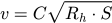
The Chezy equation relates the mean velocity of steady, uniform open-channel flow to the channel’s hydraulic radius, slope, and roughness coefficient.
v = C × √(Rₕ × S)
Chezy Equation — Chezy Coefficient
Solves for the Chezy roughness coefficient given the measured velocity, hydraulic radius, and channel slope.
C = v / √(Rₕ × S)
Chezy Equation — Hydraulic Radius
Determines the hydraulic radius from measured velocity, Chezy coefficient, and slope.
Rₕ = v² / (C² × S)
Chezy Equation — Channel Slope
Finds the channel slope needed to produce a given velocity.
S = v² / (C² × Rₕ)
Chezy-Manning — Chezy Coefficient
Converts Manning’s roughness coefficient n to the Chezy coefficient.
C = (1/n) × Rₕ^(1/6)
Chezy-Manning — Manning Roughness
Determines the Manning roughness coefficient from the Chezy coefficient and hydraulic radius.
n = Rₕ^(1/6) / C
Chezy-Manning — Hydraulic Radius
Solves for the hydraulic radius given both the Chezy coefficient and Manning roughness.
Rₕ = (C × n)⁶
How It Works
The Chezy equation relates the mean velocity of steady, uniform open-channel flow to the channel’s hydraulic radius, slope, and a roughness coefficient. Developed in the 18th century by Antoine de Chezy, it is one of the earliest formulas in hydraulic engineering. A higher Chezy coefficient means a smoother channel with less friction resistance.
Example Problem
A trapezoidal irrigation canal has a Chezy coefficient of 55, a hydraulic radius of 0.8 m, and a bed slope of 0.002. What is the flow velocity?
- v = C × √(Rₕ × S)
- v = 55 × √(0.8 × 0.002) = 55 × √0.0016
- v = 55 × 0.04 = 2.2 m/s
When to Use Each Variable
- Solve for Velocity (Chezy) — when you know the Chezy coefficient, hydraulic radius, and slope, e.g., estimating flow speed in an irrigation canal.
- Solve for Chezy Coefficient — when you have measured velocity, hydraulic radius, and slope, e.g., calibrating roughness from field data.
- Solve for Hydraulic Radius (Chezy) — when sizing a channel cross-section to achieve a target flow velocity.
- Solve for Channel Slope — when designing a canal grade to deliver a required velocity.
- Solve for Chezy from Manning — when converting a known Manning n value to the equivalent Chezy coefficient.
- Solve for Manning n — when you have a Chezy coefficient and need the Manning roughness for design tables.
- Solve for Hydraulic Radius (Manning) — when determining the hydraulic radius from both the Chezy coefficient and Manning roughness.
Key Concepts
The Chezy equation is one of the earliest open-channel flow formulas, relating mean velocity to channel roughness, hydraulic radius, and bed slope. The Chezy coefficient C encapsulates all resistance effects — a higher value means a smoother, more efficient channel. The Chezy-Manning relationship C = (1/n)R^(1/6) connects Chezy's formula to the more widely tabulated Manning roughness coefficient.
Applications
- Irrigation engineering: sizing canals and ditches for target flow rates
- Civil engineering: designing stormwater drainage channels and culverts
- Environmental engineering: estimating stream velocity for sediment transport studies
- Hydropower: calculating flow velocity in open headrace channels
Common Mistakes
- Confusing hydraulic radius with pipe radius — hydraulic radius is cross-sectional area divided by wetted perimeter, which equals D/4 for a full pipe
- Using slope in percent instead of dimensionless ratio — a 2% slope must be entered as 0.02
- Mixing up Chezy C and Manning n — a high Chezy coefficient means low roughness, but a high Manning n means high roughness
Frequently Asked Questions
What is the Chezy equation?
The Chezy equation v = C√(RₕS) calculates the average velocity of water in an open channel. It uses an empirical roughness coefficient (C) that depends on channel material and condition.
How is the Chezy coefficient related to Manning's n?
The two are related by C = (1/n) × Rₕ^(1/6). Manning’s equation is more commonly used today because n values are well-tabulated for hundreds of channel materials.
What are typical Chezy coefficient values?
Values typically range from 30 for rough natural streams to 90 for smooth concrete channels. Most engineered channels fall between 50 and 70.
Related Calculators
- Manning Equation Calculator — the modern alternative for open-channel flow velocity
- Hydraulic Radius Calculator — compute R<sub>h</sub> from cross-sectional area and wetted perimeter
- Hazen-Williams Calculator — empirical pipe flow velocity formula for water supply systems
- Reynolds Number Calculator — determine whether flow is laminar or turbulent
- Speed Converter — convert between m/s, ft/s, and other velocity units
Related Sites
- Temperature Tool — Temperature unit converter
- LoanChop — Loan prepayment calculator
- Z-Score Calculator — Z-score, percentile, and probability calculator
- InfantChart — Baby and child growth percentile charts
- Dollars Per Hour — Weekly paycheck calculator with overtime
- Medical Equations — Hemodynamic, pulmonary, and dosing calculators