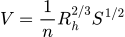
Flow Velocity (Manning's Equation)
Manning's equation estimates the average velocity of open-channel flow from the Manning roughness coefficient (n), hydraulic radius (R_h), and energy slope (S). It is the most widely used formula in hydraulic engineering.
V = (1/n) × R_h^(2/3) × S^(1/2)
Roughness Coefficient
Solve for the Manning roughness coefficient when velocity, hydraulic radius, and slope are known. Useful for calibrating channel models from field measurements.
n = R_h^(2/3) × S^(1/2) / V
Hydraulic Radius
Determine the required hydraulic radius to achieve a target velocity given the roughness and slope. The hydraulic radius equals cross-sectional area divided by wetted perimeter.
R_h = (V × n / S^(1/2))^(3/2)
Energy Grade Line Slope
Find the channel slope needed to produce a desired flow velocity. Steeper slopes or smoother surfaces increase velocity.
S = (V × n / R_h^(2/3))²
How It Works
Manning's equation V = (1/n) × R_h^(2/3) × S^(1/2) estimates the average velocity of open-channel flow from three inputs: the Manning roughness coefficient (n), the hydraulic radius (R_h), and the energy slope (S). It is the most widely used formula in hydraulic engineering for designing channels, culverts, and storm drains.
Example Problem
A concrete-lined channel (n = 0.013) has a hydraulic radius of 0.5 m and a slope of 0.002. What is the flow velocity?
- Identify the known values: n = 0.013, R_h = 0.5 m, S = 0.002.
- Determine what we are solving for: the average flow velocity V.
- Calculate the hydraulic radius term: R_h^(2/3) = 0.5^(2/3) = 0.63.
- Calculate the slope term: S^(1/2) = 0.002^(1/2) = 0.0447.
- Substitute into Manning's equation: V = (1/0.013) × 0.63 × 0.0447.
- Compute the result: V = 76.92 × 0.63 × 0.0447 ≈ 2.17 m/s. This is the average cross-sectional velocity for uniform flow.
When to Use Each Variable
- Solve for Velocity — when you know the channel roughness, hydraulic radius, and slope and need the flow speed.
- Solve for Roughness (n) — when you have field measurements of velocity, radius, and slope and want to calibrate the channel model.
- Solve for Hydraulic Radius — when designing a channel to achieve a target velocity with known roughness and slope.
- Solve for Slope — when you need to determine the channel grade required for a desired flow velocity.
Key Concepts
Manning's equation is an empirical formula for uniform, steady-state open-channel flow. The roughness coefficient n encapsulates surface friction — lower values mean smoother surfaces and higher velocities. The hydraulic radius (cross-sectional area divided by wetted perimeter) accounts for channel shape. The equation uses SI units by default; for US customary units, multiply by the conversion factor 1.49.
Applications
- Stormwater engineering: sizing culverts and drainage channels to handle design storm flows
- Irrigation: designing earthen and lined canals for agricultural water delivery
- Wastewater collection: calculating gravity sewer pipe capacity at various slopes and fill levels
- River engineering: estimating flood flow velocities for floodplain delineation and bridge scour analysis
Common Mistakes
- Forgetting the unit system factor — Manning's equation uses k = 1.0 for SI and k = 1.49 for US customary units; omitting this factor gives results off by 49%
- Using the wrong roughness coefficient — n varies significantly with surface condition; a value for new concrete (0.012) is very different from an overgrown earth channel (0.035)
- Confusing hydraulic radius with pipe radius — the hydraulic radius is area divided by wetted perimeter, which equals D/4 for a full circular pipe, not D/2
Frequently Asked Questions
What Manning's n value should I use for a concrete channel?
For finished concrete, use n = 0.012–0.013. Unfinished concrete is typically 0.014–0.017. Shotcrete or rough-formed concrete ranges from 0.016–0.020. Always check design standards for your jurisdiction, as specified values can vary.
Can Manning's equation be used for pressurized pipe flow?
No. Manning's equation is designed for gravity-driven open-channel flow with a free water surface. For pressurized (full-pipe) flow, use the Darcy-Weisbach or Hazen-Williams equation instead. Manning's can be used for partially full gravity pipes.
What is Manning's roughness coefficient?
A dimensionless value representing channel surface friction. Finished concrete is about 0.012, earth channels 0.022, and natural rocky streams around 0.040. Lower n means a smoother surface and higher velocity.
Does Manning's equation work for pipes?
Yes, for gravity-flow pipes (not pressurized). For a full circular pipe of diameter D, the hydraulic radius is D/4. This calculator uses SI units (k = 1.0); for US customary units, multiply by 1.49.
What slope do I need for a 1 m/s flow in a concrete channel?
With n = 0.013 and R_h = 0.3 m, you need S ≈ 0.0012 (about 0.12%). Steeper slopes or smoother surfaces increase velocity.
How do I convert Manning's equation from SI to US customary units?
Multiply the SI result by 1.49. In SI the formula is V = (1/n)R^(2/3)S^(1/2); in US customary it becomes V = (1.49/n)R^(2/3)S^(1/2) where R is in feet and V is in feet per second.
What is the hydraulic radius and how do I calculate it?
The hydraulic radius R_h equals the cross-sectional flow area divided by the wetted perimeter. For a rectangular channel of width w and depth d, R_h = (w×d)/(w+2d). For a full circular pipe of diameter D, R_h = D/4.
Manning's Equation Formula
Manning's equation estimates the average velocity of uniform, steady-state open-channel flow:
V = (1/n) × Rh2/3 × S1/2
Where:
- V — average flow velocity, measured in meters per second (m/s)
- n — Manning's roughness coefficient, dimensionless (lower = smoother)
- Rh — hydraulic radius (area / wetted perimeter), measured in meters (m)
- S — energy grade line slope, dimensionless (rise / run)
This calculator uses SI units (k = 1.0). For US customary units, multiply by the conversion factor 1.49. The equation is empirical and works best for uniform, fully turbulent open-channel flow.
Worked Examples
Storm Drainage
What is the flow velocity in a concrete storm drain?
A concrete-lined rectangular channel (n = 0.013) has a hydraulic radius of 0.4 m and a slope of 0.005. What is the flow velocity?
- V = (1/0.013) × 0.4^2/3 × 0.005 ^1/2
- V = 76.92 × 0.5429 × 0.07071
V ≈ 2.95 m/s
Storm drainage channels must handle peak flows during design storms. Check that velocity does not exceed erosion limits for the channel lining.
Irrigation
What slope is needed for an earth irrigation canal?
An unlined earth canal (n = 0.025) has a hydraulic radius of 0.6 m and needs to achieve a velocity of 0.8 m/s. What slope is required?
- S = (V × n / R_h ^2/3)²
- S = (0.8 × 0.025 / 0.6^2/3)²
- S = (0.02 / 0.4807)² = 0.04161²
S ≈ 0.001731
Irrigation canals need gentle slopes to deliver water without excessive erosion of the earth bed.
River Engineering
What is the Manning's n for a natural river reach?
Field measurements show a river flowing at 1.2 m/s with a hydraulic radius of 2.0 m and a slope of 0.0005. What is the effective roughness coefficient?
- n = R_h ^2/3 × S^1/2 / V
- n = 2.0^2/3 × 0.0005^1/2 / 1.2
- n = 1.587 × 0.02236 / 1.2
n ≈ 0.0296
An n value around 0.03 is typical for a clean, winding natural channel with some pools and stones.
Related Calculators
- Hydraulic Radius Calculator — compute R<sub>h</sub> and Froude number for channel analysis
- Chezy Equation Calculator — the historical predecessor to Manning's equation
- Gutter Design Calculator — applies Manning's equation to roadway gutters
- French Drain Design Calculator — subsurface drainage that complements open-channel flow
- Continuity Equation Calculator — relate velocity, area, and discharge in channels
- Length Unit Converter — convert channel dimensions between feet, meters, and other units
Related Sites
- Temperature Tool — Temperature unit converter
- LoanChop — Loan prepayment calculator
- Z-Score Calculator — Z-score, percentile, and probability calculator
- InfantChart — Baby and child growth percentile charts
- Dollars Per Hour — Weekly paycheck calculator with overtime
- Medical Equations — Hemodynamic, pulmonary, and dosing calculators