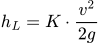
Minor Head Loss Equation
Minor losses quantify energy lost at fittings, valves, bends, and other flow disturbances in a pipe system. The loss coefficient K is determined experimentally for each fitting type. In compact systems with many fittings, minor losses can exceed friction losses from straight pipe runs.
hL = K × v² / (2g)
How It Works
Minor losses (hL = K × v²/2g) quantify energy lost at fittings, valves, bends, and other flow disturbances in a pipe system. The loss coefficient K is determined experimentally for each fitting type. In compact systems with many fittings, minor losses can exceed friction losses from straight pipe runs.
Example Problem
Water flows at 3 m/s through a fully open globe valve (K = 10). What is the head loss?
- Identify the known values: loss coefficient K = 10 (fully open globe valve), flow velocity v = 3 m/s, gravitational acceleration g = 9.81 m/s².
- Determine what we are solving for: the minor head loss hL through the fitting.
- Calculate the velocity head: v²/(2g) = 3² / (2 × 9.81) = 9 / 19.62 = 0.459 m.
- Write the minor loss equation: hL = K × v²/(2g).
- Substitute the known values: hL = 10 × 0.459 m.
- Compute the result: hL = 4.59 m. This is equivalent to the friction loss in roughly 90 m of 50 mm pipe.
A simpler example: K = 0.9 (elbow), v = 3 m/s → hL = 0.9 × 9/(19.62) = 0.413 m.
When to Use Each Variable
- Solve for Head Loss — when you know the loss coefficient and flow velocity, e.g., estimating energy loss through a valve or fitting.
- Solve for Loss Coefficient — when you know the head loss and velocity, e.g., back-calculating K from measured pressure drops.
- Solve for Velocity — when you know the head loss and loss coefficient, e.g., finding the flow speed that produces a given pressure drop.
Key Concepts
Minor losses (also called local losses) occur at pipe fittings, valves, bends, expansions, and contractions where flow is disrupted. Despite being called 'minor,' they can dominate total head loss in compact piping systems with many fittings. The loss coefficient K is dimensionless and determined experimentally for each fitting type. Head loss scales with the square of velocity, so doubling the flow speed quadruples the energy loss at each fitting.
Applications
- Building plumbing: calculating pressure drops through elbows, tees, and valves in domestic water supply systems
- HVAC systems: sizing ductwork and determining fan pressure requirements for air distribution
- Industrial piping: estimating total system head loss for pump selection in chemical process plants
- Fire protection: verifying adequate pressure at sprinkler heads after accounting for fitting losses in the supply network
Common Mistakes
- Neglecting minor losses in compact systems — in short pipe runs with many fittings (e.g., mechanical rooms), minor losses often exceed friction losses
- Using the wrong velocity — K values are applied to the velocity at the fitting cross-section, which may differ from the upstream or downstream pipe velocity
- Adding K values from different sources without checking reference conditions — some tables include entrance/exit losses separately while others include them in the fitting K value
Frequently Asked Questions
What counts as a minor loss in a piping system?
Minor losses are energy losses caused by flow disturbances at fittings, valves, bends, tees, reducers, expansions, and entrances/exits — anything other than straight pipe friction. Despite the name, they can dominate total head loss in systems with many fittings and short pipe runs.
How do you find the K value for a pipe fitting?
K values are determined experimentally and published in references like Crane TP-410 or the Hydraulic Institute standards. Common values: 90° elbow ≈ 0.9, 45° elbow ≈ 0.4, gate valve (open) ≈ 0.2, globe valve (open) ≈ 10, check valve ≈ 2.5. Always verify K values match your fitting geometry and size.
What is a loss coefficient (K value)?
K is a dimensionless number that quantifies energy loss through a fitting relative to the velocity head. A 90-degree elbow has K ≈ 0.9; a fully open globe valve has K ≈ 10. Higher K means more energy loss.
When do minor losses matter more than friction losses?
In short pipe runs with many fittings, such as building plumbing, HVAC systems, and compact process piping. In long pipelines with few fittings, friction (major) losses dominate.
What is the equivalent length method?
An alternative approach that converts each fitting into an equivalent length of straight pipe. For example, a standard 90-degree elbow might equal 30 pipe diameters of straight pipe. This simplifies total head loss calculations.
Why does head loss increase with the square of velocity?
The kinetic energy of flowing fluid is proportional to v². When flow is disrupted at a fitting, a fraction of that kinetic energy (determined by K) is converted to heat through turbulence. Doubling velocity quadruples kinetic energy and therefore quadruples the head loss.
How do you calculate total head loss in a pipe system?
Total head loss is the sum of major (friction) losses from the Darcy-Weisbach equation and all minor losses from fittings. Add up K × v²/(2g) for every fitting, then add the friction head loss for each pipe segment. The total determines the required pump head.
Minor Losses Formula
The minor losses equation quantifies energy lost at fittings, valves, and bends in a piping system:
hL = K × v² / (2g)
Where:
- hL — minor head loss, measured in meters (m) or feet (ft)
- K — loss coefficient (dimensionless), determined experimentally for each fitting type
- v — flow velocity at the fitting, measured in meters per second (m/s)
- g — gravitational acceleration, typically 9.81 m/s²
Head loss scales with the square of velocity, so doubling the flow speed quadruples the energy loss at each fitting. The term v²/(2g) is the velocity head — the kinetic energy per unit weight of the flowing fluid.
Worked Examples
Plumbing Design
What is the head loss through a 90° elbow in a residential water system?
Water flows at 2 m/s through a standard 90° elbow (K = 0.9) in a home plumbing system. Standard gravity is 9.81 m/s².
- Velocity head: v²/(2g) = 4 / 19.62 = 0.204 m
- h_L = K × v²/(2g) = 0.9 × 0.204
h_L = 0.183 m
In a system with 10 similar elbows, the total minor losses from elbows alone would be about 1.83 m of head.
Industrial Piping
What is the head loss through a globe valve at a pump station?
A fully open globe valve (K = 10) handles water flowing at 3 m/s in a pump station layout. Gravity g = 9.81 m/s².
- Velocity head: v²/(2g) = 9 / 19.62 = 0.459 m
- h_L = 10 × 0.459
h_L = 4.587 m
Globe valves have very high K values. Replacing with a gate valve (K ≈ 0.2) would cut this loss by 98%.
Fire Protection
What flow velocity produces a 0.5 m head loss through a sprinkler tee?
A sprinkler system tee fitting (K = 1.8) must not produce more than 0.5 m of head loss. What is the maximum allowable velocity?
- Rearrange: v = √(2g × h_L / K)
- v = √(2 × 9.81 × 0.5 / 1.8)
- v = √(5.45)
v = 2.334 m/s
Exceeding this velocity will cause pressure drops that may starve downstream sprinkler heads of adequate flow.
Related Calculators
- Darcy-Weisbach Calculator — calculate major (friction) losses along pipe lengths
- Pump Calculator — size pumps to overcome total head loss including minor losses
- Bernoulli Theorem Calculator — full energy balance between two points in a system
- Colebrook Equation Calculator — find the friction factor needed for major and minor loss analysis
- Pipe Flow Calculator — compute flow rate and velocity for your piping system
- Pressure Unit Converter — convert head loss between pressure units
Related Sites
- Temperature Tool — Temperature unit converter
- LoanChop — Loan prepayment calculator
- Z-Score Calculator — Z-score, percentile, and probability calculator
- InfantChart — Baby and child growth percentile charts
- Dollars Per Hour — Weekly paycheck calculator with overtime
- Medical Equations — Hemodynamic, pulmonary, and dosing calculators