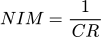
Net Income Multiplier Equation
The net income multiplier is the inverse of the capitalization rate. If a property has a 10% cap rate, its NIM is 10, meaning the property value is 10 times its net operating income.
NIM = 1 / Capitalization Rate
How It Works
The net income multiplier is simply the inverse of the capitalization rate. If a property has a 10% cap rate, its NIM is 10 (meaning the property value is 10 times its net operating income). NIM provides a quick way to estimate property value from NOI, or to convert between cap rate and multiplier formats when comparing investments.
Example Problem
A commercial property has a capitalization rate of 8% and generates $80,000 in net operating income annually.
- Identify the known value: capitalization rate = 8%.
- Determine what we are solving for: the net income multiplier (NIM).
- Convert the cap rate to a decimal: 8% / 100 = 0.08.
- Apply the NIM formula: NIM = 1 / 0.08.
- Compute the result: NIM = 12.5.
- Interpret: the property is valued at 12.5 times its NOI. Estimated value = $80,000 x 12.5 = $1,000,000.
This means the property is worth 12.5 times its net operating income. If NOI is $60,000, the estimated value is $60,000 x 12.5 = $750,000.
When to Use Each Variable
- Solve for NIM — when you know the capitalization rate and want to express it as a multiplier for quick property valuation.
- Solve for Cap Rate — when you know the NIM and need to convert it back to a capitalization rate for investment comparison.
Key Concepts
The net income multiplier is the reciprocal of the capitalization rate expressed as a decimal. It provides an intuitive shortcut: multiply NOI by NIM to estimate property value, or divide price by NOI to find NIM. A higher NIM indicates a lower cap rate, which typically reflects lower perceived risk or stronger market demand.
Applications
- Property valuation: quickly estimating market value by multiplying NOI by the NIM
- Investment screening: comparing NIM across properties to identify higher-yielding opportunities
- Portfolio analysis: converting between cap-rate and multiplier formats for reporting consistency
- Market benchmarking: tracking NIM trends over time to gauge market sentiment and pricing shifts
Common Mistakes
- Using gross income instead of net operating income — NIM is based on NOI (after expenses), not gross rent
- Forgetting to express the cap rate as a decimal before dividing — dividing 1 by 8 instead of 0.08 gives NIM of 0.125 instead of 12.5
- Treating NIM as a standalone valuation metric — NIM is only as reliable as the NOI estimate it depends on; always verify operating expenses
Frequently Asked Questions
How do you calculate the net income multiplier?
Divide 1 by the capitalization rate expressed as a decimal. For example, a 10% cap rate (0.10) gives NIM = 1 / 0.10 = 10. Alternatively, NIM = 100 / cap rate as a percentage.
What is the formula for the net income multiplier?
The formula is NIM = 1 / CR, where CR is the capitalization rate as a decimal. Equivalently, NIM = 100 / CR(%), where CR(%) is the cap rate expressed as a percentage.
How does the net income multiplier relate to the cap rate?
NIM is the mathematical inverse of the cap rate. A higher cap rate means a lower NIM and vice versa. For instance, a 5% cap rate gives NIM = 20, while a 10% cap rate gives NIM = 10. This inverse relationship means that as perceived risk decreases (lower cap rate), the price-to-income multiplier increases.
When should an investor use NIM instead of GRM?
Use NIM when you want to compare properties on a net income basis (after operating expenses). The gross rent multiplier (GRM) uses gross income and ignores expenses, so it can be misleading for properties with very different expense ratios. NIM provides a more accurate comparison because it reflects actual profitability.
What is a typical NIM for commercial property?
NIM ranges from 10 to 25 depending on the market and property type. Prime urban properties with 4-5% cap rates have NIMs of 20-25. Suburban properties with 8-10% cap rates have NIMs of 10-12.5.
Is NIM the same as the gross rent multiplier?
No. NIM uses net operating income (after expenses), while GRM uses gross scheduled income (before expenses). NIM is generally more meaningful because it accounts for operating costs.
Can you use NIM to estimate property value?
Yes. Multiply the property's annual net operating income by the NIM to get an estimated market value. For example, if NOI is $100,000 and the market NIM is 15, the estimated value is $1,500,000. This is equivalent to dividing NOI by the cap rate.
Reference: Gallinelli, Frank. 2004. What Every Real Estate Investor Needs to Know About Cash Flow. McGraw-Hill.
Net Income Multiplier Formula
The net income multiplier converts a capitalization rate into a price-to-income ratio:
NIM = 100 / Cap Rate (%)
Where:
- NIM — Net Income Multiplier (dimensionless ratio)
- Cap Rate — Capitalization Rate, expressed as a percentage (%)
Equivalently, NIM = 1 / (Cap Rate as a decimal). A 5% cap rate gives NIM = 20, meaning the property is valued at 20 times its net operating income. To find the cap rate from a NIM, simply invert: Cap Rate = 100 / NIM.
Worked Examples
Commercial Appraisal
What is the NIM for a property with an 8% cap rate?
An appraiser needs to convert a cap rate to a multiplier for a quick valuation. The property has a cap rate of 8% and generates $80,000 in NOI annually.
- NIM = 100 / Cap Rate
- NIM = 100 / 8 = 12.5
- Estimated value = NOI x NIM = $80,000 x 12.5
Estimated value = $1,000,000
The NIM of 12.5 means the property is priced at 12.5 times its annual net income.
Portfolio Analysis
What cap rate does a NIM of 16.67 represent?
An investor is comparing two properties. Property A is listed at 16.67 times NOI. The investor needs to convert this to a cap rate to compare with Property B's stated 7% cap rate.
- Cap Rate = 100 / NIM
- Cap Rate = 100 / 16.67
Cap Rate = 6%
Property A (6% cap rate) has a lower yield than Property B (7%), which may indicate lower risk or a stronger market location.
Market Research
How does a 4% cap rate translate to a property multiplier?
A market researcher is analyzing downtown office properties where cap rates have compressed to 4%. What multiplier are buyers paying?
- NIM = 100 / Cap Rate
- NIM = 100 / 4
NIM = 25
A NIM of 25 means investors are paying 25 times annual net income — a premium reflecting strong demand and low perceived risk in the downtown market.
Related Calculators
- Capitalization Rate Calculator — compute cap rate from NOI and value
- Gross Rent Multiplier Calculator — compare properties by gross income
- Net Operating Income Calculator — determine NOI for valuation
- Operating Expense Ratio Calculator — measure expense efficiency for the property
- Debt Coverage Ratio Calculator — check if NOI covers debt service payments
Related Sites
- Dollars Per Hour — Weekly paycheck calculator with overtime
- OptionsMath — Options trading profit and loss calculators
- Percent Off Calculator — Discount and sale price calculator
- CameraDOF — Depth of field calculator for photographers
- Medical Equations — Hemodynamic, pulmonary, and dosing calculators
- InfantChart — Baby and child growth percentile charts