
Fraction to Decimal
Divide the numerator by the denominator using long division. The result either terminates (3/8 = 0.375) or repeats with a fixed cycle (1/3 = 0.333...).
decimal = numerator ÷ denominator
Decimal to Fraction
For a terminating decimal with d digits after the point, multiply numerator and denominator by 10^d, then divide both by their GCD to get the lowest-terms fraction.
fraction = decimal × 10^d / 10^d, then simplify
How It Works
Fraction to decimal is straight long division: divide numerator by denominator. If the denominator's prime factors are only 2s and 5s, the decimal terminates; otherwise the long-division remainders eventually repeat and the decimal cycles. Decimal to fraction reverses this: a terminating decimal with d digits past the point equals (digits without the dot) divided by 10^d, which simplifies by dividing both numerator and denominator by their greatest common divisor.
Example Problem
Convert 3/8 to a decimal:
- Set up long division: divide 3 by 8.
- 8 does not go into 3, so write 0 before the decimal point.
- 3.000 ÷ 8: 8 goes into 30 three times (24), remainder 6.
- 8 goes into 60 seven times (56), remainder 4.
- 8 goes into 40 five times (40), remainder 0.
- Because the remainder is 0, the decimal terminates at 0.375.
Result: 3/8 = 0.375
Key Concepts
A fraction in lowest terms terminates as a decimal exactly when its denominator's prime factorization contains only 2s and 5s — these are the prime factors of the base-10 number system. Denominators like 3, 6, 7, 9, 11, and 12 introduce other primes and force the long-division remainders to cycle, producing a repeating decimal. Every repeating decimal can be converted back to an exact fraction using the algebraic 10x − x technique, which is why fractions and repeating decimals together form the rational numbers. Irrational numbers like π and √2 cannot be written as either a terminating or repeating decimal.
Applications
- Measurements: converting between fractional inches (1/2, 3/4) and decimal inches for digital calipers and CAD software
- Grade conversions: turning a quiz score like 17/20 into the decimal 0.85 or percent 85%
- Cooking and recipes: scaling a recipe by 1/3 cup × 2 = 0.667 cups when the cup measure is decimal-marked
- Statistics rounding: expressing probability 1/6 as 0.1667 for spreadsheet entry
- Currency and pricing: 4/5 of a dollar is exactly $0.80; useful for converting old fractional pricing to modern decimal currency
Common Mistakes
- Forgetting to simplify the resulting fraction — 50/100 should reduce to 1/2, not stay as 50/100
- Treating 0.3 and 1/3 as equal — 1/3 is 0.333... (repeating forever), while 0.3 is exactly 3/10
- Dropping the negative sign during conversion — −3/8 must convert to −0.375, not 0.375
- Counting decimal places wrong when converting decimals to fractions — 0.05 has two decimal places, so it becomes 5/100 = 1/20, not 5/10
Frequently Asked Questions
How do you convert a fraction to a decimal?
Divide the numerator by the denominator using long division. For 3/8, divide 3 by 8 to get 0.375. If the division never ends and remainders start repeating, the decimal is repeating (1/3 = 0.333...).
How do you convert a decimal to a fraction?
Count the digits after the decimal point. Write the number without the dot as the numerator and 10 raised to that count as the denominator, then simplify. For 0.625, that's 625/1000, which reduces to 5/8.
What is 3/8 as a decimal?
3 divided by 8 equals 0.375 exactly. It is a terminating decimal because 8 = 2³ has only the prime factor 2.
What is 0.625 as a fraction?
0.625 equals 625/1000, which simplifies to 5/8 after dividing both by their greatest common divisor (125).
Why do some fractions repeat as decimals?
A fraction in lowest terms terminates only when its denominator's prime factors are limited to 2 and 5. Any other prime factor (3, 7, 11, 13, …) forces the long-division remainders to cycle, creating a repeating decimal like 1/7 = 0.142857142857…
How do you simplify a fraction after converting?
Find the greatest common divisor (GCD) of the numerator and denominator, then divide both by it. For example, 50/100 has GCD 50, so dividing both gives 1/2 — the lowest-terms form.
What is the difference between a rational and an irrational number?
Rational numbers are values that can be written as a fraction of two integers — they always show up as either terminating or repeating decimals. Irrational numbers like π and √2 cannot be written that way and have decimals that never terminate or repeat.
How is 22/7 related to π?
22/7 ≈ 3.142857… is a classical rational approximation of π, but π is actually 3.14159265… and irrational. The two values diverge after the third decimal place.
Reference:
Standard long-division and place-value conversion. Long division identifies repeating cycles when a remainder reappears.
Fraction ↔ Decimal Formulas
decimal = numerator ÷ denominator
fraction = (decimal × 10d) / 10d, simplified
- numerator — the top part of the fraction
- denominator — the bottom part of the fraction (must be non-zero)
- d — the number of digits after the decimal point
- simplified — divide numerator and denominator by their greatest common divisor (GCD)
Visualizing 3/8 on the Number Line
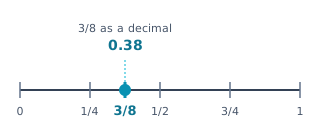
The fraction 3/8 sits between 1/4 (0.25) and 1/2 (0.5) on the number line. Long division gives the exact decimal value 0.375.
Worked Examples
Terminating Decimal
Convert 3/8 to a decimal
A textbook short-division problem with a denominator whose only prime factor is 2.
- Set up long division: 3 ÷ 8.
- 8 goes into 30 three times (24), remainder 6.
- 8 goes into 60 seven times (56), remainder 4.
- 8 goes into 40 five times (40), remainder 0.
- The remainder is 0, so the decimal terminates.
0.375
Because 8 = 2³ contains only the prime factor 2, the decimal terminates after three places.
Repeating Decimal
Convert 1/7 to a decimal
The denominator 7 has no factor of 2 or 5, so the decimal must repeat.
- Long-divide 1 ÷ 7: the remainder sequence is 3, 2, 6, 4, 5, 1, then repeats.
- Six distinct non-zero remainders means the cycle length is 6.
- The digits 1, 4, 2, 8, 5, 7 repeat forever after the decimal point.
- 1/7 = 0.142857142857… (with cycle 142857).
0.142857142857…
Any prime denominator other than 2 or 5 forces the decimal to repeat.
Decimal → Fraction
Convert 0.625 to a fraction
Three decimal places means a denominator of 10³ = 1000 before simplifying.
- 0.625 has three digits after the decimal point.
- Write as 625/1000 (multiply top and bottom by 10³).
- Find the GCD of 625 and 1000: GCD = 125.
- Divide both by 125: 625 ÷ 125 = 5 and 1000 ÷ 125 = 8.
- The simplified fraction is 5/8.
5/8
5/8 is in lowest terms because GCD(5, 8) = 1.
Related Calculators
- Simplify Fraction Calculator — reduce any fraction to its lowest terms
- GCF Calculator — find the greatest common factor used when simplifying fractions
- Fraction Addition Calculator — add fractions with shown work
- Fraction Multiplication Calculator — multiply fractions and simplify the result
- Fraction Division Calculator — divide fractions with step-by-step work
Related Sites
- Percent Off Calculator — Discount and sale price calculator
- Percent Error Calculator — Calculate percent error between experimental and theoretical values
- Z-Score Calculator — Z-score, percentile, and probability calculator
- Hourly Salaries — Hourly wage to annual salary converter
- InfantChart — Baby and child growth percentile charts
- BOGO Discount — Buy-one-get-one discount calculator