Simplify Fraction
A fraction is in simplest form when the numerator and denominator share no common factor other than 1. Find the GCD and divide both by it.
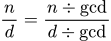
n/d = (n ÷ GCD) / (d ÷ GCD)
How It Works
A fraction is in simplest form when the numerator and denominator share no common factor other than 1. This calculator finds the GCD of both values and divides each by it. If the result is an improper fraction, it also shows the mixed number form. Simplifying does not change the value of the fraction; it only rewrites it with smaller, equivalent numbers.
Example Problem
Simplify 18/24:
- Find the greatest common divisor: GCD(18, 24) = 6.
- Divide the numerator by 6: 18 ÷ 6 = 3.
- Divide the denominator by 6: 24 ÷ 6 = 4.
- Rewrite the fraction as 3/4.
- Check whether 3 and 4 still share a factor greater than 1.
- Because they do not, 3/4 is already in lowest terms.
Result: 3/4
Key Concepts
A fraction is in simplest form (lowest terms) when its numerator and denominator share no common factor other than 1. Simplification divides both by their Greatest Common Divisor (GCD), found efficiently using Euclid's algorithm. Improper fractions (numerator >= denominator) can also be expressed as mixed numbers by dividing the numerator by the denominator to get a whole part and remainder.
Applications
- Math homework: reducing fractions to lowest terms is required in virtually all fraction arithmetic
- Engineering tolerances: expressing measurement ratios in simplest form for clarity on drawings
- Probability: simplifying outcome ratios (e.g., 12/18 = 2/3) for clearer communication of odds
- Data presentation: using simplified fractions in charts and reports for readability
Common Mistakes
- Dividing by a common factor but not the greatest one — this requires multiple reduction steps instead of one
- Assuming a fraction is already simplified without checking — always verify that GCD(numerator, denominator) = 1
- Forgetting to handle negative signs — by convention, the negative sign goes on the numerator, not the denominator
Frequently Asked Questions
How do you simplify a fraction step by step?
Find the greatest common divisor of the numerator and denominator, then divide both by that number. The result is the same value written in lowest terms.
How to simplify a fraction to lowest terms?
Find the greatest common divisor of the numerator and denominator, then divide both by it. For 12/16, the GCD is 4, giving 3/4.
How do you know when a fraction is fully simplified?
A fraction is fully reduced when the only factor shared by the numerator and denominator is 1. Quick check: if neither can be divided by the same prime (2, 3, 5, 7...), it is already in lowest terms.
What is an improper fraction vs a mixed number?
An improper fraction has a numerator larger than or equal to its denominator (e.g., 7/3). A mixed number separates the whole part from the fractional part (2 1/3). Both represent the same value.
What is the formula for simplifying fractions?
The basic idea is n/d = (n ÷ GCF) / (d ÷ GCF), where GCF is the greatest common factor shared by the numerator and denominator.
Can a negative fraction be simplified?
Yes. Simplify the absolute values using the GCF, then place the negative sign on the numerator by convention. For example, -8/12 simplifies to -2/3.
Do you always need the greatest common factor?
Using the GCF is the fastest one-step method because it guarantees the fraction is fully simplified immediately. Smaller common factors also work, but may require multiple rounds.
Reference:
Standard lowest-terms fraction simplification using the greatest common divisor.
Fraction Simplification Formula
A fraction is in lowest terms when the numerator and denominator share no common factor greater than 1.
n/d = (n ÷ GCF) / (d ÷ GCF)
The GCF is the largest number that divides both the numerator and denominator evenly.
Worked Examples
Basic Reduction
Simplify 18/24
- GCF(18, 24) = 6
- 18 ÷ 6 = 3 and 24 ÷ 6 = 4
- The reduced fraction is 3/4
3/4
Improper Fraction
Simplify 24/18
- GCF(24, 18) = 6
- 24 ÷ 6 = 4 and 18 ÷ 6 = 3
- 4/3 can also be written as 1 1/3
4/3
Already Simplified
Simplify 7/12
- GCF(7, 12) = 1
- Because the GCF is 1, the fraction is already in lowest terms
7/12
Related Calculators
- GCF Calculator — find the Greatest Common Factor of two numbers
- Fraction Addition Calculator — add fractions and automatically simplify
- Fraction Multiplication Calculator — multiply fractions with shown work
- LCM Calculator — find the least common multiple of two numbers
- Fraction Subtraction Calculator — subtract fractions and simplify the result
Related Sites
- CameraDOF — Depth of field calculator for photographers
- Percent Off Calculator — Discount and sale price calculator
- Hourly Salaries — Hourly wage to annual salary converter
- InfantChart — Baby and child growth percentile charts
- Dollars Per Hour — Weekly paycheck calculator with overtime
- BOGO Discount — Buy-one-get-one discount calculator