Least Common Multiple
The LCM is the smallest positive integer divisible by both numbers. This calculator finds it using the GCF via Euclid's algorithm.
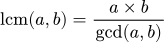
LCM(a, b) = (a × b) / GCF(a, b)
How It Works
The Least Common Multiple is the smallest positive integer divisible by both numbers. This calculator finds the GCF first using Euclid's algorithm, then computes LCM(a, b) = (a × b) / GCF(a, b). The LCM is essential for adding fractions with different denominators and for synchronizing repeating cycles.
Example Problem
Find LCM(12, 18):
- Find the greatest common factor first: GCF(12, 18) = 6.
- Multiply the two numbers: 12 × 18 = 216.
- Divide the product by the GCF: 216 ÷ 6 = 36.
- Check that both 12 and 18 divide evenly into 36.
- Since 36 is the smallest shared multiple, it is the LCM.
Result: 36
Key Concepts
The Least Common Multiple (LCM) is the smallest positive integer that both numbers divide into evenly. The most efficient method computes the GCF first (via Euclid's algorithm), then uses LCM(a,b) = |a*b| / GCF(a,b). The LCM is essential for finding the least common denominator when adding or subtracting fractions, and it appears in scheduling, gear ratio, and signal processing problems.
Applications
- Fraction arithmetic: finding the least common denominator (LCD) to add or subtract fractions with different denominators
- Scheduling: determining when two periodic events coincide (e.g., two buses with different cycle times arrive at the same stop)
- Gear systems: calculating when gear teeth re-align, which determines wear patterns and vibration cycles
- Music: finding the beat at which two rhythmic patterns synchronize
Common Mistakes
- Confusing LCM with GCF — LCM is always greater than or equal to both numbers, GCF is always less than or equal to both
- Computing a*b without dividing by GCF — the product of two numbers is their LCM only when the numbers are coprime (GCF = 1)
- Assuming LCM must be larger than both numbers — if one number divides the other, the LCM equals the larger number
Frequently Asked Questions
How do you find the LCM step by step?
One efficient method is to find the GCF first, multiply the two numbers, and divide that product by the GCF. The result is the least common multiple.
How to find the LCM of two numbers?
The fastest method is to find the GCF first (using Euclid's algorithm), then divide the product of the two numbers by the GCF. For 8 and 12: GCF = 4, LCM = (8 × 12) / 4 = 24.
Why is LCM important for fractions?
The LCM of two denominators gives you the least common denominator (LCD) needed to add or subtract fractions. Using the LCD keeps numbers small and makes simplification easier.
Can the LCM equal one of the numbers?
Yes. If one number divides the other evenly, the LCM is the larger number. For example, LCM(4, 12) = 12 because 12 is already a multiple of 4.
What is the formula for LCM?
The standard formula is LCM(a, b) = (a × b) / GCF(a, b), assuming a and b are positive integers.
When is the LCM just the product of the two numbers?
When the numbers are coprime and share no common factor greater than 1, their GCF is 1, so the LCM equals their product.
How is LCM used in real life?
LCM helps with schedules, repeating events, gear cycles, music rhythms, and finding common denominators in fraction arithmetic.
Reference:
Standard least-common-multiple identity LCM(a, b) = (a × b) / GCF(a, b), used in arithmetic and elementary number theory.
LCM Formula
The least common multiple is the smallest positive number divisible by both inputs.
LCM(a, b) = (a × b) / GCF(a, b)
This identity works because the product of two numbers contains both the shared factors and the unique factors of each number.
Worked Examples
Basic Example
Find LCM(12, 18)
- GCF(12, 18) = 6
- LCM = (12 × 18) / 6 = 216 / 6
- LCM = 36
36
One Number Divides the Other
Find LCM(4, 12)
- GCF(4, 12) = 4
- LCM = (4 × 12) / 4 = 12
- Because 12 is already a multiple of 4, it is the LCM
12
Coprime Inputs
Find LCM(7, 9)
- GCF(7, 9) = 1
- LCM = (7 × 9) / 1 = 63
- When numbers are coprime, the LCM equals their product
63
Related Calculators
- GCF Calculator — find the Greatest Common Factor of two numbers
- Fraction Addition Calculator — add fractions using the LCD
- Fraction Subtraction Calculator — subtract fractions with step-by-step work
- Fraction Multiplication Calculator — multiply fractions and simplify
Related Sites
- CameraDOF — Depth of field calculator for photographers
- Percent Off Calculator — Discount and sale price calculator
- Hourly Salaries — Hourly wage to annual salary converter
- InfantChart — Baby and child growth percentile charts
- Dollars Per Hour — Weekly paycheck calculator with overtime
- BOGO Discount — Buy-one-get-one discount calculator