Fraction Multiplication
Multiplying fractions is straightforward: multiply the numerators together and the denominators together, then simplify by dividing both by their GCD.
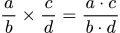
a/b × c/d = (a × c) / (b × d)
How It Works
Multiplying fractions is straightforward: multiply the numerators to get the new numerator, and multiply the denominators to get the new denominator. Then simplify the result by dividing both by their Greatest Common Divisor. In many problems, you can also cross-cancel common factors before multiplying to keep the arithmetic smaller.
Example Problem
Multiply 2/3 × 3/4:
- Multiply the numerators: 2 × 3 = 6.
- Multiply the denominators: 3 × 4 = 12.
- Write the raw product as 6/12.
- Find the GCD of 6 and 12, which is 6.
- Divide numerator and denominator by 6.
- The simplified result is 1/2.
Result: 1/2
Key Concepts
Multiplying fractions is simpler than adding them because no common denominator is needed. Multiply the numerators together for the new numerator and the denominators together for the new denominator, then simplify. Cross-canceling before multiplying keeps numbers smaller and often eliminates the need for simplification afterward.
Applications
- Cooking: scaling recipes (e.g., making 3/4 of a recipe that calls for 2/3 cup of flour)
- Probability: multiplying independent event probabilities (e.g., P(A and B) = P(A) * P(B))
- Area calculations: finding the area of a rectangle with fractional side lengths
- Discount calculations: applying a fractional discount to a fractional price
Common Mistakes
- Trying to find a common denominator — unlike addition, multiplication does not require one
- Forgetting to simplify the result — always check for common factors in the final numerator and denominator
- Not cross-canceling when possible — skipping this step leads to unnecessarily large intermediate numbers
Frequently Asked Questions
How do you multiply fractions step by step?
Multiply the numerators, multiply the denominators, then simplify the answer. No common denominator is needed for multiplication.
How to multiply fractions?
Multiply the two numerators together and the two denominators together. For 3/5 × 2/7, the result is 6/35. No common denominator is needed, unlike addition.
Can you cross-cancel before multiplying fractions?
Yes. Cross-canceling simplifies before you multiply, keeping numbers smaller. In 4/9 × 3/8, you can cancel 4 and 8 (both divide by 4) and 3 and 9 (both divide by 3), leaving 1/3 × 1/2 = 1/6.
How to multiply a fraction by a whole number?
Write the whole number as a fraction over 1, then multiply normally. For 3/4 × 5, compute 3/4 × 5/1 = 15/4 = 3 3/4.
What is the formula for multiplying fractions?
The formula is (a/b) × (c/d) = (ac)/(bd). After that, simplify the result to lowest terms if the numerator and denominator share a common factor.
Do you need a common denominator to multiply fractions?
No. Common denominators are needed for addition and subtraction, not multiplication. You can multiply straight across.
Can a fraction multiplication answer be greater than 1?
Yes. If the product's numerator is larger than its denominator after simplification, the result is an improper fraction or mixed number. For example, 7/4 × 2/3 = 7/6 = 1 1/6.
Reference:
Standard fraction-multiplication method taught in arithmetic and pre-algebra, including simplification by greatest common factor.
Fraction Multiplication Formula
Multiply fractions by multiplying numerators together and denominators together:
(a/b) × (c/d) = (a × c) / (b × d)
After multiplying, reduce the fraction by dividing the numerator and denominator by their greatest common factor.
Worked Examples
Basic Product
Multiply 2/3 × 3/4
- Multiply numerators: 2 × 3 = 6
- Multiply denominators: 3 × 4 = 12
- 6/12 simplifies to 1/2
1/2
Whole Number Product
Multiply 3/5 × 5/3
- Multiply straight across: 15/15
- 15/15 simplifies to 1
1
Mixed Number Outcome
Multiply 7/4 × 2/3
- Multiply numerators: 7 × 2 = 14
- Multiply denominators: 4 × 3 = 12
- 14/12 simplifies to 7/6 = 1 1/6
7/6
Related Calculators
- Fraction Division Calculator — divide fractions using the reciprocal method
- Simplify Fraction Calculator — reduce any fraction to lowest terms
- Grid Multiplication Calculator — multiply whole numbers with the box method
- Fraction Addition Calculator — add fractions with unlike denominators
- GCF Calculator — find the greatest common factor to simplify products
Related Sites
- CameraDOF — Depth of field calculator for photographers
- Percent Off Calculator — Discount and sale price calculator
- Hourly Salaries — Hourly wage to annual salary converter
- InfantChart — Baby and child growth percentile charts
- Dollars Per Hour — Weekly paycheck calculator with overtime
- BOGO Discount — Buy-one-get-one discount calculator