Fraction Division
Dividing fractions follows the "keep, change, flip" rule: keep the first fraction, change division to multiplication, and flip the second fraction.
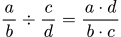
a/b ÷ c/d = (a × d) / (b × c)
How It Works
Dividing fractions follows the "keep, change, flip" rule: keep the first fraction, change division to multiplication, and flip the second fraction (take its reciprocal). Then multiply the numerators and denominators, and simplify using the GCD. If the divisor has a numerator of zero, the expression is undefined because you would be dividing by zero.
Example Problem
Divide 3/4 ÷ 2/5:
- Keep the first fraction as 3/4.
- Change division to multiplication.
- Flip the second fraction: 2/5 becomes 5/2.
- Multiply numerators and denominators: 3 × 5 = 15 and 4 × 2 = 8.
- Write the quotient as 15/8.
- Convert the improper fraction to a mixed number: 15/8 = 1 7/8.
Result: 15/8 or 1 7/8
Key Concepts
Dividing by a fraction is equivalent to multiplying by its reciprocal — the 'keep, change, flip' rule. This works because division asks 'how many groups of this size fit?' and flipping converts the question into a multiplication. After multiplying numerators and denominators, the result is simplified by dividing both by their GCD.
Applications
- Cooking: halving or thirding a recipe that uses fractional measurements (e.g., 3/4 cup divided by 2)
- Sewing and crafting: dividing fabric lengths in fractional yards among multiple pieces
- Math education: building toward division of algebraic fractions and rational expressions
- Unit conversion: dividing fractional rates (e.g., 2/3 mile per 1/4 hour) to find unit rates
Common Mistakes
- Flipping the wrong fraction — you flip the divisor (second fraction), not the dividend (first fraction)
- Forgetting to simplify after multiplying — always check the GCD and reduce to lowest terms
- Dividing by zero — if the second fraction's numerator is zero, the division is undefined
Frequently Asked Questions
How do you divide fractions step by step?
Keep the first fraction, change division to multiplication, flip the second fraction, multiply across, and simplify. This is the standard reciprocal method taught in arithmetic.
How to divide fractions step by step?
Keep the first fraction unchanged, flip the second fraction (swap its numerator and denominator), then multiply across. Simplify the result by dividing numerator and denominator by their GCD.
Why do you flip the second fraction when dividing?
Dividing by a fraction is the same as multiplying by its reciprocal. This is because division asks "how many groups of this size fit?" and the reciprocal converts that question into a multiplication.
Can you divide a fraction by a whole number?
Yes. Write the whole number as a fraction with denominator 1 (e.g., 3 = 3/1), then apply the keep-change-flip rule. For example, 2/5 ÷ 3 = 2/5 × 1/3 = 2/15.
What is the formula for dividing fractions?
A general formula is (a/b) ÷ (c/d) = (a × d) / (b × c). It comes directly from multiplying by the reciprocal of the divisor.
Can the answer to fraction division be a whole number?
Yes. If the simplified denominator becomes 1, the result is a whole number. For example, 4/2 ÷ 2/2 simplifies to 2.
What happens if the second fraction is zero?
Division by zero is undefined. Since a zero fraction has a numerator of 0, you cannot flip it into a valid reciprocal, so the expression has no valid quotient.
Reference:
Standard reciprocal method ('keep, change, flip') for fraction division taught in arithmetic and pre-algebra.
Fraction Division Formula
Divide fractions by multiplying the first fraction by the reciprocal of the second:
(a/b) ÷ (c/d) = (a × d) / (b × c)
This is the same as the keep-change-flip rule: keep the first fraction, change division to multiplication, and flip the second fraction.
Worked Examples
Reciprocal Method
Divide 3/4 ÷ 2/5
- Keep 3/4
- Change division to multiplication
- Flip 2/5 to 5/2
- Multiply: 3/4 × 5/2 = 15/8 = 1 7/8
15/8
Whole Number Quotient
Divide 4/2 ÷ 2/2
- Flip the divisor: 2/2 becomes 2/2
- Multiply: 4/2 × 2/2 = 8/4
- 8/4 simplifies to 2
2
Proper Fraction Result
Divide 2/5 ÷ 4/5
- Flip 4/5 to 5/4
- Multiply: 2/5 × 5/4 = 10/20
- 10/20 simplifies to 1/2
1/2
Related Calculators
- Fraction Multiplication Calculator — multiply fractions with shown work
- Fraction Addition Calculator — add fractions with unlike denominators
- Long Division Calculator — divide whole numbers with step-by-step work
- Fraction Subtraction Calculator — subtract fractions with step-by-step work
- GCF Calculator — find the greatest common factor to simplify results
Related Sites
- CameraDOF — Depth of field calculator for photographers
- Percent Off Calculator — Discount and sale price calculator
- Hourly Salaries — Hourly wage to annual salary converter
- InfantChart — Baby and child growth percentile charts
- Dollars Per Hour — Weekly paycheck calculator with overtime
- BOGO Discount — Buy-one-get-one discount calculator