Horsepower from Trap Speed
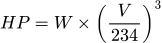
Trap speed is the velocity recorded as a vehicle crosses the quarter-mile finish line. This formula converts that speed and the vehicle's weight into an estimated horsepower. The constant 234 was derived empirically from drag strip data.
HP = W × (V / 234)³
How It Works
Trap speed is the vehicle's finish-line velocity at the end of the quarter mile. This calculator converts that speed and the total race weight into an estimated wheel-horsepower value using HP = W × (V / 234)³. The method is empirical, meaning the constant 234 comes from a large body of drag-strip data rather than a direct physics derivation. Because trap speed depends on how much kinetic energy the car has built up by the finish line, it is usually less sensitive than elapsed time to the launch, reaction, and traction in the first 60 feet.
Example Problem
A 3,500 lb car traps at 110 mph. Estimate the wheel horsepower from trap speed.
- Use the trap-speed horsepower formula: HP = W × (V / 234)³.
- Substitute the known values: HP = 3,500 × (110 / 234)³.
- Compute the speed ratio: 110 / 234 = 0.4701.
- Cube the ratio: 0.4701³ = 0.1039.
- Multiply by race weight: 3,500 × 0.1039 = 363.6.
- Estimated wheel horsepower = 363.6 hp.
This estimate is often closer to the car’s true wheel horsepower than an ET-based estimate, especially when traction or shifting is inconsistent.
Key Concepts
Trap speed is the velocity measured at the quarter-mile finish line, and the formula HP = W × (V / 234)³ uses that speed and race weight to estimate wheel horsepower. Because trap speed depends mainly on the energy delivered over the run, it is less affected than elapsed time by traction, launch technique, or reaction time. Horsepower scales with the cube of speed, which is why adding a few mph at the top end often demands a major power increase.
Applications
- Drag racing: estimating horsepower from time slip data when a dyno is not available
- Performance tuning: cross-checking trap speed HP estimates against dyno pulls to validate modifications
- Vehicle comparison: evaluating power-to-weight performance using a standardized metric across different vehicles
- Data logging: confirming whether a change in tune or boost level produced a real finish-line speed gain
Common Mistakes
- Using curb weight instead of total race weight — add driver, fuel, and cargo to get the weight at the finish line
- Comparing trap speed HP to dyno crank HP — the trap speed method estimates wheel HP, which is 15-20% lower than crank HP
- Ignoring wind and weather — headwinds, altitude, and temperature affect trap speed and skew the HP estimate
- Treating tire growth or wheelspin near the top end as irrelevant — unstable finish-line speed data still distorts the estimate
Frequently Asked Questions
Is trap speed more accurate than elapsed time for HP?
Trap speed is less affected by traction and driver reaction time, so it often gives a more consistent HP estimate. Elapsed time is more sensitive to launch technique.
What weight should I use?
Use the total race weight: vehicle curb weight plus driver, fuel, and any cargo. For most street cars, add roughly 180 lb to the published curb weight.
Why does the chart curve upward so steeply?
Horsepower scales with the cube of trap speed. A modest increase in speed requires a large increase in power because aerodynamic drag rises with velocity squared and the time to accelerate shortens.
Does this estimate wheel horsepower or crank horsepower?
It estimates wheel horsepower because the result is based on what the car actually delivers to the pavement. Crank horsepower is usually 15–20% higher depending on drivetrain loss.
Why is trap speed steadier than elapsed time?
Trap speed reflects the energy the vehicle has accumulated by the end of the run, so it is less sensitive to a mediocre launch or a small traction issue in the first 60 feet. ET includes every mistake and every bit of wheelspin from the start.
Can I use this on an eighth-mile time slip?
No. The constant 234 is tuned for quarter-mile trap speed. Eighth-mile horsepower estimates use a different relationship because the car spends less time accelerating against aerodynamic drag.
What if I changed gearing but not engine power?
Gearing can affect elapsed time more than trap speed. If the engine makes the same power but launches harder, ET may improve more than trap speed. That is another reason racers like trap speed when comparing real power output.
Reference:
Wallace Racing. Quarter Mile Trap Speed / Horsepower Relationships. Empirical drag-racing performance formulas compiled from time-slip data.
Horsepower from Trap Speed Formula
Quarter-mile trap speed estimates wheel horsepower from the finish-line velocity and total race weight. Because finish-line speed reflects the energy delivered over the whole run, it is usually steadier than ET-based horsepower.
HP = W × (V / 234)³
Where:
- HP — estimated wheel horsepower
- W — vehicle race weight in pounds, including driver and fuel
- V — quarter-mile trap speed in miles per hour
Like the elapsed-time version, this is an empirical drag-racing relationship. It tends to be less affected by launch quality, so racers often use trap speed for a more stable horsepower estimate when comparing runs.
Worked Examples
Street Car Time Slip
What horsepower does a 3,500 lb car need to trap 110 mph?
A full-weight street car crosses the quarter-mile finish line at 110 mph and weighs 3,500 lb with the driver. Estimate wheel horsepower from trap speed.
- V / 234 = 110 / 234 = 0.4701
- 0.4701³ = 0.1039
- HP = 3,500 × 0.1039 = 363.6 hp
Bracket Car Upgrade
How much power is implied by a 124 mph trap speed?
A 3,300 lb bracket car picks up to 124 mph after an engine upgrade. Use trap speed to estimate the new wheel horsepower.
- V / 234 = 124 / 234 = 0.5299
- 0.5299³ = 0.1488
- HP = 3,300 × 0.1488 = 491.0 hp
Metric Roll-Race Build
What horsepower corresponds to 1,480 kg at 198 km/h?
A metric setup sheet lists a 1,480 kg race weight and a 198 km/h trap speed. Estimate wheel horsepower while keeping the example in SI display units.
- Convert weight: 1,480 kg × 2.20462 = 3,263 lb
- Convert speed: 198 km/h × 0.621371 = 123.0 mph
- HP = 3,263 × (123.0 / 234)³ = 472.9 hp
Related Calculators
- HP from Elapsed Time — estimate HP using quarter-mile ET
- Horsepower Calculator — HP from torque and RPM
- Gear Equations Calculator — calculate vehicle speed from RPM and gear ratio
- Engine Equations Calculator — displacement and volumetric efficiency
- Speed Unit Converter — convert between mph, km/h, m/s, and other speed units
Related Sites
- Dollars Per Hour — Weekly paycheck calculator with overtime
- Compare 2 Loans — Side-by-side loan comparison calculator
- Medical Equations — Hemodynamic, pulmonary, and dosing calculators
- InfantChart — Baby and child growth percentile charts
- Temperature Tool — Temperature unit converter
- LoanChop — Loan prepayment calculator