Horsepower from Elapsed Time
Estimates engine horsepower from your quarter-mile elapsed time (ET) and vehicle weight. The constant 5.825 was derived from thousands of observed drag strip runs relating weight, time, and power.
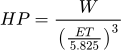
HP = W / (ET / 5.825)³
How It Works
This calculator estimates quarter-mile wheel horsepower from elapsed time (ET) and total race weight using the empirical drag-racing relationship HP = W / (ET / 5.825)³. Start with the vehicle's race weight, including driver, fuel, and anything else onboard during the run. Divide the elapsed time by 5.825, cube that ratio, and then divide the weight by the result. Lower ET values require disproportionately more power because elapsed time sits inside a cubic term.
Example Problem
A 3,200 lb car runs a 12.5 second quarter-mile. Estimate the wheel horsepower from elapsed time.
- Use the quarter-mile ET horsepower formula: HP = W / (ET / 5.825)³.
- Substitute the known values: HP = 3,200 / (12.5 / 5.825)³.
- Compute the ET ratio: 12.5 / 5.825 = 2.146.
- Cube the ratio: 2.146³ = 9.889.
- Divide race weight by the cubic term: 3,200 / 9.889 = 323.6.
- Estimated wheel horsepower = 323.6 hp.
Because the formula estimates wheel horsepower, a crank-horsepower estimate would usually be 15–20% higher after accounting for drivetrain loss.
Key Concepts
The elapsed time (ET) horsepower formula is empirical rather than theoretical. It was fit to thousands of real quarter-mile passes, so it works best when the car hooks consistently and the ET is truly power-limited. It estimates wheel horsepower, not advertised crank horsepower, because the time slip reflects the power actually delivered to the pavement after drivetrain losses. Compared with trap-speed horsepower, the ET method is more sensitive to launch quality, traction, shifting, and track preparation.
Applications
- Drag racing: estimating horsepower gains from engine modifications using before-and-after time slips
- Performance tuning: verifying dyno numbers against real-world quarter-mile results
- Vehicle comparison: comparing power-to-weight performance across different vehicles using a common metric
- Bracket racing: checking whether a new setup change produced a meaningful power increase instead of just a better launch
Common Mistakes
- Using curb weight instead of race weight — the formula needs total weight including driver, fuel, and cargo
- Expecting exact results — the formula is an approximation within ±5-10%, affected by traction, weather, and driver skill
- Confusing wheel HP with crank HP — the ET method estimates wheel horsepower; crank HP is typically 15-20% higher
- Comparing runs from poor track prep or wheelspin directly — ET punishes traction problems, so horsepower estimates fall if the car spins or bogs
Frequently Asked Questions
How accurate is the elapsed time HP estimate?
It is an approximation within about ±5–10%. Track conditions, driver skill, traction, and aerodynamic drag all affect real-world results.
Should I use curb weight or race weight?
Use the total weight as it crosses the finish line, including the driver and fuel. For most street cars, add about 180 lb to the curb weight.
Does this estimate wheel HP or crank HP?
The formula estimates wheel horsepower (WHP), since elapsed time reflects power at the wheels after drivetrain losses. Crank HP is typically 15–20% higher.
Why is ET-based horsepower so sensitive to traction?
Elapsed time includes everything that happens between the starting line and the finish line. A bad launch, tire spin, or a missed shift stretches ET and makes the horsepower estimate look lower, even if trap speed suggests the engine is making the same power.
Is elapsed time or trap speed better for horsepower?
Trap speed is usually better for estimating horsepower because it is less sensitive to launch technique and traction. Elapsed time is still useful, especially when you compare runs from the same car under similar conditions.
Can I use this for eighth-mile times?
No. This formula is tuned for quarter-mile elapsed times. Eighth-mile horsepower estimates use different constants because the vehicle spends less time at high speed and aerodynamic drag plays a different role.
Why does a small ET improvement require so much more horsepower?
Horsepower scales with the inverse cube of ET in this formula. That means trimming a few tenths off a quick car’s time slip often requires a surprisingly large power gain — or a much better launch.
Reference:
Wallace Racing. Quarter Mile ET / Horsepower Relationships. Empirical drag-racing performance formulas compiled from time-slip data.
Horsepower from Elapsed Time Formula
Quarter-mile elapsed time estimates wheel horsepower by comparing how long a given race weight takes to cover the strip. Faster ET values require much more power because the formula scales with the cube of elapsed time.
HP = W / (ET / 5.825)³
Where:
- HP — estimated wheel horsepower
- W — vehicle race weight in pounds, including driver and fuel
- ET — quarter-mile elapsed time in seconds
This is an empirical drag-racing relationship, not a first-principles physics derivation. It works best when the run is traction-limited only briefly and the recorded ET reflects the car’s actual power-to-weight performance.
Worked Examples
Street / Strip Coupe
What horsepower does a 3,200 lb car need for a 12.5-second quarter mile?
A rear-wheel-drive coupe weighs 3,200 lb with the driver and fuel onboard, and it runs a 12.5-second quarter mile. Estimate the wheel horsepower from elapsed time.
- ET / 5.825 = 12.5 / 5.825 = 2.146
- 2.146³ = 9.889
- HP = 3,200 / 9.889 = 323.6 hp
Weekend Drag Car
How much power is needed for an 11.2-second pass?
A full-weight car tips the scales at 3,450 lb and records an 11.2-second elapsed time. Use the ET formula to estimate wheel horsepower.
- ET / 5.825 = 11.2 / 5.825 = 1.923
- 1.923³ = 7.112
- HP = 3,450 / 7.112 = 485.1 hp
Metric Time Slip
How much power does a 1,520 kg car need for a 10.9-second quarter mile?
A metric time slip reports a race weight of 1,520 kg and an elapsed time of 10.9 seconds. Estimate wheel horsepower while keeping the example in SI inputs.
- Convert weight: 1,520 kg × 2.20462 = 3,351.0 lb
- ET / 5.825 = 10.9 / 5.825 = 1.871
- 1.871³ = 6.549, so HP = 3,351.0 / 6.549 = 511.7 hp
Related Calculators
- HP from Trap Speed — estimate HP using quarter-mile trap speed
- Horsepower Calculator — HP from torque and RPM
- Gear Equations Calculator — calculate vehicle speed from RPM and gear ratio
- Engine Equations Calculator — displacement and volumetric efficiency
- Power Unit Converter — convert between HP, watts, kW, and BTU/hr
Related Sites
- Dollars Per Hour — Weekly paycheck calculator with overtime
- Compare 2 Loans — Side-by-side loan comparison calculator
- Medical Equations — Hemodynamic, pulmonary, and dosing calculators
- InfantChart — Baby and child growth percentile charts
- Temperature Tool — Temperature unit converter
- LoanChop — Loan prepayment calculator