How It Works
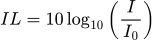
This calculator covers five equation groups related to sound waves: intensity level, sound pressure level (SPL), wavelength/frequency/velocity, point source intensity, and noise pollution level. Select an equation type and the variable you want to solve for, enter the known values, and the result updates automatically. Intensity Level (IL) measures how loud a sound is relative to a reference intensity, typically I₀ = 10⁻¹² W/m² (the threshold of human hearing). Sound Pressure Level (SPL) is the analogous measure using pressure, with a reference of Pₙₑₒ = 2 × 10⁻⁵ Pa. Both are expressed in decibels (dB). A loudspeaker emits sound at a pressure of 0.2 Pa. With the standard reference pressure of 2 × 10⁻⁵ Pa, what is the SPL? A simpler example: sound traveling at 343 m/s with a frequency of 440 Hz has a wavelength of 343 / 440 = 0.78 m. The wave equation λ = v / f connects wavelength, velocity, and frequency. In air at 20 °C the speed of sound is about 343 m/s. Use this equation when you know any two of the three variables. For a point source radiating uniformly in all directions, the intensity at a distance r is I = Pₐᵥ / (4πr²). This inverse-square law means that doubling the distance reduces intensity to one quarter. Use this when you need to find the power emitted, the distance from the source, or the intensity at a given radius. The noise pollution level combines statistical noise descriptors L₁₀, L₅₀, and L₉₀ (the dB(A) levels exceeded 10%, 50%, and 90% of the measurement period) into a single metric. The formula is NPL = L₅₀ + (L₁₀ − L₉₀) + (L₁₀ − L₉₀)² / 60. The standard reference intensity is I₀ = 10⁻¹² W/m², which represents the threshold of human hearing at 1 kHz. All intensity level measurements in decibels are relative to this baseline.
Example Problem
A loudspeaker emits sound at a pressure of 0.2 Pa. With the standard reference pressure of 2 × 10⁻⁵ Pa, what is the SPL?
- Identify the knowns. Measured sound pressure P = 0.2 Pa, reference pressure P_ref = 2 × 10⁻⁵ Pa = 0.00002 Pa (the threshold of human hearing at 1 kHz).
- Identify what we're solving for. We want the sound pressure level SPL in decibels (dB).
- Write the SPL formula in symbols: SPL = 20 × log₁₀(P / P_ref). The 20 (not 10) is because SPL is referenced to pressure, which scales with the square root of intensity.
- Substitute the known values: SPL = 20 × log₁₀(0.2 / 0.00002).
- Simplify the ratio first: 0.2 / 0.00002 = 10,000 = 10⁴, so log₁₀(10,000) = 4.
- **SPL = 20 × 4 = 80 dB** — about the loudness of a typical alarm clock or busy street traffic.
The standard reference intensity is I₀ = 10⁻¹² W/m², which represents the threshold of human hearing at 1 kHz. All intensity level measurements in decibels are relative to this baseline.
When to Use Each Variable
- Solve for Intensity Level — when you know the sound intensity and reference intensity, e.g., measuring industrial noise levels for OSHA compliance.
- Solve for Sound Pressure Level — when you have a sound pressure measurement and want to express it in decibels, e.g., characterizing loudspeaker output.
- Solve for Wavelength — when you know frequency and velocity, e.g., calculating room modes for acoustic treatment design.
- Solve for Point Source Intensity — when you know emitted power and distance, e.g., predicting noise levels at various distances from a construction site.
- Solve for Noise Pollution Level — when you have statistical noise descriptors L10, L50, and L90, e.g., assessing community noise impact from a highway.
Key Concepts
Sound waves are mechanical pressure disturbances that propagate through a medium. Intensity level and sound pressure level both express loudness in decibels relative to standard references (threshold of hearing). The wave equation connects wavelength, frequency, and velocity — knowing any two determines the third. For point sources, intensity follows the inverse-square law: doubling the distance reduces intensity to one quarter. The noise pollution level combines statistical noise metrics into a single descriptor of environmental noise impact.
Applications
- Noise control engineering: measuring and mitigating industrial, construction, and traffic noise to meet regulations
- Architectural acoustics: designing concert halls, studios, and classrooms for optimal sound quality
- Environmental monitoring: assessing community noise exposure from airports, highways, and railways
- Audio engineering: calibrating speakers and microphones using SPL and frequency response measurements
- Occupational safety: determining worker noise exposure levels and selecting appropriate hearing protection
Common Mistakes
- Adding decibels arithmetically — dB values are logarithmic, so 60 dB + 60 dB equals 63 dB, not 120 dB
- Confusing intensity level with sound pressure level — IL uses power per area (10 log), while SPL uses pressure (20 log)
- Using the speed of sound at sea level for all conditions — sound velocity varies with temperature, humidity, and altitude
- Forgetting that the inverse-square law assumes free-field conditions — reflections from walls and ground alter the actual intensity distribution
Frequently Asked Questions
What is the reference intensity for sound?
The standard reference intensity is I₀ = 10⁻¹² W/m², which represents the threshold of human hearing at 1 kHz. All intensity level measurements in decibels are relative to this baseline.
Can SPL be negative?
Yes. SPL is negative when the measured sound pressure is below the reference pressure of 2 × 10⁻⁵ Pa. Such sounds are typically inaudible to humans.
Why use a logarithmic scale for sound?
Human perception of loudness is approximately logarithmic. The decibel scale compresses the enormous range of sound intensities (from 10⁻¹² W/m² to over 1 W/m²) into a manageable 0–120 dB range that correlates more naturally with perceived loudness.
How does temperature affect sound velocity?
The speed of sound in air increases with temperature. At 0 °C it is about 331 m/s, and at 20 °C about 343 m/s. The approximate relationship is v ≈ 331 + 0.6 × T, where T is in degrees Celsius.
What is the difference between sound intensity and sound pressure level?
Intensity level (IL) uses the ratio of sound power per unit area to a reference intensity (10 × log₁₀), while sound pressure level (SPL) uses the ratio of pressure amplitudes (20 × log₁₀). Both yield values in decibels, and for plane waves in free field they are numerically equal.
How do you add two sound levels in decibels?
Decibel addition requires converting back to linear intensities. Two equal sources at 60 dB sum to 60 + 10 × log₁₀(2) ≈ 63 dB — not 120 dB. For unequal sources, convert each to intensity (10^(L/10)), add them, then convert the sum back with 10 × log₁₀. This is why doubling the number of speakers gives only a 3 dB increase.
How quickly does sound intensity fall with distance?
For a point source in free space, intensity follows the inverse-square law: I = P_av / (4π r²). Doubling the distance cuts intensity to one-quarter — equivalent to a 6 dB drop in SPL per doubling of distance. Reflective surfaces (walls, ground, ceilings) reduce this loss significantly indoors, which is why concert venues sound louder at the back than the inverse-square law predicts.
Why does sound travel faster in water and steel than in air?
Wave speed in any medium is v = √(B / ρ), where B is the bulk modulus (stiffness) and ρ is density. Water and steel are denser than air, but they are far stiffer, so the stiffness ratio dominates: sound travels about 1,500 m/s in water and roughly 5,100 m/s in steel — versus 343 m/s in 20 °C air. This is also why submarines and railway workers can hear approaching objects at long range through their respective media.
References:
Tipler, Paul A. 1995. Physics For Scientists and Engineers.
Worth Publishers. 3rd ed. • Vesilind, P. Aarne, J. Jeffrey Peirce and Ruth F. Weiner. 1994.
Environmental Engineering. Butterworth Heinemann. 3rd ed.
Worked Examples
Medical Imaging
What is the wavelength of a 5 MHz medical ultrasound probe in soft tissue?
Diagnostic ultrasound transducers commonly run at 5 MHz, and the speed of sound in human soft tissue is taken as 1540 m/s. The wavelength sets the smallest reliably resolvable feature for the probe.
- Knowns: v = 1540 m/s (soft tissue), f = 5 MHz = 5,000,000 Hz
- Formula: λ = v / f
- λ = 1540 / 5,000,000
λ ≈ 3.08 × 10⁻⁴ m ≈ 0.31 mm
Axial resolution in B-mode ultrasound is roughly one to two wavelengths, so a 5 MHz probe resolves details on the order of a fraction of a millimeter.
Concert Acoustics
What sound pressure level corresponds to a 200 Pa peak in front of a stadium PA?
A large concert PA can produce a peak acoustic pressure of about 200 Pa near the front-of-house listening position. Comparing it to the hearing-threshold reference of 20 µPa gives the SPL in decibels.
- Knowns: P = 200 Pa, P_ref = 20 µPa = 0.00002 Pa
- Formula: SPL = 20 × log₁₀(P / P_ref)
- SPL = 20 × log₁₀(200 / 0.00002)
- SPL = 20 × log₁₀(1 × 10⁷) = 20 × 7
SPL = 140 dB
140 dB is the threshold of pain and well above any safe exposure limit; this scenario assumes peak pressure, not RMS, and is intentionally illustrative.
Audio Engineering
What is the sound intensity 10 m from a 100 W omnidirectional loudspeaker?
Treat a 100 W acoustic-power loudspeaker as a point source radiating uniformly into free space. Assuming inverse-square spreading with no reflections, find the on-axis intensity at 10 m.
- Knowns: P_av = 100 W, r = 10 m
- Formula: I = P_av / (4π × r²)
- I = 100 / (4π × 10²)
- I = 100 / 1256.64
I ≈ 0.0796 W/m²
Real loudspeakers are directional, indoor reflections add energy, and 100 W of acoustic power is unusually high (most boxes are a few watts acoustic) — the formula gives the free-field upper bound.
Sound Wave Formulas
This calculator covers five independent sound-wave relationships used across acoustics, audio engineering, and environmental noise work:
λ = v / fWavelength from velocity and frequency
IL = 10 × log₁₀(I / I₀)Intensity level (dB), reference I₀ = 10⁻¹² W/m²
SPL = 20 × log₁₀(P / Pref)Sound pressure level (dB), reference Pref = 2×10⁻⁵ Pa
I = Pav / (4π × r²)Point-source intensity (inverse-square law)
NPL = L₅₀ + (L₁₀ − L₉₀) + (L₁₀ − L₉₀)² / 60Noise pollution level (dB(A))
Where:
- λ — wavelength, in meters (m)
- f — frequency, in hertz (Hz)
- v — propagation speed (≈ 343 m/s in 20 °C air, ≈ 1,500 m/s in water), in m/s
- I, I₀ — measured and reference sound intensity, in W/m²
- P, Pref — measured and reference RMS sound pressure, in pascals (Pa)
- IL, SPL — intensity level and sound pressure level, in decibels (dB)
- Pav — average acoustic power radiated by the source, in watts (W)
- r — distance from the point source, in meters (m)
- L₁₀, L₅₀, L₉₀ — A-weighted dB(A) levels exceeded 10%, 50%, and 90% of the measurement period
The wavelength relation λ = v / f assumes a single-medium, non-dispersive wave. The intensity-level and SPL formulas use logarithmic ratios so that the ~12-order-of-magnitude span of audible sound compresses into the familiar 0–120 dB range. The point-source equation assumes free-field (no reflections) and a uniformly radiating source — real loudspeakers and indoor measurements deviate due to directivity and room reflections.
References: Tipler, Paul A. 1995. Physics For Scientists and Engineers. Worth Publishers. 3rd ed. • Vesilind, P. Aarne, J. Jeffrey Peirce and Ruth F. Weiner. 1994. Environmental Engineering. Butterworth Heinemann. 3rd ed.
Related Calculators
- Sound Wave Speed Calculator — v = f × λ — dedicated single-equation page
- Sound Intensity Decibels Calculator — β = 10 × log₁₀(I/I₀) — dedicated page
- Doppler Effect Equations Calculator — calculate observed frequency shifts due to relative motion between source and observer
- Force Equation Calculator — solve for force, mass, or acceleration using Newton's second law
- Power Calculator — calculate mechanical power from work and time
- Pendulum Formulas Calculator — determine period and frequency of a simple pendulum
- Frequency Converter — convert between Hz, kHz, MHz, and other frequency units
Related Sites
- Temperature Tool — Temperature unit converter
- Z-Score Calculator — Z-score, percentile, and probability calculator
- InfantChart — Baby and child growth percentile charts
- Dollars Per Hour — Weekly paycheck calculator with overtime
- OptionsMath — Options trading profit and loss calculators
- Medical Equations — Hemodynamic, pulmonary, and dosing calculators