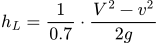
Bar Rack Headloss
Bar rack headloss depends on the velocity difference through and upstream of the bars. The 0.7 factor accounts for the bar loss coefficient. Typical clean headloss is 10–40 mm.
h_L = (1/0.7) × (V² − v²) / (2g)
Fine Screen Headloss
Fine screen headloss uses the flow rate, effective open area, and a discharge coefficient. Fine screens have openings of 0.5–6 mm and can remove smaller solids than bar racks.
h_L = (1/2Cg) × (Q/A)²
How It Works
Screening is the first step in a wastewater treatment plant, catching rags, sticks, plastics, and other large debris before they damage pumps and clog pipes. Bar racks use spaced parallel bars (typically 25–50 mm openings), while fine screens have openings as small as 0.5–6 mm. The headloss across each type is the key design parameter for channel sizing.
Example Problem
A bar rack has an approach velocity of 0.6 m/s, a bar-opening velocity of 0.9 m/s, and g = 9.81 m/s². What is the headloss?
- Identify the knowns. Approach (upstream) velocity v = 0.6 m/s, bar-opening velocity V = 0.9 m/s, and gravitational acceleration g = 9.81 m/s². The 0.7 in the denominator is the Kirschmer loss coefficient for clean racks.
- Identify what we're solving for. We want the headloss h_L across the bar rack — the additional water surface elevation needed to drive flow through the constricted openings.
- Write the Kirschmer equation in symbols: h_L = (1 / 0.7) × (V² − v²) / (2g).
- Substitute the known values: h_L = (1 / 0.7) × (0.9² − 0.6²) / (2 × 9.81) = 1.429 × (0.81 − 0.36) / 19.62.
- Simplify the arithmetic: 1.429 × 0.45 / 19.62 = 1.429 × 0.02294.
- State the result with units: **h_L ≈ 0.033 m (33 mm)** — squarely within the 10–40 mm clean-rack range; expect this to rise several-fold as debris accumulates between cleanings.
Clean bar rack headloss is typically 10–40 mm; it increases as debris accumulates.
When to Use Each Variable
- Solve for Bar Rack Headloss — when you know the approach and opening velocities, e.g., checking whether a bar rack design meets maximum headloss criteria.
- Solve for Opening Velocity — when you know the headloss and approach velocity, e.g., verifying bar spacing is adequate for the design flow.
- Solve for Fine Screen Headloss — when you know the flow rate, screen area, and discharge coefficient, e.g., sizing the screen channel depth.
- Solve for Fine Screen Discharge — when you know the allowable headloss and screen area, e.g., determining the maximum flow a screen can handle.
Key Concepts
Screening headloss is driven by the velocity increase through the restricted opening. For bar racks, the Kirschmer equation uses the velocity difference between the approach channel and the bar openings. For fine screens, headloss depends on the ratio of flow rate to effective open area and a discharge coefficient that accounts for screen geometry and clogging.
Applications
- Municipal wastewater plants: sizing bar racks and fine screens for peak wet-weather flows
- Industrial pretreatment: protecting downstream equipment from fibrous or stringy waste materials
- Combined sewer systems: designing screening facilities that handle storm surge without bypassing
- Aquaculture and intake structures: preventing fish and debris from entering water supply systems
Common Mistakes
- Designing only for clean-screen headloss — screens accumulate debris rapidly, and headloss can increase 5-10x between cleanings
- Using average flow instead of peak flow — screens must pass peak wet-weather flows without exceeding the maximum allowable headloss
- Forgetting the 0.7 loss coefficient in the bar rack equation — omitting it underestimates headloss by about 30%
- Mixing velocity units — the equation requires consistent units (m/s or ft/s) for both approach and opening velocities
Frequently Asked Questions
What is the purpose of screening in wastewater treatment?
Screening removes large solids — rags, plastics, sticks, and debris — that could damage pumps, clog pipes, or interfere with downstream biological and chemical treatment processes. It is the first unit operation in virtually every treatment plant.
What is the difference between coarse and fine screens?
Coarse screens (bar racks) have bar spacings of 25–50 mm and catch large debris. Fine screens have openings of 0.5–6 mm and remove smaller solids, sometimes replacing primary clarifiers in compact treatment plants.
How much headloss do bar racks cause?
Clean bar racks typically produce 10–40 mm of headloss. As screenings accumulate, headloss rises and can exceed 150 mm, triggering automatic rake cleaning. Maximum allowable headloss is set during design, usually at 150–300 mm.
Worked Examples
Municipal WWTP Headworks
What is the bar-rack headloss for V = 0.9 m/s through and v = 0.6 m/s approach?
A 50 MGD municipal wastewater treatment plant has a clean coarse bar rack at the influent channel. Design flow gives an upstream approach velocity v = 0.6 m/s and a through-bar velocity V = 0.9 m/s. What is the clean-screen headloss?
- Knowns: V = 0.9 m/s, v = 0.6 m/s, g = 9.81 m/s²
- h_L = (1 / 0.7) × (V² − v²) / (2g)
- h_L = (1 / 0.7) × (0.81 − 0.36) / 19.62
- h_L = (1 / 0.7) × 0.02293
h_L ≈ 0.033 m (3.3 cm)
Clean-screen headloss should stay below about 0.15 m at peak flow; the 0.7 factor in the Metcalf-Eddy form accounts for irregular bar shapes and accumulated rags that aren't visible at the clean-screen condition.
Sewer Pump-Station Inlet
How much head does a bar rack take when through-bar velocity rises to 1.2 m/s?
A wet-well sewage pump station experiences peak-storm flow that drives the through-bar velocity to 1.2 m/s with v = 0.4 m/s upstream. What is the additional pumping head the bar rack imposes on the lift station?
- Knowns: V = 1.2 m/s, v = 0.4 m/s, g = 9.81 m/s²
- h_L = (1 / 0.7) × (V² − v²) / (2g)
- h_L = (1 / 0.7) × (1.44 − 0.16) / 19.62
- h_L = (1 / 0.7) × 0.06524
h_L ≈ 0.093 m (9.3 cm)
Storm-event headloss climbs quickly as the V/v ratio grows; sustained operation above 0.15 m signals time to rake the bars. Most modern pump stations use an automatic raking system triggered by an upstream level switch.
Industrial Pre-Treatment — Fine Screen
What is the headloss through a fine screen passing 0.5 m³/s with 0.4 m² open area?
A food-processing plant uses a perforated-plate fine screen ahead of dissolved-air flotation. The screen passes Q = 0.5 m³/s through an effective open area A = 0.4 m², with a discharge coefficient C = 0.6 typical of clean perforated plate. What is the clean-screen headloss?
- Knowns: Q = 0.5 m³/s, A = 0.4 m², C = 0.6, g = 9.81 m/s²
- h_L = (1 / (2 × C × g)) × (Q / A)²
- h_L = (1 / 11.772) × (1.25)²
- h_L = 0.0850 × 1.5625
h_L ≈ 0.133 m (13.3 cm)
Fine screens generate more headloss than bar racks because the open area is far smaller. C typically drops from 0.6 (clean) to about 0.3 when half-blinded, doubling the operating headloss — schedules for backwash or brush cleaning are sized around this drop.
Related Calculators
- Activated Sludge Calculator — design the biological treatment stage downstream of screening
- Flocculation Calculator — calculate mixing for chemical treatment after screening
- Trommel Screen Calculator — size rotating screens for solid waste separation
- Pipe Flow Calculator — determine flow velocity approaching the bar screen
- Speed Unit Converter — convert approach velocity between ft/s, m/s, and other units
Related Sites
- CameraDOF — Depth of field calculator for photographers
- Medical Equations — Hemodynamic, pulmonary, and dosing calculators
- Hourly Salaries — Hourly wage to annual salary converter
- RN Calc — Nursing dosage and calculation tools
- InfantChart — Baby and child growth percentile charts
- Z-Score Calculator — Z-score, percentile, and probability calculator