Speed / Gear Ratio
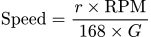
Speed equals tire radius times RPM divided by 168 times gear ratio
Links vehicle speed to engine RPM, tire radius, and the final drive gear ratio. The constant 168 handles unit conversion from inches and RPM to miles per hour. Solve for any one variable when you know the other three.
v = (r × RPM) / (168 × G)
Shows how a tire-size change alters your gearing. When you install larger tires, the effective gear ratio drops, lowering RPM at highway speed and potentially hurting acceleration.
G_e = (d_old / d_new) × G
Converts metric tire sizes (e.g., 225/65R17) to inches. Section width (W) is in millimeters, aspect ratio (A) is a decimal, and rim diameter (d_r) is in inches.
d = (2 × W × A) / 25.4 + d_r
Multiplies the differential, transfer case, and transmission ratios to find the overall low-range reduction for off-road driving. Higher crawl ratios provide more torque at the wheels for rock crawling.
C = D × T × G_t
The gear equation links vehicle speed to engine RPM, tire size, and the final drive gear ratio. The constant 168 handles the unit conversion from inches and RPM to miles per hour (63,360 in/mi ÷ 60 min/hr ÷ 2π). The effective gear ratio shows how a tire-size change alters your gearing. The tire diameter equation converts metric tire sizes to inches. The crawl ratio multiplies the differential, transfer case, and transmission ratios to find the overall low-range reduction for off-road driving.
A truck with 15-inch tire radius, 3.73 gear ratio, cruising at 3,000 RPM. What is the speed?
The gear ratio equation links engine RPM to vehicle speed through tire size and the final drive ratio. The constant 168 converts inches and RPM to miles per hour. The effective gear ratio shows how a tire-size change alters gearing — larger tires lower the effective ratio, reducing RPM at highway speed. The crawl ratio multiplies all drivetrain ratios to determine the overall mechanical advantage in low range.
Larger tires lower your engine RPM at highway speed, which can hurt low-end acceleration and cause the transmission to hunt between gears. Re-gearing to a numerically higher ratio (e.g., 3.73 to 4.10) restores the original RPM range.
Lower ratios like 2.73:1 or 3.08:1 keep RPM down at highway speed, improving fuel economy. However, they sacrifice acceleration. The best ratio depends on tire size and the engine’s torque curve.
The gear ratio here is the overall ratio (transmission gear × differential ratio). In top gear (often 1:1 or an overdrive like 0.7:1), the effective ratio equals the differential ratio multiplied by the transmission gear.
It bundles three unit conversions: 63,360 inches per mile divided by 60 minutes per hour divided by 2π radians per revolution gives 168.067. The 168 lets you plug tire radius in inches and RPM directly and read speed in mph.
No. Final drive is just the differential ratio. Crawl ratio multiplies the differential, transfer case low range, and transmission first-gear ratios together to give the overall low-range mechanical advantage. A solid rock-crawling rig wants crawl ratios of 60:1 or higher.
The 225 is the section width in millimeters, 65 is the aspect ratio as a percentage (sidewall height = 65% of section width), and 17 is the rim diameter in inches. The tire diameter formula converts this to overall diameter in inches for gear math.
A higher numerical ratio (e.g., 4.10:1 vs. 3.08:1) means more crankshaft revolutions per wheel revolution, which multiplies engine torque at the wheels. The trade-off is higher RPM at any given road speed, which hurts highway fuel economy.
Reference: Results are approximate and assume no drivetrain losses or tire slip.
Ford F-150 Highway Cruise — Speed / RPM
A late-model Ford F-150 with 3.55 final-drive gears and 33-inch tires (rolling radius ≈ 16.5 in) cruises at 70 mph on the interstate in top gear (1.0 transmission ratio). Compute the engine RPM to compare against the cam's torque-peak window and judge fuel economy at cruise.
RPM ≈ 2530
A truck running at ~2500 rpm at 70 mph is in the meat of its torque curve and gets the best fuel economy. Dropping to 3.31 gears or going to 35-inch tires drops cruise RPM by ~200 rpm, often improving highway MPG by 1–2 mpg.
Jeep Wrangler Tire Upsize — Effective Gear Ratio
A Jeep Wrangler ships with 28-inch tires and 3.73 axle gears. The owner installs 33-inch tires for off-road clearance. The taller tire effectively raises the gearing — making acceleration sluggish and final-drive RPM lower. Compute the new effective gear ratio so we can decide whether to re-gear the axle.
G_e ≈ 3.16
Dropping from an effective 3.73 to 3.16 is roughly a half-step taller — most Jeep owners re-gear to 4.10 or 4.56 to restore the original behavior. Use the dedicated Effective Gear Ratio page when comparing multiple re-gear options.
Rubicon Off-Road Build — Crawl Ratio
A Jeep Wrangler Rubicon trim ships with 4.10 axle gears, a 4.0:1 NV241OR low-range transfer case, and a 4.71:1 first gear in the NSG-370 manual transmission. Compute the total crawl ratio — the multiplier between engine RPM and tire RPM in low-low — to judge how tightly the driver can creep over rocks at idle.
C ≈ 77.2 : 1
Hardcore rock-crawler builds target 100:1 or higher by stacking additional underdrive (Atlas dual-range t-case, 5.13 axle gears). 77:1 is solid factory-spec for trail use; the engine moves the tires at ~1.3 mph per 1000 rpm in low-low.
Four equations cover the most common drivetrain math: speed from gearing, the effect of tire-size changes on effective ratio, metric tire-size conversion, and the overall crawl ratio in low range.
Where:
The 168 constant in the speed formula bundles 63,360 in/mi ÷ 60 min/hr ÷ 2π so the result drops out in mph when tire radius is in inches and engine speed is in rpm. Crawl ratios of 40:1 are typical for stock 4×4s; dedicated rock crawlers run 80:1 or higher. The tire-diameter formula divides by 25.4 to convert the millimeter sidewall height to inches before adding the rim diameter.
Note: Results are approximate and assume no drivetrain losses or tire slip.