How It Works
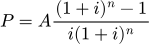
The uniform-series present-worth factor (P/A) converts a stream of equal periodic payments A into a single present value P. The formula P = A × [(1 + i)^n − 1] / [i(1 + i)^n] sums the discounted value of n level payments at rate i per period. Use it to find the lump-sum value today of a future annuity (lottery, pension, lease) or to back out the loan amount supported by a known monthly payment.
Example Problem
An ordinary annuity pays $1,000 at the end of each year for 10 years. At a discount rate of 10%, what is the present value of the entire stream?
- Identify the known data points. Periodic payment A = $1,000 at the end of each year, periodic discount rate i = 0.10 per year, number of periods n = 10 years.
- Identify what we're solving for. We want the present value P — the lump-sum value today of the entire 10-year payment stream.
- Write the uniform-series present-worth formula: P = A × [(1 + i)^n − 1] / [i(1 + i)^n].
- Substitute the known values: P = 1,000 × [(1.10)^10 − 1] / [0.10 × (1.10)^10].
- Simplify the bracketed factor: (1.10)^10 = 2.593742, so the numerator is 2.593742 − 1 = 1.593742 and the denominator is 0.10 × 2.593742 = 0.2593742, giving the P/A factor 1.593742 / 0.2593742 = 6.14457.
- **Present value P = $6,144.57** today, even though the total nominal payments are $10,000 — the difference is the discount for time value.
The stream is worth $6,144.57 today even though total payments are $10,000 — discounting reflects the time value of money.
Key Concepts
Annuity present value is the lump-sum equivalent of a future payment stream. It is the inverse of the capital recovery factor: P/A and A/P are reciprocals, so the same equation that amortizes a loan also values an annuity. The PV depends on the discount rate, the payment size, and the number of periods — never on the dollar amount alone. Ordinary annuity (payments at end of period) is the engineering-economics default; for annuity due (start of period), multiply the ordinary PV by (1 + i).
Applications
- Lottery lump-sum vs. annuity — compare the announced cash option to the present value of the 30-year payment stream
- Pension valuation — convert a pension's monthly benefit into a lump-sum equivalent for divorce settlements or planning
- Lease analysis — find the lump-sum cost equivalent to a stream of lease payments
- Bond pricing — the present value of a bond's coupon stream is an annuity PV at the yield to maturity
- Loan affordability — convert what you can pay each month into the maximum loan principal you can support
Common Mistakes
- Confusing annuity PV (P/A) with annuity FV (F/A) — present worth discounts to TODAY, future value compounds to the FINAL period
- Entering interest rate as a percent — use 0.10 for 10%, not 10
- Forgetting that the first payment is one period in the future for an ordinary annuity — annuity-due payments at period 0 require a (1 + i) adjustment
- Adding a starting lump sum to the PV — a known starting balance is a separate present value, not part of the annuity
- Mixing annual rate with monthly payments — convert to a consistent period basis before applying the formula
Frequently Asked Questions
How do you calculate the present value of an annuity?
Use P = A × [(1 + i)^n − 1] / [i(1 + i)^n] where A is the periodic payment, i is the periodic discount rate, and n is the number of payments. Example: $1,000 per year for 10 years at 10% gives P = 1,000 × 6.1446 = $6,144.57.
What is the formula for ordinary annuity present value?
P = A × [(1 + i)^n − 1] / [i(1 + i)^n]. The bracketed factor is the uniform-series present-worth factor (P/A). Multiply by the periodic payment A to get the present-day equivalent value P of the entire payment stream.
What is the difference between annuity present value and annuity future value?
Annuity PV (P = A × P/A) is the lump-sum value TODAY of a stream of future payments. Annuity FV (F = A × F/A) is the lump-sum value at the END of the stream after the last payment. They differ by the compound-growth factor (1 + i)^n.
Should I take the lottery lump sum or annual payments?
Compare the offered lump sum to the present value of the annuity stream at YOUR discount rate. If you can invest the lump sum at a higher rate than the annuity's implied yield, take the lump sum. Most state lotteries' cash options are calibrated near a 3-5% discount rate.
How do I find the loan amount for a given monthly payment?
Use the annuity PV formula with the monthly payment A, monthly rate i, and total months n. A $1,500 monthly payment over 30 years at 0.5% monthly (6% annual) supports a loan principal of $250,187 — the present value of the payment stream.
Why is the present value less than the total payments?
Discounting accounts for the time value of money — a dollar received in year 10 is worth less than a dollar received today. The further out the payment, the heavier the discount. A 10-year, $1,000/year stream totals $10,000 nominal but is worth only $6,144.57 today at 10%.
Reference:
Lindeburg, Michael R. 1992. Engineer In Training Reference Manual. Professional Publication, Inc. 8th Edition.
Worked Examples
Lottery Lump-Sum
What is the present value of $50,000 per year for 20 years at a 5% discount rate?
- P = A × [(1 + i)^n − 1] / [i(1 + i)^n]
- P = 50,000 × [(1.05)^20 − 1] / [0.05 × (1.05)^20]
- P = 50,000 × 12.4622
- P ≈ $623,111
Mortgage Affordability
What loan principal does a $1,500 monthly payment support over 30 years at 6% APR?
- Convert to monthly: i = 0.005, n = 360
- P = 1,500 × [(1.005)^360 − 1] / [0.005 × (1.005)^360]
- P = 1,500 × 166.7916
- P ≈ $250,187
Pension Lump-Sum Buyout
What is the present value of a $2,500/month pension for 25 years at 4% APR?
- i = 0.04 / 12 ≈ 0.003333, n = 300
- P = 2,500 × [(1.003333)^300 − 1] / [0.003333 × (1.003333)^300]
- P = 2,500 × 189.4525
- P ≈ $473,631
Related Calculators
- Capital Recovery Calculator — convert a present amount into equal annual payments (inverse of annuity PV)
- Annuity Future Value Calculator — future value of equal periodic deposits
- Sinking Fund Calculator — periodic deposit to reach a future target
- Present Value Calculator — P = F / (1+i)^n for a single future lump sum
- Future Value Calculator — F = P(1+i)^n compound growth of a single sum
- Compounding & Discount Factors (All-in-One) — all six engineering-economy equations in one switcher
- Present Worth Analysis Calculator — compare project alternatives on a present-worth basis
Related Sites
- OptionsMath — Options trading profit and loss calculators
- Compare 2 Loans — Side-by-side loan comparison calculator
- LoanChop — Loan prepayment calculator
- Medical Equations — Hemodynamic, pulmonary, and dosing calculators
- Dollars Per Hour — Weekly paycheck calculator with overtime
- RN Calc — Nursing dosage and calculation tools