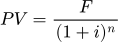
Present Value (Single Payment)
Converts a single future payment into today’s dollars using a discount rate. This is the foundation of investment analysis, bond pricing, and capital budgeting.
PV = F / (1+i)ⁿ
Annuity Present Value
Calculates the present value of a series of equal annual payments. Used for loan amortization, pension valuation, and lease analysis.
PV = A × [(1+i)ⁿ − 1] / [i(1+i)ⁿ]
Annuity Future Value
Determines the future value of a series of equal annual deposits. Used for savings accumulation, retirement planning, and sinking fund analysis.
F = A × [(1+i)ⁿ − 1] / i
How It Works
Present worth analysis converts future cash flows into today’s dollars using a discount rate. It answers the question: “What is a future payment worth right now?” This is the foundation of investment analysis, bond pricing, and capital budgeting. The calculator supports three modes: single-payment present/future value, annuity present value (series of equal payments), and annuity future value (savings accumulation).
Example Problem
You will receive $50,000 in 5 years. At a 6% discount rate, what is it worth today?
- Identify the known data points. Future amount F = $50,000 received 5 years from now, periodic discount rate i = 0.06 per year, number of periods n = 5 years.
- Identify what we're solving for. We want the present value PV — what that $50,000 future payment is worth in today's dollars.
- Write the single-payment present-value formula: PV = F / (1 + i)^n.
- Substitute the known values: PV = 50,000 / (1.06)^5.
- Simplify the discount factor: (1.06)^5 = 1.338226, so PV = 50,000 / 1.338226.
- **Present value PV = $37,362.91** today — about 75% of the future amount, with the remainder representing the discount for waiting 5 years.
If instead you receive $10,000 per year for 5 years at 6%, the annuity PV is $10,000 × 4.2124 = $42,124.
When to Use Each Variable
- Solve for Present Value — when you will receive a single lump sum in the future and want to know its value today, e.g., pricing a zero-coupon bond.
- Solve for Annuity PV — when you will receive equal periodic payments over time and want to know their combined present value, e.g., valuing a pension or loan.
- Solve for Annuity FV — when you make equal periodic deposits and want to know the total accumulated value at the end, e.g., retirement savings projections.
Key Concepts
The time value of money means a dollar today is worth more than a dollar in the future because it can earn interest. The discount rate reflects opportunity cost — what you could earn elsewhere. Present value shrinks as the discount rate or time horizon increases, which is why long-term projects need higher returns to justify investment.
Applications
- Capital budgeting: comparing investment alternatives by discounting all future cash flows to today's dollars
- Bond pricing: calculating the fair price of a bond as the present value of its coupon payments plus face value
- Real estate valuation: discounting future rental income and resale proceeds to determine property worth
- Retirement planning: computing how much to save annually to reach a target future nest egg
Common Mistakes
- Using a nominal rate when cash flows are real (inflation-adjusted) or vice versa — mismatched rates and cash flows produce meaningless results
- Forgetting to match the compounding period to the payment period — monthly payments with an annual rate require dividing the rate by 12 and multiplying periods by 12
- Double-counting the initial investment — PV formulas discount future cash flows; the initial outlay at time zero should not be discounted again
Frequently Asked Questions
What discount rate should I use for present value?
Use your required rate of return or cost of capital. For personal investments, this might be 6–8%. For corporate projects, use the weighted average cost of capital (WACC). Higher discount rates reduce present value.
What is net present value (NPV)?
NPV is the present value of all cash inflows minus the initial investment. An NPV greater than zero means the project earns more than the discount rate. A $100,000 project with $120,000 in PV of cash flows has an NPV of $20,000.
How is present value used in real estate?
Real estate investors discount future rental income and resale proceeds to determine what a property is worth today. If 10 years of $50,000 NOI discounts to $368,000 and the resale discounts to $500,000, the property is worth $868,000.
What is the formula for future value from a present amount?
Use F = PV(1 + i)^n. If PV is 8,000, i is 5%, and n is 6 periods, the future value is 8,000(1.05)^6 ≈ 10,723.10.
When do you use annuity present value instead of single-payment present value?
Use annuity present value when the cash flow is a level series of equal payments over time, such as rent, pension payments, or uniform maintenance savings. Use single-payment present value for one lump sum.
Why does present worth fall as the discount rate rises?
A higher discount rate means future cash flows are worth less today because your opportunity cost of capital is higher. The same future payment becomes less attractive as the required return increases.
Reference:
Newnan, D.G., Eschenbach, T.G., & Lavelle, J.P. Engineering Economic Analysis. Oxford University Press.
Present Worth Formulas
Present worth analysis brings future cash flows back to today's dollars. Depending on the cash-flow shape, you can use a single-payment factor or an annuity factor.
Single Payment
PV = F / (1 + i)^n
Annuity Present Value
PV = A[(1+i)^n − 1] / [i(1+i)^n]
Annuity Future Value
F = A[(1+i)^n − 1] / i
Worked Examples
Single Future Payment
What is the present worth of $25,000 due in 7 years at 5%?
- PV = F / (1 + i)^n
- PV = 25,000 / (1.05)^7
- PV ≈ $17,768.87
Lease / Pension Stream
What present value corresponds to $3,000 per year for 10 years at 6%?
- Use the annuity present-value factor.
- Substitute A = 3,000, i = 0.06, n = 10.
- PV ≈ $22,080.29
Savings Accumulation
What future value builds from $2,000 annual deposits for 12 years at 4%?
- Use F = A[(1+i)^n − 1] / i.
- Substitute A = 2,000, i = 0.04, n = 12.
- F ≈ $30,038.53
Reference: Newnan, D.G., Eschenbach, T.G., & Lavelle, J.P. Engineering Economic Analysis. Oxford University Press.
Related Calculators
- Compounding & Discount Factors Calculator — compound amount factors
- Profitability Index Calculator — rank investment opportunities
- Interest Rate Calculator — simple and compound interest
- Rule of 72 Calculator — quickly estimate doubling time for investments
- Depreciation Calculator — account for asset depreciation in project analysis
Related Sites
- Dollars Per Hour — Weekly paycheck calculator with overtime
- OptionsMath — Options trading profit and loss calculators
- Percent Off Calculator — Discount and sale price calculator
- CameraDOF — Depth of field calculator for photographers
- Medical Equations — Hemodynamic, pulmonary, and dosing calculators
- InfantChart — Baby and child growth percentile charts