How It Works
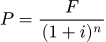
Present value (PV) is what a future amount of money is worth today after discounting at a fixed periodic interest rate. The single-payment present-worth formula P = F / (1 + i)^n turns a future sum F into its present-day equivalent P given n periods at rate i. Discounting is the inverse of compounding — use it for bond pricing, valuing a future windfall today, or comparing future cash flows on a common basis (NPV).
Example Problem
You will receive $10,000 in 10 years. At a discount rate of 5% per year, what is that future payment worth today?
- Choose Solve For = Present Value (P). The formula is P = F / (1 + i)^n.
- Substitute F = 10,000, i = 0.05, n = 10.
- Compute (1.05)^10 = 1.628895.
- Divide: P = 10,000 / 1.628895 = 6,139.13.
- A future $10,000 payment is worth $6,139.13 today at a 5% discount rate.
Higher discount rates produce smaller present values — at 10% the same $10,000 is worth only $3,855.43 today.
Key Concepts
Present value answers 'what would I pay today to receive this future cash flow?'. The discount factor 1 / (1 + i)^n shrinks future amounts back to a present-day equivalent — the further away the cash flow, the heavier the discount. The same per-period discount rate principle drives NPV calculations, bond pricing, and lease valuation. Choose a discount rate that reflects the opportunity cost or required rate of return; engineering-economics textbooks tabulate the factor as P/F (P over F).
Applications
- Bond pricing — discount each future coupon plus the face-value redemption to today's value
- Net present value (NPV) — sum the present values of every future project cash flow
- Lease vs. buy comparisons — convert future lease payments into a present-day equivalent
- Lottery lump-sum vs. annuity — compare the lump-sum payout to the present value of the annuity stream
- Legal settlements — translate a structured future payout into a present-day fair value
Common Mistakes
- Entering interest rate as a percent instead of a decimal — use 0.05 for 5%, not 5
- Using a discount rate inconsistent with risk — riskier cash flows demand higher discount rates
- Mixing real and nominal rates — if cash flows are inflation-adjusted, use the real rate; if not, use the nominal rate
- Using the wrong number of periods — discount a 5-year monthly cash flow at the monthly rate over 60 months, not the annual rate over 5
- Forgetting that PV is just one cash flow — a series of payments needs the uniform-series present-worth formula (annuity present value)
Frequently Asked Questions
How do you calculate present value?
Divide the future amount F by (1 + i)^n where i is the discount rate per period and n is the number of periods. Example: $10,000 received in 10 years at a 5% discount rate is worth $10,000 / (1.05)^10 = $6,139.13 today.
What is the formula for present value of a single sum?
P = F / (1 + i)^n. The factor 1 / (1 + i)^n is the single-payment present-worth factor (P/F) — it shrinks the future sum F into its present-day equivalent P.
What is the difference between present value and future value?
Present value (PV) is what a future amount is worth today after discounting. Future value (FV) is what a present amount grows to after compounding. They are inverses: PV = FV / (1 + i)^n and FV = PV × (1 + i)^n.
What discount rate should I use?
Use the rate that reflects your opportunity cost or required return. For a low-risk Treasury cash flow, a Treasury yield works. For a corporate project, the firm's weighted average cost of capital (WACC) is typical. For personal decisions, the rate you could earn on a safe alternative investment is reasonable.
How does a higher discount rate affect present value?
Higher discount rates make future cash flows worth less today. A $10,000 cash flow 10 years out is worth $6,139.13 at a 5% rate but only $3,855.43 at 10% — discounting more aggressively shrinks the present value.
Can I use present value for monthly cash flows?
Yes — convert the annual rate to a monthly rate (divide by 12) and use the total number of months as n. A $5,000 payment due in 36 months at a 9% annual rate discounts at i = 0.0075 per month: P = 5,000 / (1.0075)^36 = $3,820.74.
Reference:
Lindeburg, Michael R. 1992. Engineer In Training Reference Manual. Professional Publication, Inc. 8th Edition.
Worked Examples
Bond Face Value
What is a $1,000 face-value zero-coupon bond worth today, due in 5 years at a 6% discount rate?
- P = F / (1 + i)^n
- P = 1,000 / (1.06)^5
- P = 1,000 / 1.3382
- P ≈ $747.26
Lottery Winnings
What is a $50,000 future settlement worth today if you discount at 8% over 12 years?
- P = F / (1 + i)^n
- P = 50,000 / (1.08)^12
- P = 50,000 / 2.5182
- P ≈ $19,855.95
Project Hurdle Rate
What discount rate makes a project producing $25,000 in 7 years worth $15,000 today?
- i = (F/P)^(1/n) − 1
- i = (25,000 / 15,000)^(1/7) − 1
- i = 1.6667^(0.1429) − 1
- i ≈ 0.0760 (7.60% per year)
Related Calculators
- Future Value Calculator — F = P(1+i)^n compound growth of a single sum
- Capital Recovery Calculator — convert a present amount into equal annual payments
- Annuity Present Value Calculator — present value of equal periodic payments
- Annuity Future Value Calculator — future value of equal periodic deposits
- Sinking Fund Calculator — periodic deposit needed to reach a future target
- Compounding & Discount Factors (All-in-One) — all six engineering-economy equations in one switcher
- Present Worth Analysis Calculator — compare project alternatives on a present-worth basis
Related Sites
- Compare 2 Loans — Side-by-side loan comparison calculator
- LoanChop — Loan prepayment calculator
- Dollars Per Hour — Weekly paycheck calculator with overtime
- Hourly Salaries — Hourly wage to annual salary converter
- OptionsMath — Options trading profit and loss calculators
- BOGO Discount — Buy-one-get-one discount calculator