How It Works
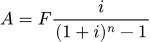
The sinking-fund factor (A/F) converts a future target amount F into the equal periodic deposits A required to accumulate it at rate i per period. The formula A = F × i / [(1 + i)^n − 1] is the inverse of the uniform-series compound-amount factor. Use it for any goal where you need to set aside money on a regular schedule — bond redemption reserves, equipment replacement funds, college tuition targets, and corporate debt sinking funds.
Example Problem
A municipality needs to accumulate $50,000 in 10 years to retire a bond issue. The reserve fund earns 10% per year, compounded annually. What equal deposit at the end of each year is required?
- Identify the known data points. Future target F = $50,000, periodic interest rate i = 0.10 per year, number of periods n = 10 years.
- Identify what we're solving for. We want the equal annual deposit A that accumulates to $50,000 by the end of year 10.
- Write the sinking-fund formula: A = F × i / [(1 + i)^n − 1].
- Substitute the known values: A = 50,000 × 0.10 / [(1.10)^10 − 1].
- Simplify the denominator: (1.10)^10 = 2.593742, so (1.10)^10 − 1 = 1.593742, giving A = 50,000 × 0.10 / 1.593742 = 5,000 / 1.593742.
- **Annual deposit A = $3,137.27 per year** for 10 years.
Total deposits over 10 years are $31,372.70; interest earned by the reserve is $18,627.30 — over a third of the target.
Key Concepts
A sinking fund is a savings plan designed to retire a debt or accumulate a known future amount through regular, equal deposits. The sinking-fund factor A/F depends only on rate and periods, so the same factor works for a $50,000 target and a $50,000,000 target at the same terms. The factor is small at long horizons and high rates — that's the power of compounding doing most of the work — and large at short horizons or low rates, where the deposits have to do more of the heavy lifting.
Applications
- Bond sinking fund reserves — municipalities and corporations save periodically to retire bonds at maturity
- Equipment replacement funds — set aside money each year for a future equipment purchase
- College tuition targets — parents save a fixed annual amount to reach a known future tuition cost
- Emergency reserve building — accumulate a six-month expense buffer through regular contributions
- Capital project reserves — accumulate funds for a future infrastructure replacement or major maintenance event
Common Mistakes
- Confusing sinking fund (A/F) with capital recovery (A/P) — sinking fund TARGETS a future amount; capital recovery starts from a present amount
- Mismatched compounding frequency — annual rate with monthly deposits is wrong; convert to a consistent period basis
- Entering interest rate as a percent — use 0.10 for 10%, not 10
- Forgetting that ordinary annuity deposits occur at end of period — the first deposit doesn't earn interest in period 1
- Assuming the deposit equals total target divided by periods — that ignores compound interest and overstates the required deposit
Frequently Asked Questions
How do you calculate a sinking fund deposit?
Use A = F × i / [(1 + i)^n − 1] where F is the future target, i is the periodic rate, and n is the number of periods. Example: to reach $50,000 in 10 years at 10%, the required annual deposit is A = 50,000 × 0.10 / 1.593742 = $3,137.27.
What is the formula for sinking fund factor?
The sinking-fund factor A/F = i / [(1 + i)^n − 1]. Multiply by the future target F to find the required equal periodic deposit A. It's the inverse of the uniform-series compound-amount factor F/A.
What is the difference between a sinking fund and capital recovery?
Sinking fund (A/F) converts a FUTURE target into equal deposits — you save A per period to reach F at maturity. Capital recovery (A/P) converts a PRESENT amount into equal payments — you start with P today and pay A per period. They use different formulas: A/F = i / [(1+i)^n − 1], A/P = i(1+i)^n / [(1+i)^n − 1].
Why is the deposit less than F divided by n?
Compound interest does part of the work. If you ignored interest, you would need $5,000 per year to reach $50,000 in 10 years. With 10% interest, you only need $3,137.27 — the earlier deposits compound and reduce the required contribution from each subsequent deposit.
Can I use this for monthly contributions?
Yes — convert the annual rate to a monthly rate (annual ÷ 12) and use the total number of months. To save $100,000 in 5 years at 6% APR with monthly deposits, use i = 0.005, n = 60, and you get A = $1,432.86 per month.
When are sinking funds required by law?
Some municipal and corporate bond indentures legally require a sinking fund — periodic deposits into a trustee-held account to retire portions of the bond before maturity. This reduces the issuer's repayment risk at maturity and gives bondholders an extra layer of protection.
Reference:
Lindeburg, Michael R. 1992. Engineer In Training Reference Manual. Professional Publication, Inc. 8th Edition.
Worked Examples
Equipment Replacement
What yearly deposit accumulates $100,000 in 8 years for equipment replacement at 5%?
- A = F × i / [(1 + i)^n − 1]
- A = 100,000 × 0.05 / [(1.05)^8 − 1]
- A = 100,000 × 0.05 / 0.4775
- A ≈ $10,472.18 per year
College Tuition Target
What monthly deposit reaches $80,000 in 15 years at 7% APR for college?
- Convert to monthly: i = 0.07 / 12 ≈ 0.005833, n = 180
- A = 80,000 × 0.005833 / [(1.005833)^180 − 1]
- A = 80,000 × 0.005833 / 1.8460
- A ≈ $252.74 per month
Bond Sinking Fund
What annual deposit retires a $1,000,000 bond in 20 years at 4%?
- A = F × i / [(1 + i)^n − 1]
- A = 1,000,000 × 0.04 / [(1.04)^20 − 1]
- A = 1,000,000 × 0.04 / 1.1911
- A ≈ $33,581.75 per year
Related Calculators
- Annuity Future Value Calculator — future value of equal periodic deposits (inverse of sinking fund)
- Capital Recovery Calculator — convert a present amount into equal annual payments
- Annuity Present Value Calculator — present value of equal periodic payments
- Future Value Calculator — F = P(1+i)^n compound growth of a single sum
- Present Value Calculator — P = F / (1+i)^n discounting of a future lump sum
- Compounding & Discount Factors (All-in-One) — all six engineering-economy equations in one switcher
- Interest Rate Calculator — simple and compound interest computations
Related Sites
- Hourly Salaries — Hourly wage to annual salary converter
- Dollars Per Hour — Weekly paycheck calculator with overtime
- LoanChop — Loan prepayment calculator
- Compare 2 Loans — Side-by-side loan comparison calculator
- Percent Error Calculator — Calculate percent error between experimental and theoretical values
- Temperature Tool — Temperature unit converter