How It Works
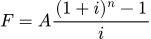
The uniform-series compound-amount factor (F/A) converts a stream of equal periodic deposits A into a single future value F. The formula F = A × [(1 + i)^n − 1] / i sums n equal payments, each compounded for the remaining periods at rate i. This is the ordinary-annuity future value — payments occur at the END of each period. Use it for retirement-savings projections, IRA accumulations, and any goal where you deposit a fixed amount on a regular schedule.
Example Problem
You deposit $1,000 at the end of every year for 10 years into an account earning 10% per year. What is the balance immediately after the tenth deposit?
- Identify the known data points. Periodic deposit A = $1,000 at the end of each year, periodic interest rate i = 0.10 per year, number of periods n = 10 years.
- Identify what we're solving for. We want the future value F — the account balance immediately after the tenth deposit.
- Write the uniform-series compound-amount formula: F = A × [(1 + i)^n − 1] / i.
- Substitute the known values: F = 1,000 × [(1.10)^10 − 1] / 0.10.
- Simplify the bracketed factor: (1.10)^10 = 2.593742, so [(1.10)^10 − 1] / i = 1.593742 / 0.10 = 15.93742.
- **Future value F = $15,937.42** at the end of year 10 (total deposits $10,000 plus $5,937.42 in compound interest).
Total deposits were 10 × 1,000 = 10,000; interest earned was 5,937.42 over the 10-year horizon.
Key Concepts
An ordinary annuity has level cash flows at the end of each period — the most common annuity convention in engineering economics. The factor F/A = [(1 + i)^n − 1] / i depends only on rate and periods, not the dollar amount, so doubling the deposit doubles the future value at the same terms. If deposits occur at the START of each period (annuity due), multiply the ordinary-annuity FV by (1 + i) for the additional period of compounding on each payment.
Applications
- Retirement savings projections — IRA, 401(k), or pension accumulations from regular contributions
- College savings plans (529) — periodic deposits compounding to a target tuition fund
- Sinking funds — accumulating money to retire a bond or replace equipment
- Goal-based saving — how much your emergency fund will be worth after N years of regular deposits
- Insurance premium reserves — how a stream of premium payments accumulates with investment income
Common Mistakes
- Assuming deposits compound from period 0 — the first deposit of an ordinary annuity earns no interest in period 1 (it's deposited at the end)
- Using an annual rate with monthly deposits — convert to a monthly rate and use total months
- Confusing ordinary annuity (end-of-period) with annuity due (start-of-period) — multiply by (1 + i) to convert
- Entering interest rate as a percent instead of a decimal — use 0.10 for 10%, not 10
- Forgetting that this gives the future value of deposits only — a starting lump sum needs a separate future-value compound calculation added on
Frequently Asked Questions
How do you calculate the future value of an annuity?
Use F = A × [(1 + i)^n − 1] / i where A is the periodic deposit, i is the periodic rate, and n is the number of deposits. Example: $1,000 per year at 10% for 10 years gives F = 1,000 × [(1.10)^10 − 1] / 0.10 = 1,000 × 15.937 = $15,937.42.
What is the formula for ordinary annuity future value?
F = A × [(1 + i)^n − 1] / i. The bracketed factor [(1 + i)^n − 1] / i is called the uniform-series compound-amount factor (F/A). Multiply it by the periodic deposit A to get the accumulated future value F.
What is the difference between ordinary annuity and annuity due?
Ordinary annuity payments occur at the END of each period; annuity-due payments occur at the START. Annuity due has one extra period of compounding on every payment, so its future value is (1 + i) × the ordinary-annuity value. Engineering economics defaults to ordinary annuity.
Can I use this for monthly retirement contributions?
Yes — convert the annual rate to a monthly rate (annual ÷ 12) and use the total number of months. Depositing $500 per month for 30 years at 7% annual gives i = 0.005833, n = 360, and F = $500 × 1,219.971 = $609,985.
How is annuity future value different from single-payment compound amount?
Single-payment compound amount F = P(1 + i)^n grows ONE lump sum over time. Annuity future value F = A × [(1 + i)^n − 1] / i grows a STREAM of equal deposits. If you start with a lump sum and also make periodic deposits, add the two future values together.
Why does the first deposit not compound for the full term?
In an ordinary annuity, the first deposit is made at the end of period 1 — so it compounds for n − 1 periods, not n. The last deposit is made at the end of period n and earns no compounding before the final balance is measured. The formula already accounts for this.
Reference:
Lindeburg, Michael R. 1992. Engineer In Training Reference Manual. Professional Publication, Inc. 8th Edition.
Worked Examples
401(k) Retirement
What is the future value of $500 per month for 30 years at 7% annual interest?
- Convert to monthly: i = 0.07 / 12 ≈ 0.005833, n = 360
- F = A × [(1 + i)^n − 1] / i
- F = 500 × [(1.005833)^360 − 1] / 0.005833
- F ≈ $609,985
College Fund
If you deposit $3,000 per year for 18 years at 6%, what will the college fund be worth?
- F = A × [(1 + i)^n − 1] / i
- F = 3,000 × [(1.06)^18 − 1] / 0.06
- F = 3,000 × [2.8543 − 1] / 0.06
- F ≈ $92,713
Reverse: Required Deposit
What annual deposit accumulates to $1,000,000 in 25 years at 8%?
- A = F × i / [(1 + i)^n − 1]
- A = 1,000,000 × 0.08 / [(1.08)^25 − 1]
- A = 1,000,000 × 0.08 / 5.8485
- A ≈ $13,678.78 per year
Related Calculators
- Sinking Fund Calculator — find the periodic deposit needed to reach a future target
- Annuity Present Value Calculator — present value of equal periodic payments
- Capital Recovery Calculator — convert a present amount into equal annual payments
- Future Value Calculator — F = P(1+i)^n for a single lump-sum deposit
- Present Value Calculator — discount a future lump sum to its present-day equivalent
- Compounding & Discount Factors (All-in-One) — all six engineering-economy equations in one switcher
- Rule of 72 Calculator — quick estimate of doubling time
Related Sites
- Dollars Per Hour — Weekly paycheck calculator with overtime
- Hourly Salaries — Hourly wage to annual salary converter
- Compare 2 Loans — Side-by-side loan comparison calculator
- LoanChop — Loan prepayment calculator
- OptionsMath — Options trading profit and loss calculators
- Z-Score Calculator — Z-score, percentile, and probability calculator