
Calculate Spherical Segment Volume
Use this form when both circle radii (top a, bottom b) and the perpendicular distance between the planes (h) are known. The formula is closed-form in (a, b, h) — it does NOT require the full sphere radius R.
V = (π h / 6)(3a² + 3b² + h²)
Calculate Lateral (Zonal) Surface Area
Use this form for the curved zonal band only — the side of the segment, excluding the two flat disks. The sphere radius R is derived internally from (a, b, h), then S_lat = 2π R h.
S_lat = 2π R h
Calculate Total Surface Area
Use this form when the lateral band AND both flat circular disks are part of the enclosing surface — e.g., a closed-off slice of a spherical tank or a dome with a circular skylight cut into it.
S = 2π R h + π a² + π b²
Calculate Sphere Radius from Segment Dimensions
Use this form to back out the full sphere radius from the two circle radii (a, b) and the segment height h. Useful when measuring a slice of a sphere and you need the radius of the parent sphere.
R = √(a² + z₂²), z₂ = ((b² − a²)/h + h)/2
How It Works
A spherical segment is the region of a sphere between two parallel planes — it generalises the spherical cap (which has only one plane plus an apex). It is fully characterised by the two cross-section radii (a on the upper plane, b on the lower plane) and the perpendicular distance h between the planes. From those three numbers the full sphere radius R is determined by z₂ = ((b² − a²)/h + h)/2 and R² = a² + z₂². Volume is the closed-form V = (π h / 6)(3a² + 3b² + h²) — it does not require R. The lateral (zonal) surface area is S_lat = 2π R h, and the total surface area adds the two flat disks: S = 2π R h + π a² + π b².
Example Problem
A spherical tank of unknown radius is sliced by two parallel cuts. The smaller cross-section has radius a = 3 m, the larger has radius b = 4 m, and the perpendicular distance between the two cuts is h = 1 m. Find the segment volume, the sphere radius, and the curved (lateral) and total surface areas.
- Knowns: a = 3 m, b = 4 m, h = 1 m.
- Locate the planes relative to the sphere center: z₂ = ((b² − a²)/h + h)/2 = ((16 − 9)/1 + 1)/2 = (7 + 1)/2 = 4 m above the center; z₁ = z₂ − h = 3 m above the center.
- Sphere radius: R² = a² + z₂² = 9 + 16 = 25 ⇒ R = 5 m (exact — this is a Pythagorean configuration).
- Volume (closed-form in a, b, h): V = (π h / 6)(3a² + 3b² + h²) = (π / 6)(27 + 48 + 1) = 76π / 6 = 38π / 3 ≈ 39.7935 m³.
- Lateral (zonal) surface area: S_lat = 2π R h = 2π · 5 · 1 = 10π ≈ 31.4159 m².
- Flat disks: top π a² = 9π ≈ 28.27 m², bottom π b² = 16π ≈ 50.27 m².
- Total surface area: S = S_lat + π a² + π b² = 10π + 9π + 16π = 35π ≈ 109.96 m². Sanity check using R: R² confirms both a² + z₂² = 25 and b² + z₁² = 25. ✓
The volume formula V = (π h / 6)(3a² + 3b² + h²) does not contain R — it is closed-form in the three measurable inputs. R is only needed for the curved (zonal) surface area, and it is fully determined by (a, b, h).
When to Use Each Variable
- Solve for Volume — when both cross-section radii (a, b) and the segment height (h) are known and you need the contents of the slice — partial fill of a spherical tank between two depth markers, dome with a circular skylight removed.
- Solve for Lateral Area — when you need the curved zonal band only (no flat tops or bottoms) — paint or coating for the side of a dome slice.
- Solve for Total Surface Area — when the curved zonal band AND both flat disks matter — closed enclosure that is a slice of a sphere, dome with a circular hole giving an upper rim plus a lower floor.
- Solve for Sphere Radius — when you measured a, b, h on a real spherical object and need the parent sphere's radius — reverse-engineering a planetary cap profile or a dome's underlying sphere.
Key Concepts
A spherical segment generalises the spherical cap: a cap has one cutting plane and an apex (h goes from plane to the pole), while a segment has TWO parallel planes and no apex (h is the distance between them). If you let one of the segment's radii go to zero, the segment degenerates into a spherical cap — the missing circle collapses to the cap's apex. The zonal (lateral) surface area is famously simple — S_lat = 2π R h depends only on R and h, NOT on the position of the band along the sphere. This is Archimedes' hat-box theorem: two equal-width parallel slices of a sphere have equal curved surface area regardless of where they are cut. The volume formula V = (π h / 6)(3a² + 3b² + h²), in contrast, does depend on both radii — equal-height bands at the equator hold more than bands near the pole.
Applications
- Spherical tanks and pressure vessels: liquid volume between two measured depths in a spherical storage tank
- Architecture and dome design: dome roof with a circular skylight cut out (the segment volume is the enclosed air space; total surface area is paint + glazing area)
- Optics: zonal sections of spherical mirrors and lenses, light-cone solid angles modeled as spherical zones
- Planetary geology: caldera, crater rim, or polar ice cap modeled as a slice of a sphere when the apex is missing or unknown
- Marine engineering: ballast volume in a partially flooded spherical buoy between two waterline marks
Common Mistakes
- Confusing a spherical segment with a spherical cap — a cap has ONE plane and a pointy apex; a segment has TWO planes and is a band with two flat disks. If your slice has an apex, use the spherical cap calculator.
- Forgetting that R is derived — you do not need to know the sphere's radius in advance. The three input radii (a, b, h) fully determine R via z₂ = ((b² − a²)/h + h)/2 and R² = a² + z₂².
- Using V = (π h² / 3)(3R − h) (the cap formula) for a segment with two parallel cuts — that formula assumes the apex is included. For a segment, use V = (π h / 6)(3a² + 3b² + h²) instead.
- Forgetting whether to add the two flat disks when computing surface area — open zonal bands use just S_lat = 2π R h, closed (capped) bands use S = 2π R h + π a² + π b².
- Trying to invert h or one of the radii from the volume — these inversions are cubic or quartic and not provided. Solve for any missing radius by measurement instead.
Frequently Asked Questions
How do you calculate the volume of a spherical segment?
Use V = (π h / 6)(3a² + 3b² + h²), where a is the radius of the smaller (upper) circular cross-section, b is the radius of the larger (lower) cross-section, and h is the perpendicular distance between the two parallel planes. For a = 3 m, b = 4 m, h = 1 m, V = (π/6)(27 + 48 + 1) = 76π/6 = 38π/3 ≈ 39.79 m³. The full sphere radius is not required.
What is the formula for the surface area of a spherical segment?
The lateral (zonal) surface area is S_lat = 2π R h, where R is the parent sphere radius derived from (a, b, h). If both flat circular disks are also part of the surface, add them to get total S = 2π R h + π a² + π b². For a = 3, b = 4, h = 1: R = 5, S_lat = 10π ≈ 31.42, S = 35π ≈ 109.96.
What is the difference between a spherical segment and a spherical cap?
A spherical cap has ONE cutting plane and an apex — it is a dome ending in a point. A spherical segment has TWO parallel cutting planes and no apex — it is a band sliced between two depths of the sphere. The cap is the special case of the segment where one of the circle radii is zero (the missing circle has collapsed to the apex).
How do you find the sphere radius from a spherical segment?
Compute z₂ = ((b² − a²)/h + h)/2 (the signed height of the upper plane above the sphere center). Then R = √(a² + z₂²). Equivalently R = √(b² + z₁²) where z₁ = z₂ − h. The two formulas must agree — that is the geometric consistency check.
What is the zonal area of a sphere?
The zonal area is the curved surface of a spherical segment — the curved band between two parallel planes, excluding the flat circular disks. It equals S_lat = 2π R h, which depends only on the sphere radius R and the band height h. This is Archimedes' hat-box theorem: equal-height bands have equal zonal area no matter where they are cut.
Does the spherical segment volume formula require the sphere radius?
No. V = (π h / 6)(3a² + 3b² + h²) is closed-form in just (a, b, h) — the three quantities you can measure directly on the segment. The sphere radius R is only needed for the curved (lateral) surface area, and the calculator derives it for you.
Can a and b be equal?
Yes. When a = b, the two cutting planes are equidistant from the sphere center (z₁ = −z₂ = −h/2). This is a symmetric segment — a barrel-like band centered on the equator if h is small. The formulas all degenerate cleanly; nothing special is required.
What units does the spherical segment calculator use?
Pick any length unit for a, b, and h (the unit selectors let you mix meters, feet, inches, etc. — values are converted to a canonical unit internally before computing). Volume is reported in your chosen volume unit (cubic meters, liters, gallons, cubic feet, etc.). Surface areas are returned in the canonical square-meter unit; the result table converts to your preferred unit.
Reference:
Weisstein, Eric W. "Spherical Segment." MathWorld — A Wolfram Web Resource. https://mathworld.wolfram.com/SphericalSegment.html
Worked Examples
Partial Tank Fill Between Depth Marks
How much liquid sits between two depth marks in a spherical tank?
A spherical tank is filled past one depth mark to a second, higher depth mark. The wetted upper surface forms a circle of radius a = 3 m; the wetted lower surface forms a circle of radius b = 4 m; the vertical distance between the two marks is h = 1 m. Find the volume of liquid between the two marks.
- Knowns: a = 3 m (upper circle), b = 4 m (lower circle), h = 1 m.
- Formula: V = (π h / 6)(3a² + 3b² + h²)
- V = (π / 6)(27 + 48 + 1) = 76π / 6 = 38π / 3 ≈ 39.79 m³
- Equivalently, the sphere has radius R = √(a² + z₂²) = √(9 + 16) = 5 m.
Volume between the marks ≈ 39.79 m³ (about 10,510 US gallons)
The volume formula does not need R — you can solve the segment without knowing the tank's radius in advance. R is only needed if you also want the curved surface area.
Dome with Skylight
How much paint covers the curved band of a dome with a circular skylight?
A dome sits on a circular base of radius b = 6 m. A circular skylight of radius a = 2 m is cut into the top. The vertical distance from the skylight rim down to the base is h = 3 m. Compute the lateral (curved) area for paint estimates.
- Knowns: a = 2 m, b = 6 m, h = 3 m.
- Solve for sphere radius: z₂ = ((36 − 4)/3 + 3)/2 = (32/3 + 3)/2 = (41/3)/2 ≈ 6.833 m
- R = √(a² + z₂²) = √(4 + 46.694) ≈ √50.694 ≈ 7.120 m
- Lateral surface area: S_lat = 2π R h = 2π · 7.120 · 3 ≈ 134.18 m²
Lateral (curved band) surface area ≈ 134.18 m²
The skylight and the floor disk are NOT included in S_lat. Add π a² + π b² if you also need to clad the rim and floor.
Polar Ice Cap Zone
What is the sphere radius implied by a measured polar zone on a planet?
A polar zone on a planet has been mapped with a southern circular boundary at latitude radius a = 1,500 km and a northern boundary at b = 800 km, with a perpendicular separation between the two parallel boundary planes of h = 400 km. Estimate the planetary radius.
- Knowns: a = 1500 km, b = 800 km, h = 400 km.
- z₂ = ((800² − 1500²) / 400 + 400) / 2 = ((640000 − 2250000) / 400 + 400) / 2
- z₂ = (−4025 + 400) / 2 = −1812.5 km (negative ⇒ upper plane is BELOW the equator)
- R = √(a² + z₂²) = √(1500² + 1812.5²) = √(2,250,000 + 3,285,156.25) ≈ √5,535,156 ≈ 2,352.7 km
Implied sphere radius ≈ 2,353 km
A negative z₂ simply means the smaller circle is below the equator — the math works the same way and R² = a² + z₂² is still positive.
Spherical Segment Formulas
A spherical segment is the region of a sphere between two parallel planes. It is fully characterised by the upper-circle radius a, lower-circle radius b, and the perpendicular distance h between the two planes. The full sphere radius R is determined by those three inputs.
V = (π h / 6)(3a² + 3b² + h²)Volume equals pi h over six times the quantity three a squared plus three b squared plus h squared
S_lat = 2π R hLateral surface area equals two pi R h

S = 2π R h + π a² + π b²Total surface area equals two pi R h plus pi a squared plus pi b squared

R = √(a² + z₂²), z₂ = ((b² − a²)/h + h)/2Sphere radius equals the square root of a squared plus z two squared, where z two equals one half times the quantity b squared minus a squared over h plus h

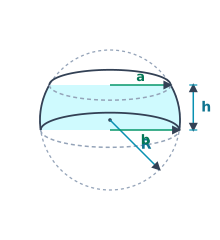
Where:
- V — volume of the spherical segment (the band between the two planes)
- S_lat — lateral (zonal) curved surface area, excluding both flat disks
- S — total surface area: lateral band plus both flat disks
- R — full sphere radius (derived from a, b, h — not an independent input)
- a — radius of the upper circular cross-section
- b — radius of the lower circular cross-section
- h — perpendicular distance between the two parallel cutting planes
- z₂ — signed height of the upper plane above the sphere's center (negative if the upper plane is below the center)
Related Calculators
- Spherical Cap Calculator — the segment's special case when one circle collapses to an apex
- Sphere Calculator — volume and surface area of the full sphere
- Hemisphere Calculator — the half-sphere case
- Circle Calculator — geometry of the flat top and bottom disks
- Volume Converter — switch between m³, L, gallons, ft³
Related Sites
- Temperature Tool — Temperature unit converter
- Z-Score Calculator — Z-score, percentile, and probability calculator
- OptionsMath — Options trading profit and loss calculators
- Medical Equations — Hemodynamic, pulmonary, and dosing calculators
- Dollars Per Hour — Weekly paycheck calculator with overtime
- Percent Off Calculator — Discount and sale price calculator