Sphere Calculator
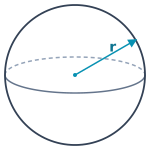
Volume equals four-thirds pi r cubed
Use this form when the radius of a sphere is known and you need the enclosed volume — sizing a ball, a pressurized tank, a fuel droplet, or any spherical container.
V = (4/3) π r³
Use this form when you need the surface area of a sphere — painting and coating estimates, heat-transfer area for a ball-shaped object, or any sphere-area lookup.
S = 4π r²
Use this rearrangement when a target volume is known and you need the sphere's radius — for example to size a spherical tank from a target capacity.
r = ∛(3V / (4π))
This sphere calculator uses V = (4/3) π r³ for volume, S = 4π r² for surface area, and the cube-root rearrangement r = ∛(3V/(4π)) for the inverse solve. Pick the unknown with the solve-for toggle, enter the remaining value in any supported length or volume unit, and the calculator converts to SI internally before computing all related quantities — diameter d = 2r and great-circle circumference C = 2πr — so you can size spherical tanks, balls, droplets, and any one-radius geometry from a single page.
A spherical pressure vessel has an inner radius of 5 m. What volume does it hold, and what is its surface area?
523.6 m³ is about 138,000 US gallons — the size of a small water-tower-class spherical tank. Spherical pressure vessels are common when you need an even stress distribution across the wall.
A sphere is the set of points equidistant from a single center — fully determined by a single number, the radius r. Every other property follows from r: volume V scales with r³, surface area S scales with r², diameter d = 2r, and the great-circle circumference C = 2πr. The cube-vs-square scaling matters: doubling the radius multiplies the volume by 8 but only multiplies the surface area by 4. This is why small droplets dry faster than large ones (they have proportionally more surface) and large planets retain heat longer than small ones (they have proportionally less surface).
Use V = (4/3) π r³. Cube the radius, multiply by π, and multiply by 4/3. For example a sphere with r = 5 m has V = (4/3) · π · 125 = 500π/3 ≈ 523.6 m³.
S = 4π r². Square the radius and multiply by 4π. For a sphere with r = 5 m, S = 4 · π · 25 = 100π ≈ 314.16 m². Note this is exactly four times the great-circle area π r².
Rearrange V = (4/3) π r³ to r = ∛(3V/(4π)). For example a 523.6 m³ sphere has r = ∛(3 · 523.6 / (4π)) = ∛125 = 5 m. The cube root undoes the cubing in the volume formula.
Diameter is twice the radius: d = 2 r. Most real-world specifications quote diameter (a 250 mm ball, a 12-inch globe), but the volume and surface-area formulas use radius, so divide diameter by two before plugging in.
A great circle is any circle on the sphere whose center coincides with the sphere's center — the largest possible circle that can be drawn on the surface. Its circumference is 2π r, and its enclosed area (the great-circle area, not the spherical cap area) is π r². The equator of the Earth is a great circle.
Volume scales with the cube of the radius, so doubling r multiplies V by 8. Surface area scales with the square, so doubling r multiplies S by 4. This cube-versus-square scaling is why a giant ball has dramatically more interior than a small ball of the same density, but only proportionally more surface to lose heat through.
Not directly. A hemisphere is half the volume — V_hemi = (2/3) π r³ — and its surface area includes both the curved half (2π r²) and the flat circular base (π r²). A spherical shell (hollow sphere wall) is the difference between two solid spheres: V_shell = (4/3) π (R³ − r³).
Compute the volume in m³ using V = (4/3) π r³ and convert: 1 m³ ≈ 264.17 US gallons. The calculator's ResultTable shows the volume in liters, gallons, cubic feet, and other units automatically — just pick the desired unit from the table.
Reference:
Weisstein, Eric W. "Sphere." MathWorld — A Wolfram Web Resource. https://mathworld.wolfram.com/Sphere.html
Pressure Vessel Sizing
A spherical LNG storage tank has an inner radius of 5 m. Use V = (4/3) π r³ to find its capacity in cubic meters and liters.
Volume ≈ 523.6 m³ ≈ 523,598 liters
Spherical vessels distribute internal pressure evenly across the wall, which is why high-pressure gas storage often uses sphere geometry.
Surface Coating
A municipal water tower built as a sphere has an outer radius of 10 m. The exterior surface area determines how much paint is needed for a single coat.
Surface area ≈ 1,256.6 m² (~13,527 ft²)
Real-world coverage depends on paint type, surface roughness, and number of coats — always check the manufacturer's spread rate.
Inverse Solve
A specialty chemical tank must hold 1,000 L (1.0 m³). Use the inverse formula r = ∛(3V/(4π)) to find the required inner radius.
Radius ≈ 0.620 m → diameter ≈ 1.24 m
A spherical tank for 1,000 L is about 1.24 m across — surprisingly large because volume scales with r³. Cylindrical tanks of the same capacity have smaller external footprints.
All sphere properties follow from a single dimension: the radius r. Volume, surface area, diameter, and great-circle circumference all derive from it:
Where:


