Cylinder Calculator
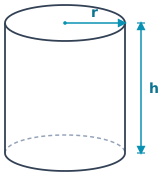
Volume equals pi times radius squared times height
Use this form when you know the base radius and height of a right circular cylinder and need the enclosed volume. It is the standard formula for sizing tanks, pipes, columns, and any cylindrical container.
V = π r² h
Use this form when you need the area of the curved side plus both circular ends. Common for painting, coating, insulation, and material-takeoff estimates on closed cylinders.
S = 2π r (r + h)
Use this form when only the curved side matters — labels, wraps, banded insulation, the painted side of a tank that already has separate end-cap calculations.
L = 2π r h
Use this rearrangement when you know the required volume and a fixed height, and need the base radius. Common when sizing a tank to fit a vertical space.
r = √(V / (π h))
Use this rearrangement when the base radius is fixed by the diameter of available stock or footprint, and you need the height that gives a target volume.
h = V / (π r²)
This cylinder calculator uses V = π r² h plus the surface-area pair S = 2π r (r + h) and L = 2π r h to solve for any of volume, total surface area, lateral surface area, radius, or height. Pick the unknown with the solve-for toggle, enter the remaining two values with any supported length, area, or volume units, and the calculator converts to SI internally before computing all related quantities — including diameter d = 2r and base circumference C = 2π r — so you can size tanks, pipes, columns, paint coverage, and label wraps from a single page.
A cylindrical water tank has an inner radius of 5 m and a height of 10 m. What volume does it hold?
Round trip check: from V ≈ 785.398 m³ and h = 10 m, the inverse formula r = √(V / (π h)) recovers r = 5 m, which confirms the forward calculation.
A right circular cylinder is the solid formed by rotating a rectangle around one of its sides — equivalently, two parallel circular bases joined by a perpendicular curved surface. The geometry is fully determined by two numbers: the base radius r and the height h. Every other property — volume, surface area, diameter, base circumference — follows from those two. Lateral surface area is the curved side alone, and total surface area adds the two circular end caps. Because the cap area scales with r² while the lateral area scales with r·h, tall slender cylinders are dominated by lateral area, and short squat ones by their caps.
Use V = π r² h. Square the base radius, multiply by the height, then multiply by π. For example, a cylinder with r = 5 m and h = 10 m has V = π · 25 · 10 ≈ 785.4 m³.
Total surface area is S = 2π r (r + h), which expands to 2π r² + 2π r h — the two circular end caps plus the curved side. Lateral surface area (the curved side only) is L = 2π r h.
Lateral surface area is just the curved side — the part that would unroll into a rectangle of width 2π r and height h. Total surface area adds the two circular end caps, each with area π r², so it is 2π r² greater than the lateral value.
Rearrange V = π r² h to r = √(V / (π h)). For example, a 785.4 m³ tank that is 10 m tall has r = √(785.4 / (π · 10)) = √25 = 5 m.
Rearrange V = π r² h to h = V / (π r²). For a 785.4 m³ tank with r = 5 m, the height is 785.4 / (π · 25) = 10 m.
Diameter is twice the radius: d = 2 r. Real-world specs (pipes, drums, tanks) usually quote diameter, but the volume and surface-area formulas use radius, so divide diameter by two before plugging in.
One cubic meter is 1,000 liters or about 264.17 US gallons. The calculator handles the conversion automatically — pick liters or gallons from the volume unit dropdown to read the answer in your preferred unit.
Not directly. A hollow cylinder (a pipe wall) has both an outer radius R and an inner radius r, and its volume is π (R² − r²) h. Use this calculator for the solid-cylinder versions of volume and surface area; for a tube, compute the outer cylinder and inner cylinder separately and subtract.
Reference:
Weisstein, Eric W. "Cylinder." MathWorld — A Wolfram Web Resource. https://mathworld.wolfram.com/Cylinder.html
Tank Sizing
A municipal storage tank has an inner radius of 5 m and inner height of 10 m. Use V = π r² h to find its capacity in cubic meters and liters.
Volume ≈ 785.4 m³ ≈ 785,398 liters
For pressure-test fill or chemical dosing, use the inside dimensions. For paint or insulation, use the outside dimensions instead.
Coatings and Wraps
A structural column has an outside diameter of 0.6 m (radius 0.3 m) and a height of 4 m. The total exterior including end caps is the total surface area S = 2π r (r + h).
Total surface area ≈ 8.10 m²; lateral only ≈ 7.54 m²
If both end caps are welded to other structure and don't need paint, use the lateral area instead of the total surface area.
Inverse Solve
A pharmaceutical tank must hold 100 L (0.1 m³). The vessel diameter is fixed by available stock at 0.4 m (r = 0.2 m). Find the required inside height with h = V / (π r²).
Height ≈ 0.796 m (about 79.6 cm)
Real tanks need freeboard above the working volume — add 5–10 % to the calculated height for headspace and a vent allowance.
All cylinder properties are determined by two dimensions: the base radius r and the height h. From those, the volume, two surface areas, diameter, and base circumference all follow:
Where:




