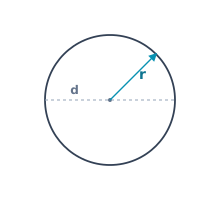
Diameter from Radius
The diameter of a circle is simply twice the radius.
d = 2r
Circumference from Radius
The circumference is the total distance around the circle.
C = 2πr
Circumference from Diameter
An equivalent formula using the diameter directly.
C = πd
Circumference from Area
Derives the circumference directly from the area.
C = 2√(πA)
Area from Radius
The most common circle area formula.
A = πr²
Area from Diameter
Calculates the area using the diameter.
A = (π/4)d²
Area from Circumference
Derives the area directly from the circumference.
A = C² / (4π)
How It Works
A circle is defined by a single measurement — its radius. From the radius you can derive every other property: the diameter is twice the radius, the circumference is 2πr, and the area is πr². This calculator lets you work backwards from any known value to find the others.
Example Problem
A circle has a radius of 5. Find its area, circumference, and diameter.
- Start with the radius r = 5.
- Area = π × 5² = 25π ≈ 78.5398 square units.
- Circumference = 2π × 5 = 10π ≈ 31.4159 units.
- Diameter = 2 × 5 = 10 units.
Verify: circumference from area = 2√(π × 78.5398) ≈ 31.4159
When to Use Each Variable
- Solve for Area — when you know the radius or diameter and need the size of a circular floor, label, lid, or opening.
- Solve for Circumference — when you need the distance around a wheel, pipe, fountain, tank, or circular path.
- Solve for Radius — when the diameter is easier to measure in the field but the formula you need uses radius.
Key Concepts
A circle is uniquely defined by a single measurement — its radius. Every other property (diameter, circumference, area) derives from the radius through π. The circumference-to-diameter ratio is the constant π ≈ 3.14159. This calculator lets you work forwards from radius or backwards from any known property to find all the others.
Applications
- Construction: calculating material needed for circular foundations, columns, and decorative features
- Manufacturing: determining the area of circular blanks for stamping, cutting, or machining operations
- Landscaping: computing the area and perimeter fencing for circular garden beds and pools
- Packaging: sizing lids, labels, and wraps for cylindrical containers
Common Mistakes
- Confusing radius and diameter — remember d = 2r; using one when the formula expects the other doubles or halves the result
- Forgetting to square the radius in the area formula — A = πr², not πr
- Using 3.14 instead of a full-precision π — for large circles the rounding error becomes significant
- Mixing circumference and area units — circumference is in linear units (m), area is in square units (m²)
Frequently Asked Questions
How do you find the area of a circle from its diameter?
Use A = (π/4)d². For a diameter of 10, the area is (π/4)×100 ≈ 78.54 square units.
How do you calculate circumference from the area?
Use C = 2√(πA). For an area of 78.54, the circumference is 2√(π×78.54) ≈ 31.42.
What is the relationship between circumference and diameter?
Circumference equals π times the diameter: C = πd. Dividing any circle’s circumference by its diameter always gives π ≈ 3.14159.
What is the difference between radius and diameter?
The radius is the distance from the center to the edge. The diameter is the distance across the circle through its center — exactly twice the radius.
What is the formula for the area of a circle?
The standard circle-area formula is A = πr². Square the radius first, then multiply by π. If the radius is 7, the area is π × 49 ≈ 153.94 square units.
How do you find radius from circumference?
Use r = C / (2π). For a circumference of 50, the radius is 50 / (2π) ≈ 7.96 units.
Can you find circle area from circumference?
Yes. Use A = C² / (4π). This is useful when you can wrap a tape around the circle but cannot measure the radius directly.
Reference: Reference: Circle geometry identities derived from Euclidean geometry and standard engineering mathematics handbooks.
Circle Formulas
A circle is fully defined by one measurement. Once you know radius, diameter, circumference, or area, you can move between them with these standard formulas:
Diameter and Radius
d = 2r
r = d / 2
Circumference
C = 2πr
C = πd
Area
A = πr²
A = (π / 4)d²
Converting Between C and A
A = C² / (4π)
C = 2√(πA)
Worked Examples
Landscaping
What is the area of a circular patio with a 12 ft radius?
- Use the area formula A = πr².
- A = π × 12² = π × 144.
- A ≈ 452.39 square feet.
Track Design
What circumference do you get from a 30 m diameter fountain?
- Use C = πd.
- C = π × 30.
- C ≈ 94.25 meters around the edge.
Reverse Calculation
A round label has circumference 50 cm. What is its area?
- Use A = C² / (4π).
- A = 50² / (4π) = 2500 / (4π).
- A ≈ 198.94 square centimeters.
Related Calculators
- Circle Sector Calculator — Calculate sector area from radius and central angle.
- Circle Arc Length Calculator — Find the arc length for a given radius and angle.
- Circle Segment Calculator — Compute chord length, segment height, and segment area.
- Geometric Formulas Calculator — Area and volume for 11 shapes including spheres and cylinders.
- Area Converter — Convert between square meters, square feet, acres, and other area units.
Related Sites
- Z-Score Calculator — Z-score to probability and percentile calculator
- Percent Error Calculator — Calculate measurement accuracy and percent error
- CameraDOF — Depth of field calculator for photographers
- Percent Off Calculator — Discount and sale price calculator
- InfantChart — Baby and child growth percentile charts
- Dollars Per Hour — Weekly paycheck calculator with overtime