Circle Sector Calculator
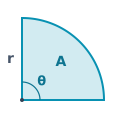
Area equals one half times radius squared times theta
The sector area equals one-half times the radius squared times the central angle in radians.
A = ½r²θ
Determines the radius needed to produce a given sector area at a known central angle.
r = √(2A / θ)
Finds the central angle that produces a given sector area with a known radius.
θ = 2A / r²
A sector is a "pie slice" of a circle bounded by two radii and the arc between them. The sector area formula A = ½r²θ uses the central angle in radians. If you know the angle in degrees, the calculator converts it automatically.
A sector has a radius of 10 cm and a central angle of 90°. Find the sector area.
A 90° sector is exactly one-quarter of the circle, so its area is πr²/4.
A sector is the region bounded by two radii and the arc between them — like a slice of pie. Its area is proportional to the central angle: A = ½r²θ (radians) or A = (θ/360)πr² (degrees). The sector area is always a fraction of the full circle area πr², where the fraction equals the central angle divided by a full revolution.
Use the formula A = ½r²θ, where r is the radius and θ is the central angle in radians. If the angle is in degrees, use A = (θ/360)πr². For a 10 cm radius and 90° angle, the sector area is (π × 100 × 90)/360 ≈ 78.54 cm².
The sector area formula is A = ½r²θ (with θ in radians) or A = πr²θ/360 (with θ in degrees). Both give the same result. The formula derives from the fact that a sector's area is proportional to its central angle.
Measure the radius of the pizza (half the diameter) and the angle of the slice. A pizza cut into 8 equal slices has 45° per slice. Then use A = πr²θ/360. For a 14-inch (35.6 cm) pizza with 8 slices: A = π × 17.8² × 45/360 ≈ 124.7 cm² per slice.
A sector is a 'pie slice' bounded by two radii and the arc between them. A segment is the region between a chord and the arc it cuts off. The segment area equals the sector area minus the triangle formed by the two radii and chord. Sectors always include the center point; segments never do.
A 60-degree sector is 60/360 = 1/6 of the full circle. Its area is one-sixth of πr². Similarly, a 90° sector is 1/4, a 120° sector is 1/3, and a 180° sector (semicircle) is 1/2.
Multiply the degree measure by π/180. For example, 90° × π/180 = π/2 ≈ 1.5708 radians. Common conversions: 30° = π/6, 45° = π/4, 60° = π/3, 90° = π/2, 180° = π, 360° = 2π.
No. The maximum sector area equals the full circle area πr² when the central angle is 360° (2π radians). Any sector with a smaller angle will have a proportionally smaller area. Angles greater than 360° are not standard for sectors.
The sector area formula calculates the area of a “pie slice” bounded by two radii and the arc between them:
Where:
The sector area is proportional to the central angle. A full circle (θ = 2π) gives A = πr². A semicircle (θ = π) gives half that area.
Land Surveying
A surveyor measures a wedge-shaped property plot radiating from a central point. The lot spans 72° with boundaries 50 m long.
A ≈ 1,570.8 m²
This equals about 0.157 hectares or 0.388 acres. The sector formula is standard in cadastral surveying for radial subdivisions.
Sprinkler Design
A rotating sprinkler head covers a sector with an 8 m throw radius and 120° sweep angle. What area gets watered?
A ≈ 67.02 m²
Landscape designers use sector area to ensure full coverage with minimal overlap between adjacent sprinkler heads.
Data Visualization
A pie chart is drawn with a 6 cm radius. A category representing 25% of the data occupies a 90° sector. What area does the slice cover?
A ≈ 28.27 cm²
This is exactly one-quarter of the full circle area (π × 36 ≈ 113.1 cm²), confirming the proportional relationship.
