Chord Length
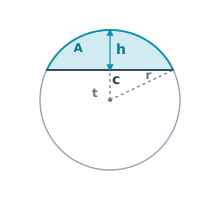
The chord length depends on the circle radius and the perpendicular distance from the center to the chord midpoint.
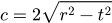
c = 2√(r² − t²)
Segment Area
The segment area formula uses the inverse cosine function to account for the curved boundary.
A = r² arccos((r−h)/r) − (r−h)√(2rh − h²)
Segment Height (Sagitta)
The segment height (sagitta) is the perpendicular distance from the chord midpoint to the arc.
h = r − t
How It Works
A circle segment is the region between a chord and the arc it subtends. Three key measurements describe a segment: the chord length (c), the segment height or sagitta (h), and the distance from the center to the chord midpoint (t). These are related to the circle’s radius by simple geometric formulas.
Example Problem
A circle has radius 10 and the perpendicular distance from the center to a chord is 6. Find the chord length and segment height.
- Start with radius r = 10 and center-to-chord distance t = 6.
- Chord length: c = 2√(10² − 6²) = 2√64 = 16.
- Segment height: h = r − t = 10 − 6 = 4.
- Using r = 10 and h = 4 in the area formula gives about 44.73 square units.
When to Use Each Variable
- Solve for Chord Length — when you know the circle radius and the perpendicular distance from center to chord, e.g., measuring the width of a circular window cutout.
- Solve for Segment Area — when you know the radius and segment height, e.g., calculating the cross-sectional area of liquid in a partially filled horizontal tank.
- Solve for Segment Height — when you know the radius and center-to-chord distance, e.g., finding the depth of a circular arch above its chord.
Key Concepts
A circle segment is the region between a chord and the arc it subtends. Three key measurements define a segment: the chord length (c), the sagitta or segment height (h), and the apothem distance from center to chord midpoint (t). These are related by h = r - t and c = 2√(r² - t²). The segment area involves an inverse cosine because the curved boundary is not a straight line.
Applications
- Tank gauging: calculating the volume of liquid in a horizontal cylindrical tank from the fluid depth
- Construction: determining the area of arched openings and bridge segments
- Optics: computing the area of lens cross-sections for light-gathering calculations
- Mechanical engineering: calculating the cross-sectional area of partially filled pipes for flow estimation
Common Mistakes
- Confusing segment height (sagitta) with the distance from center to chord — they are complementary: h + t = r
- Using the segment area formula for a semicircle when ½πr² is simpler and exact
- Mixing up segment and sector — a sector is bounded by two radii and an arc, while a segment is bounded by a chord and an arc
Frequently Asked Questions
What is the difference between a circle segment and a sector?
A sector is a "pie slice" bounded by two radii and an arc. A segment is the region between a chord and the arc. The segment area equals the sector area minus the triangular area formed by the two radii and the chord.
What is the sagitta of a circle segment?
The sagitta (segment height, h) is the perpendicular distance from the midpoint of the chord to the arc. It equals the radius minus the distance from the center to the chord midpoint: h = r − t.
How do you find the chord length if you know the radius and sagitta?
First calculate t = r − h (the center-to-chord distance). Then apply c = 2√(r² − t²). For r = 10 and h = 3, t = 7, and c = 2√(100 − 49) = 2√51 ≈ 14.28.
Can the segment area formula be solved for radius?
The segment area formula involves both r² and arccos, making it transcendental — there is no closed-form algebraic solution for r given A and h. Numerical methods are required.
What is the formula for circle segment area?
Use A = r² arccos((r − h)/r) − (r − h)√(2rh − h²). The first term captures the sector area, and the second subtracts the triangular portion below the arc.
How do you find segment height from radius and center distance?
Use h = r − t. If radius is 12 and center-to-chord distance is 9, the segment height is 3.
Why does chord length shrink as t increases?
As the chord moves farther from the center, it intercepts a smaller slice of the circle. The term √(r² − t²) gets smaller, so the chord shortens.
Reference: Reference: Standard circle-segment identities from engineering geometry and trigonometry texts.
Circle Segment Formulas
A circle segment sits between a chord and the arc above it. These formulas connect chord length, segment height (sagitta), center-to-chord distance, and segment area.
Chord Length
c = 2√(r² − t²)
Segment Height
h = r − t
Segment Area
A = r² arccos((r − h) / r) − (r − h)√(2rh − h²)
Worked Examples
Tank Geometry
What chord length do you get from r = 8 and t = 5?
- Use c = 2√(r² − t²).
- c = 2√(8² − 5²) = 2√39.
- c ≈ 12.49 units.
Bridge Arch
What is the segment height for r = 15 and t = 11?
- Use h = r − t.
- h = 15 − 11.
- h = 4 units.
Pipe Cross-Section
What segment area comes from r = 10 and h = 3?
- Substitute r = 10 and h = 3 into the segment-area formula.
- Evaluate the arccos and square-root terms carefully.
- The segment area is about 22.49 square units.
Related Calculators
- Circle Calculator — Calculate area, circumference, radius, and diameter.
- Circle Sector Calculator — Find sector area from radius and central angle.
- Circle Arc Length Calculator — Compute arc length from radius and angle.
- Triangle Calculator — Solve right, equilateral, and scalene triangles.
- Area Converter — Convert between area units.
Related Sites
- CameraDOF — Depth of field calculator for photographers
- Hourly Salaries — Hourly wage to annual salary converter
- OptionsMath — Options trading profit and loss calculators
- Temperature Tool — Temperature unit converter
- BOGO Discount — Buy one get one deal savings calculator
- Medical Equations — Clinical and medical calculators