Circle Arc Length Calculator
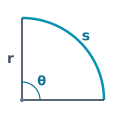
Arc length equals radius times theta
The arc length equals the radius multiplied by the central angle in radians.
s = rθ
Determines the radius of the circle given a known arc length and central angle.
r = s / θ
Finds the central angle subtended by a given arc length and radius.
θ = s / r
An arc is a portion of a circle's circumference. The arc length formula s = rθ is one of the simplest in geometry: multiply the radius by the central angle in radians. This calculator handles degree-to-radian conversion automatically, so you can enter the angle in either unit.
A circle has radius 5 m and a central angle of 60°. Find the arc length.
The arc is exactly one-sixth of the circumference because 60° is one-sixth of 360°.
The arc length formula s = rθ is one of the simplest and most fundamental relationships in geometry. It connects the linear distance along a curve to the radius and central angle measured in radians. A radian is defined so that the arc length equals the radius when θ = 1, which is what makes the formula so elegant and unit-free.
Use the formula s = rθ, where r is the radius and θ is the central angle in radians. If the angle is in degrees, convert first by multiplying by π/180. For example, a 10 m radius circle with a 90° angle has arc length s = 10 × (90π/180) = 10 × 1.5708 ≈ 15.71 m.
The arc length formula is s = rθ (radians) or equivalently s = πrθ/180 (degrees). Here s is the arc length, r is the radius, and θ is the central angle. The formula follows directly from the definition of a radian.
You need at least two of the three variables (s, r, θ) to find the third. Without the angle, you can determine it if you know the arc length and radius: θ = s/r. If you only know the chord length and radius, you can find the angle using θ = 2 × arcsin(chord / 2r), then compute the arc length.
Arc length is the distance measured along the curved path of the circle between two points, while chord length is the straight-line distance between those same two points. The arc is always longer than the chord (except for a zero-degree angle where both are zero). For small angles, they are nearly equal.
A radian is defined as the angle where the arc length equals the radius (s = r when θ = 1 rad). This definition makes the formula s = rθ exact with no conversion factor. Using degrees requires an extra factor of π/180.
A semicircle has a central angle of π radians (180°). Its arc length is s = rπ, which is half the circumference. For r = 10, the semicircular arc is 10π ≈ 31.42.
The full circumference is the arc length for a complete 360° (2π radian) rotation: C = 2πr. Any arc is a fraction of this, proportional to the central angle: s = rθ. A 90° arc is one-quarter of the circumference, a 180° arc is half, and so on.
The arc length formula connects the distance along a curve to the circle's radius and the central angle:
Where:
The formula works because a radian is defined so that the arc length equals the radius when θ = 1 rad. For a full circle (θ = 2π), the arc length equals the circumference 2πr.
Road Design
A highway on-ramp curves through 45° with a centerline radius of 200 m. Find the curve length.
s ≈ 157.08 m
Road designers use this to calculate pavement length, guardrail runs, and lane markings along curved sections.
Architecture
An arched doorway has a radius of 0.5 m (semicircular arch, 180°). How long is the trim piece?
s ≈ 1.5708 m
Builders measure the arc to cut flexible trim, crown molding, or decorative bands that follow the curve.
Manufacturing
A plumber bends a copper pipe through 90° around a mandrel with a 0.3 m radius. How much pipe does the bend consume?
s ≈ 0.4712 m
Knowing the arc length prevents cutting pipe too short and accounts for material consumed by the bend.
