Density Calculator
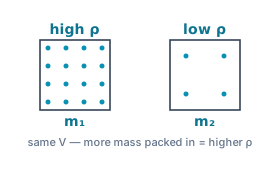
Density equals mass divided by volume
Use this form when you know how much a sample weighs and how much space it occupies. It is the standard way to identify a material, compare fluids, or verify whether a measured sample matches a reference density.
ρ = m / V
Use this rearrangement when the material density is known and you need the total mass of a batch, slab, tank, or component. This is common in structural estimating, logistics, and process design.
m = ρ × V
Use this version when you know how much material you have and how dense it is, but need to size storage or occupied space. It is especially useful for tanks, packaging, and bulk material handling.
V = m / ρ
This density calculator uses the relationship ρ = m / V to solve for density, mass, or volume. You choose the unknown with the solve-for toggle, enter the other two values, and the calculator converts units automatically before solving the equation. That makes it useful for lab work, engineering estimates, fluid calculations, and any problem where you need to move between how much material there is and how much space it occupies.
A lab sample has a mass of 2,700 g and displaces 1,000 cm³ of water. What is its density?
That result is consistent with aluminum, so density can be used as a quick material-identification check when the sample is reasonably pure.
Density is an intrinsic material property that describes how much mass is packed into a given volume. A small piece of aluminum and a large block of aluminum have the same density even though their masses and volumes are different. Density is also closely related to specific volume, which is its reciprocal, and to specific gravity, which compares density against a reference fluid such as water.
Use the formula ρ = m / V. Divide the mass of the sample by the volume it occupies, making sure the units are consistent with the density unit you want. For example, 2.7 kg divided by 0.001 m³ gives a density of 2,700 kg/m³.
The density formula is ρ = m / V, where ρ is density, m is mass, and V is volume. The same relationship can be rearranged to m = ρ × V and V = m / ρ when mass or volume is the unknown.
Density has units, such as kg/m³ or g/cm³, and tells you the mass per unit volume of a material. Specific gravity is unitless because it is a ratio: the material density divided by the density of a reference fluid, usually water. A specific gravity of 2.7 means the material is 2.7 times as dense as water.
Common SI and lab units include kg/m³, kg/L, g/mL, and g/cm³. Imperial work often uses lb/ft³ or lb/gal. This calculator converts automatically, which helps when your mass and volume measurements come from different unit systems.
Yes. Most solids, liquids, and gases expand as temperature increases, so their density decreases if mass stays the same. The effect is especially important for gases and for liquids stored across a wide temperature range, which is why engineering references usually state density at a specific temperature.
Often, yes. If you measure mass and volume carefully, the calculated density can be compared against reference values for metals, plastics, fuels, and other materials. It works best when the sample is pure and free of voids, coatings, or trapped moisture.
An object floats in a fluid when its average density is lower than the density of that fluid. That is why wood floats on water and solid steel sinks. Shape still matters because hollow objects can trap air and lower their average density enough to float.
The formula itself is exact, but the final answer is only as accurate as the mass and volume measurements you enter. Errors in displaced-volume tests, rounded dimensions, temperature shifts, or mixed units are the most common reasons real-world density calculations drift from handbook values.
Reference:
Tipler, Paul A. 1995. Physics for Scientists and Engineers. Worth Publishers. 3rd ed.
Materials Science
A materials lab measures an aluminum specimen with a mass of 2,700 g and a displaced volume of 1,000 cm³. Use the density formula to confirm whether the result matches typical aluminum.
Density ≈ 2.7 g/cm³, which is also 2,700 kg/m³
This is a good purity check for metals, but temperature and trapped air can shift the measured volume slightly.
Civil Engineering
A slab pour requires 2.5 m³ of concrete, and the mix design density is 2,400 kg/m³. Calculate the concrete mass to size the crane lift and truck delivery.
Mass = 6,000 kg
Actual delivered mass can vary with moisture content and aggregate selection, so field densities should come from the approved mix data.
Manufacturing
A maintenance team needs to store 850 kg of hydraulic oil with a density of 0.85 kg/L. Use the density equation to size the tank volume in liters.
Volume = 1,000 L
Storage calculations should include freeboard and thermal expansion, because oils expand as temperature rises.
The density formula relates mass, volume, and how tightly a material is packed:
Where:
This formula is exact for any measured mass and volume pair. The main limitation is the quality of your measurements: density changes with temperature, pressure, moisture content, and trapped voids, so engineering design values should come from the right reference condition for the material.
Densities of everyday materials with their measurement conditions and sources. Click a material to load its density into the calculator. For the complete, sortable list of all materials, see the material density reference.
| Material | kg/m³ | g/cm³ | lb/ft³ | Condition | Type | Source |
|---|---|---|---|---|---|---|
| Aluminum | 2,700 | 2.7 | 168.6 | 20 °C, solid | Metal | RSC Periodic Table |
| Iron | 7,870 | 7.87 | 491.3 | 20 °C, solid | Metal | RSC Periodic Table |
| Copper | 8,960 | 8.96 | 559.4 | 20 °C, solid | Metal | RSC Periodic Table |
| Lead | 11,300 | 11.3 | 705.4 | 20 °C, solid | Metal | RSC Periodic Table |
| Gold | 19,300 | 19.3 | 1205 | 20 °C, solid | Metal | RSC Periodic Table |
| Carbon steel | 7,850 | 7.85 | 490.1 | room temp, typical | Metal | CRC Handbook |
| Stainless steel | 8,000 | 8 | 499.4 | room temp, typical | Metal | CRC Handbook |
| Oak (air-dried) | 750 | 0.75 | 46.82 | 12% moisture, typical | Solid | CRC Handbook |
| Ice | 917 | 0.917 | 57.25 | 0 °C, solid | Solid | CRC Handbook |
| Concrete | 2,400 | 2.4 | 149.8 | cured, typical | Solid | CRC Handbook |
| Glass (window) | 2,500 | 2.5 | 156.1 | room temp, typical | Solid | CRC Handbook |
| Gasoline | 745 | 0.745 | 46.51 | 15 °C, liquid, typical | Liquid | CRC Handbook |
| Ethanol | 789 | 0.789 | 49.26 | 20 °C, liquid | Liquid | PubChem (NIH) |
| Water (pure) | 1,000 | 1 | 62.43 | 4 °C, liquid (max density) | Liquid | USGS Water Science School |
| Dry air | 1.204 | 0.001204 | 0.07516 | 20 °C, 1 atm | Gas | CRC Handbook |
Sources: RSC Periodic Table (elements), USGS (water), PubChem / NIH (pure compounds), and the CRC Handbook of Chemistry and Physics, 97th ed. (alloys, building materials, gases). Alloy and building-material values are typical and vary with composition, temperature, and moisture content.


