Weight Equation Calculator
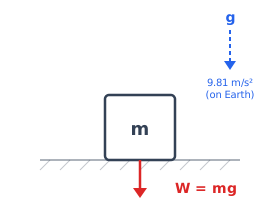
Weight equals mass times gravitational acceleration
Weight is the gravitational force on an object. Unlike mass (which stays the same everywhere), weight changes with gravitational acceleration. On Earth, g ≈ 9.81 m/s²; on the Moon, g ≈ 1.62 m/s².
W = m × g
Weight is the gravitational force on an object: W = m × g. Unlike mass (which stays the same everywhere), weight changes with gravitational acceleration. On Earth, g ≈ 9.81 m/s²; on the Moon, g ≈ 1.62 m/s². The same 70 kg person weighs 687 N on Earth but only 113 N on the Moon.
A 50 kg suitcase is placed on a scale at sea level on Earth. What is its weight in newtons?
A simpler example: a 10 kg backpack on Earth weighs 10 × 9.81 = 98.1 N.
Weight is a force, not a property of matter. It results from gravity acting on mass and is measured in newtons (N) or pounds-force (lbf). Mass remains constant regardless of location, but weight changes with gravitational acceleration. This distinction matters in engineering, space science, and any context where g differs from Earth's standard 9.81 m/s².
Use the formula W = m × g. Multiply the object's mass in kilograms by the gravitational acceleration (9.81 m/s² on Earth). For example, a 70 kg person has a weight of 70 × 9.81 = 686.7 N on Earth.
The weight formula is W = m × g, where W is weight in newtons, m is mass in kilograms, and g is gravitational acceleration in meters per second squared. You can rearrange it to find mass (m = W / g) or gravity (g = W / m).
Mass (kg) measures the amount of matter in an object and never changes. Weight (N) is the gravitational force on that mass and varies with location. A 70 kg person weighs 686.7 N on Earth but only 113.4 N on the Moon.
The Moon's gravitational acceleration is about 1.62 m/s², roughly one-sixth of Earth's 9.81 m/s². Multiply your mass in kg by 1.62 to get your lunar weight in newtons. A 70 kg person weighs about 113.4 N on the Moon versus 686.7 N on Earth.
Scales are calibrated assuming standard Earth gravity. They actually measure force (weight) but display the equivalent mass. In a different gravitational field — like on Mars — the reading would be wrong unless recalibrated.
Mars: 3.72 m/s². Jupiter: 24.79 m/s². Moon: 1.62 m/s². Venus: 8.87 m/s². A 70 kg person would weigh 260 N on Mars, 1,735 N on Jupiter, and 621 N on Venus.
Weight is a vector quantity — it has both magnitude and direction. Weight always points toward the center of the gravitational body (downward on Earth's surface). The W = mg formula gives the magnitude; the direction is always along the gravitational field line.
Reference:
Lindeburg, Michael R. 1992. Engineer In Training Reference Manual. Professional Publication, Inc. 8th Edition.
The weight equation defines the gravitational force acting on an object:
Where:
On Earth's surface, g averages 9.81 m/s² but varies slightly with latitude and altitude (9.78 at the equator to 9.83 at the poles). For other bodies: Moon 1.62 m/s², Mars 3.72 m/s², Jupiter 24.79 m/s².
Red = weight (W = mg)Blue = gravitational field (g)
Space Exploration
The Perseverance rover has a mass of 1,025 kg. Mars has a gravitational acceleration of 3.72 m/s². What is the rover's weight on the Martian surface?
On Earth, the same rover weighs 10,055 N — nearly 2.6× more. Mission planners must account for this difference when designing landing systems.
Structural Engineering
A reinforced concrete floor slab has a mass of 12,000 kg. Calculate the gravitational force (dead load) it exerts on the support beams.
Structural engineers must add safety factors (typically 1.2–1.4× for dead loads) when sizing beams and columns. This calculation gives the unfactored load.
Elevator Design
An elevator cable has a maximum rated load of 25,000 N. Assuming standard Earth gravity, what is the maximum mass the cable can hold?
m ≈ 2,548.4 kg
This is the static limit. Dynamic loads during acceleration and deceleration increase the effective force, so elevator cables are rated well above the static maximum.
Gravitational acceleration varies across the solar system. Click a row to load that body's gravity — your current mass and units are preserved. For full planetary data (mass, radius, escape velocity), see the planetary data reference.
| Body | g (m/s²) | 70 kg Weight | Type |
|---|---|---|---|
| Sun | 274 | 19,180 N | Star |
| Mercury | 3.7 | 259 N | Rocky planet |
| Venus | 8.87 | 621 N | Rocky planet |
| Earth | 9.807 | 686 N | Rocky planet |
| Moon | 1.62 | 113 N | Moon |
| Mars | 3.71 | 260 N | Rocky planet |
| Jupiter | 24.79 | 1,735 N | Gas giant |
| Saturn | 10.44 | 731 N | Gas giant |
| Uranus | 8.87 | 621 N | Ice giant |
| Neptune | 11.15 | 781 N | Ice giant |
| Pluto | 0.62 | 43 N | Dwarf planet |
Surface gravity values are approximate averages. Actual values vary with altitude, latitude, and local geology.
