AJ Designer

Density Converter

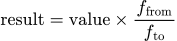
result equals value times from-factor divided by to-factor

Density Conversion =

1 Kilogram / Meter³ (kg/m³)

Solution in Other Units

UnitValue
Kilogram / Meter³ (kg/m³)1
Gram / Centimeter³ (g/cm³)0.001
Kilogram / Liter (kg/L)0.001
Gram / Milliliter (g/mL)0.001
Pound / Foot³ (lb/ft³)0.062427961
Pound / Inch³ (lb/in³)3.6127292e-5
Slug / Foot³ (slug/ft³)0.0019403203
Gram / Meter³ (g/m³)1000
Kilogram / Deciliter (kg/dL)0.0001
Milligram / Liter (mg/L)1000
Ounce / Foot³ (oz/ft³)0.99884737
Ounce / Inch³ (oz/in³)0.00057803667
Pound / Bushel UK (lb/bu)0.080179336
Pound / Bushel US (lb/bu)0.077688855
Pound / Gallon UK (lb/gal)0.010022417
Pound / Gallon US (lb/gal)0.0083454045
Pound / Yard³ (lb/yd³)1.6855549
Slug / Inch³ (slug/in³)1.1228706e-6
Ton Metric / Meter³ (t/m³)0.001
Share:

Density Unit Conversion

Transforms a density value between all supported units using precise factors relative to kg/m³.

result = value × (factor_from ÷ factor_to)

How It Works

This converter transforms a density value from one unit into every other supported density unit using precise multiplication factors. Each unit is defined relative to kg/m³.

Example Problem

Convert 1,000 kg/m³ to lb/ft³.

  1. 1,000 × 0.062428 ≈ 62.43 lb/ft³
  2. This is the density of water at 4 °C.

Key Concepts

Density is mass per unit volume, a fundamental physical property that determines whether objects float or sink, how fluids behave, and how materials are specified in engineering. The SI base unit is kg/m³, but g/cm³, lb/ft³, and many other units are common across different industries. All conversions are simple multiplications relative to the kg/m³ base.

Applications

  • Material science: converting between SI and imperial density units for material specification sheets
  • Chemical engineering: translating density data between lab units (g/cm³) and process units (kg/m³ or lb/ft³)
  • Geology: comparing rock and mineral densities reported in different regional unit systems

Common Mistakes

  • Confusing g/cm³ with kg/m³ — they differ by a factor of 1,000 (water is 1 g/cm³ = 1,000 kg/m³)
  • Mixing up mass density and weight density — weight density includes gravitational acceleration and has units like N/m³ or lbf/ft³
  • Using specific gravity as if it has units — specific gravity is dimensionless; multiply by water's density to get actual density

Frequently Asked Questions

What is density?

Density is mass per unit volume, commonly measured in kg/m³ or g/cm³.

How do you convert kg/m³ to lb/ft³?

Multiply by approximately 0.06243.

Why are there so many density units?

Different industries use different systems. Scientists use g/cm³, engineers lb/ft³, SI standard is kg/m³.

Related Calculators

Related Sites