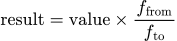
result equals value times from-factor divided by to-factor
Viscosity Conversion =
Solution in Other Units
Unit
Value
Pascal-Second (Pa·s)
1
Millipascal-Second (mPa·s)
1000
Centipoise (cP)
1000
Pound / Foot-Second (lb/ft·s)
0.67196898
Slug / Foot-Second (slug/ft·s)
0.020885434
Kilogram / Meter-Second (kg/m·s)
1
Micropascal-Second (µPa·s)
1000000
Newton-Second / Meter² (N·s/m²)
1
Poise (P)
10
Pound / Foot-Hour (lb/ft·h)
2419.0883
Pound-Force-Second / Foot² (lbf·s/ft²)
0.020885434
Share:
Viscosity Unit Conversion
This converter transforms a dynamic viscosity value from one unit into all other supported viscosity units. Each unit is defined relative to the Pascal-second (Pa·s) as the base unit.
result = value × (from factor / to factor)
How It Works
This converter transforms a dynamic viscosity value from one unit into all other supported viscosity units. Each unit is defined relative to the Pascal-second (Pa·s) as the base unit, so the converter multiplies by the source factor and divides by the target factor.
Example Problem
Convert 0.89 pascal-seconds (Pa·s) to centipoise (cP).
1 Pa·s = 1,000 cP.
0.89 × 1,000 = 890 cP.
Key Concepts
Dynamic viscosity quantifies a fluid's internal resistance to flow. It is defined as the ratio of shear stress to shear rate. The SI unit is the Pascal-second (Pa-s), while the CGS unit Poise (P) and its sub-unit centipoise (cP) remain widely used in industry. Water at 20 degrees C has a viscosity of about 1 cP, making centipoise a convenient reference point.
Food science: ensuring consistent texture in sauces, beverages, and dairy products
Pharmaceutical manufacturing: controlling coating viscosity for tablet and capsule production
Lubricant selection: matching oil viscosity grades (SAE, ISO) to operating temperature ranges
Common Mistakes
Confusing dynamic and kinematic viscosity — kinematic viscosity is dynamic viscosity divided by density, and the units are different (m²/s vs Pa-s)
Ignoring temperature dependence — viscosity can change by an order of magnitude over a 50 degree C range, so always specify the temperature
Mixing CGS and SI without converting — 1 Poise = 0.1 Pa-s, not 1 Pa-s
Frequently Asked Questions
What is dynamic viscosity?
Dynamic viscosity measures a fluid’s resistance to flow under an applied force. The SI unit is the Pascal-second (Pa·s), and a common CGS unit is the Poise (P).
How do you convert centipoise to Pascal-seconds?
Divide the centipoise value by 1,000. For example, water at 20°C has a viscosity of about 1 cP = 0.001 Pa·s.
What is the difference between dynamic and kinematic viscosity?
Dynamic viscosity measures resistance to flow, while kinematic viscosity is dynamic viscosity divided by fluid density. This converter handles dynamic viscosity only.
Related Calculators
Density Converter — density is used to derive kinematic viscosity from dynamic viscosity.