Hemisphere Calculator
Volume equals two-thirds pi r cubed
Use this form when the radius is known. The hemisphere holds exactly half the volume of a full sphere with the same radius.
V = (2/3) π r³
Use this form for the curved hemispherical surface PLUS the flat circular base. Common for closed-bottom hemispherical tanks and domes with floors.
S = 3π r²
Use this form for the curved dome surface only (excluding the flat base). Common for open hemispheres like protective domes and bowls.
S_curved = 2π r²
Use this rearrangement when the volume is known and you need the radius.
r = ∛(3V / (2π))
This hemisphere (half sphere) calculator solves V = (2/3)πr³ for volume, S = 3πr² for total surface area (curved + flat base), and S_curved = 2πr² for the curved dome surface alone. The inverse r = ∛(3V/(2π)) recovers the radius from the volume. Pick the unknown with the solve-for toggle and enter the remaining values. Base disk area (πr²) and base circumference (2πr) are always shown as supplementary outputs.
A hemispherical glass dome covers an exhibit with a 3 m radius. What is the dome's volume, curved surface area, and total surface area?
At r = 3, the numeric value of V and curved SA happen to coincide (both equal 18π) — a numerical curiosity, not a structural relationship. They have different units (m³ vs m²).
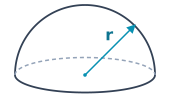
A hemisphere is exactly half of a sphere, cut by a plane through the center. The flat side is a circular disk (the equator of the original sphere). All hemisphere formulas derive from sphere formulas by halving: V_sphere = (4/3)πr³ → V_hemi = (2/3)πr³; A_sphere = 4πr² → A_hemi_curved = 2πr². The total surface area of a hemisphere adds the flat base (πr²) to the curved half, giving 3πr².
Use V = (2/3) π r³. The hemisphere holds half the volume of the full sphere. For r = 3 m, V = 18π ≈ 56.549 m³.
Total surface area is S = 3πr² (curved 2πr² plus the flat circular base πr²). Curved surface alone is 2πr². For r = 3 m: total ≈ 84.82 m², curved ≈ 56.55 m².
A hemisphere is exactly half of a sphere, formed by cutting the sphere through its center with a plane. Its volume is half the sphere's; its curved surface area is half the sphere's. The total surface area adds a flat circular base that the sphere doesn't have.
Rearrange V = (2/3)πr³ to r = ∛(3V/(2π)). For V = 56.549 m³, r = ∛(169.65 / 6.2832) = ∛27 = 3 m.
The curved half-sphere surface is 2πr². The flat circular base contributes another πr². Total: 2πr² + πr² = 3πr². Half a sphere has more surface than a quarter sphere because it includes the new flat face that wasn't there in the full sphere.
Total surface area (S = 3πr²) includes both the curved dome and the flat circular base. Curved surface area (2πr²) is just the dome — useful when the base is open or already painted.
Use the curved surface area 2πr² (not 3πr²) because there's no base to paint. For a 5 m radius open dome, 2π·25 = 50π ≈ 157.1 m² of paint coverage.
No — those have different formulas. A half cylinder has V = (1/2)πr²h; a half cone has V = (1/6)πr²h. A hemisphere is specifically half of a sphere — use the sphere or this hemisphere calculator.
Reference:
Weisstein, Eric W. "Hemisphere." MathWorld — A Wolfram Web Resource. https://mathworld.wolfram.com/Hemisphere.html
Dome
A glass exhibit dome is a hemisphere with 3 m radius. Compute its volume to estimate interior air conditioning load.
Volume ≈ 56.5 m³ (about 14,930 US gallons)
Half the volume of a 3 m sphere (113 m³). Useful for scaling estimates between full-sphere and dome geometries.
Open Dome
An astronomy observatory has an open-bottom hemispherical dome with radius 5 m. Compute the curved surface area to estimate paint.
Curved surface area ≈ 157.1 m² (≈ 1,690 ft²)
Open-bottom domes need only the curved-area formula. If the dome had a floor, use S = 3πr² ≈ 235.6 m² instead.
Inverse Solve
A salad bowl must hold 100 L (0.1 m³). The bowl is hemispherical. Find the required radius.
Radius ≈ 0.363 m (≈ 36.3 cm)
The diameter is twice that — about 0.73 m (29 inches). A surprisingly large bowl for 100 liters because hemispherical capacity is half that of a sphere.
A hemisphere (half sphere) is defined by a single dimension: the radius r. Volume, both surface-area variants, and the base disk all derive from it.
Where:



