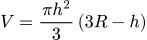
Calculate Spherical Cap Volume
Use this form when the full sphere radius R and the cap height h are known. The cap is the dome-shaped region cut off by a plane; this is the standard partial-fill formula for a spherical tank.
V = (π h² / 3)(3R − h)
Calculate Spherical Cap Curved Surface Area
Use this form for the curved dome surface only (no flat base). The result is linear in h — a half-height cap covers half the curved surface of a full sphere of the same radius.
S_curved = 2π R h
Calculate Spherical Cap Total Surface Area
Use this form for the curved dome PLUS the flat circular base disk. Equals 2πRh + πh(2R − h), with the second term being the base area πa².
S_total = π h (4R − h)
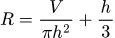
Calculate Sphere Radius from Cap Volume and Height
Inverse form: given the cap volume V and the cap height h, recover the full sphere's radius R. Useful when designing a tank to hit a target partial-fill capacity at a known fill depth.
R = V / (π h²) + h / 3
How It Works
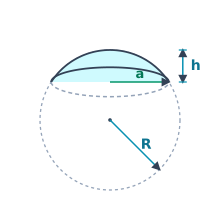
A spherical cap is the dome-shaped region cut from a sphere by a single plane. It is fully characterised by the full sphere radius R and the cap height h (perpendicular distance from the cutting plane to the top of the cap). This calculator solves V = (π h² / 3)(3R − h) for volume, S_curved = 2π R h for the curved dome surface, S_total = π h (4R − h) for curved + flat base, and the inverse R = V/(π h²) + h/3 to back out the sphere radius from a target volume. The base radius a = √(h(2R − h)) and base disk area π a² are always shown as supplementary outputs.
Example Problem
A spherical pressure tank has interior radius R = 5 m and is filled with liquid to a depth of h = 2 m measured up from the bottom of the tank. The liquid forms a spherical cap. Compute the volume of liquid, the wetted curved surface area, the total wetted area, and the radius of the free-surface circle.
- Knowns: R = 5 m (full sphere radius), h = 2 m (cap height = liquid depth).
- Volume: V = (π · h² / 3)(3R − h) = (π · 4 / 3)(15 − 2) = (4π / 3) · 13 = 52π / 3 ≈ 54.4543 m³.
- Curved surface area (wetted dome): S_curved = 2π R h = 2π · 5 · 2 = 20π ≈ 62.832 m².
- Base radius (free-surface circle): a = √(h(2R − h)) = √(2 · 8) = √16 = 4 m.
- Base area (free-surface disk): π a² = 16π ≈ 50.265 m².
- Total surface area (curved + base): S_total = π h (4R − h) = π · 2 · 18 = 36π ≈ 113.097 m². Sanity check: 20π + 16π = 36π ✓.
- Inverse check: R = V / (π h²) + h / 3 = (52π/3) / (4π) + 2/3 = 13/3 + 2/3 = 5 m, recovering the input radius.
All four spherical-cap formulas degenerate cleanly: at h = R the cap is a hemisphere (V = (2/3)π R³, S_curved = 2π R²); at h = 2R the cap is the full sphere (V = (4/3)π R³) and the base radius collapses to zero.
When to Use Each Variable
- Solve for Volume — when R and h are known and you need the dome's volume — partial-fill of a spherical tank, dome enclosure capacity, or volume of a contact lens.
- Solve for Curved Surface Area — when you need only the dome's outer surface — wetted area in a partially filled sphere, paint or coating for an open-bottom dome.
- Solve for Total Surface Area — when both the curved dome and the flat base disk matter — closed-bottom dome roofs, hemispherical-with-floor enclosures.
- Solve for Sphere Radius — when you know the target cap volume and cap height — sizing a spherical tank to hit a partial-fill capacity at a documented liquid depth.
Key Concepts
A spherical cap is one of three closely related sphere sections. (1) When h = R the cap is a hemisphere — half a sphere. (2) When h < R the cap is shallower than a hemisphere (think contact lens or shallow dome). (3) When R < h < 2R the cap is more than half a sphere (a spherical 'bowl with overhang'). The base radius a is the radius of the circle where the cutting plane intersects the sphere — it grows from zero at h = 0, peaks at a = R when h = R (the equator), then shrinks back to zero at h = 2R as the cutting plane reaches the bottom pole. Volume is monotonic in h: more cap height always means more volume, but the relationship is not linear because the cross-section widens then narrows.
Applications
- Storage and process tanks: liquid volume in a partially filled spherical or hemispherical tank as a function of fill depth
- Architecture: dome roofs, planetariums, gas-holder caps — volume and surface area for HVAC and structural sizing
- Optics and biomedical: contact lens curved area (sagittal cap), corneal cap geometry, sclera measurements
- Astronomy: spherical-cap viewport on an observatory dome, lit-fraction of the moon when modeled as a cap
- Aerospace: spherical-cap nose cone heat-shield surface area
Common Mistakes
- Confusing cap height h with sphere radius R — h is the height of the dome above the cutting plane, not the sphere's radius. They are equal only in the hemisphere special case.
- Forgetting the constraint h ≤ 2R — a cap height greater than the sphere diameter is geometrically impossible.
- Using V = (4/3)π R³ (full sphere) when the tank is only partially filled — substitute the cap formula V = (π h²/3)(3R − h) instead.
- Mixing the base radius a with the sphere radius R — a depends on h, R is fixed by the sphere itself.
- Forgetting whether to add the flat base when computing surface area — closed-bottom domes use S_total = π h (4R − h), open-bottom domes use just the curved S_curved = 2π R h.
Frequently Asked Questions
How do you calculate the volume of a spherical cap?
Use V = (π h² / 3)(3R − h), where R is the full sphere radius and h is the cap height (depth of the dome). For R = 5 m and h = 2 m, V = (4π/3) · 13 = 52π/3 ≈ 54.45 m³.
What is a spherical cap?
A spherical cap is the dome-shaped region of a sphere cut off by a single plane. The cutting plane creates a flat circular base; everything on one side of that plane is the cap. When the plane passes through the sphere's centre, the cap is exactly a hemisphere.
How do you find the volume of liquid in a partially filled spherical tank?
If the tank has interior radius R and the liquid depth (measured from the lowest point of the tank up to the free surface) is h, the liquid volume is V = (π h² / 3)(3R − h). This is the standard partial-fill formula for a spherical tank. For a half-full hemispherical end-cap, h = R and V reduces to (2/3)π R³.
What is the surface area of a spherical dome?
The curved dome surface (no floor) is S_curved = 2π R h — surprisingly simple, and linear in h. If you also need the floor (the flat base disk), add π h (2R − h), giving the total S_total = π h (4R − h). For R = 5 m, h = 2 m: curved 20π ≈ 62.8 m², total 36π ≈ 113.1 m².
What is the formula for the base radius of a spherical cap?
The base radius is a = √(h(2R − h)), where R is the sphere radius and h is the cap height. This is the radius of the circular cross-section where the cutting plane intersects the sphere. At h = R it reaches its maximum a = R (the sphere's equator); at h = 0 or h = 2R it is zero (a single point of tangency).
How is a spherical cap different from a hemisphere?
A hemisphere is the special case of a spherical cap where h = R — the cutting plane passes through the sphere's centre and the cap is exactly half the sphere. A general spherical cap can be shallower (h < R, a shallow dome) or deeper (R < h < 2R, more than half a sphere). All hemisphere formulas are spherical-cap formulas evaluated at h = R.
Can a spherical cap's height exceed the sphere's diameter?
No. The cap height h must satisfy 0 < h ≤ 2R. At h = 2R the 'cap' becomes the whole sphere and the base radius collapses to zero (the cutting plane is tangent at the opposite pole). The calculator rejects h > 2R as geometrically impossible.
How do you find the sphere's radius given the cap volume and height?
Rearrange V = (π h² / 3)(3R − h) for R: R = V / (π h²) + h / 3. For V = 52π/3 m³ and h = 2 m, R = (52π/3) / (4π) + 2/3 = 13/3 + 2/3 = 5 m, recovering the sphere radius.
Reference:
Weisstein, Eric W. "Spherical Cap." MathWorld — A Wolfram Web Resource. https://mathworld.wolfram.com/SphericalCap.html
Worked Examples
Partial Tank Fill
How much liquid is in a 5 m spherical tank filled to 2 m depth?
A spherical pressure vessel of radius R = 5 m holds liquid to a depth of h = 2 m. Find the liquid volume — the liquid forms a spherical cap.
- Knowns: R = 5 m, h = 2 m
- Formula: V = (π h² / 3)(3R − h)
- V = (π · 4 / 3)(15 − 2) = (4π / 3) · 13 = 52π / 3 ≈ 54.45 m³
Volume ≈ 54.45 m³ (about 14,380 US gallons)
Even though the tank is only 20% full by depth (2 m of 10 m diameter), it already holds about 10% of the tank's total capacity — sphere cross-sections widen quickly near the bottom.
Dome Roof
How much paint covers a dome roof with 8 m base radius and 3 m height?
A spherical-cap dome roof has a base (footprint) radius a = 8 m and a peak height of h = 3 m above the wall. Compute the curved surface area for paint estimates.
- Solve for the sphere radius: a² = h(2R − h) ⇒ R = (a² + h²) / (2h) = (64 + 9) / 6 ≈ 12.17 m
- Confirm h ≤ 2R: 3 ≤ 24.33 ✓
- Formula: S_curved = 2π R h = 2π · (73/6) · 3 = 73π m²
- S_curved ≈ 229.34 m²
Curved surface area ≈ 229.3 m² (≈ 2,468 ft²)
Loading this example into the calculator uses R ≈ 12.167 and h = 3 m. To go straight from the footprint radius a to the dome roof's sphere radius, use R = (a² + h²)/(2h).
Contact Lens
What is the curved area of a soft contact lens?
A soft contact lens models as a shallow spherical cap with base curve (sphere radius) R = 8.6 mm and sagitta (cap height) h = 1.5 mm. Compute the curved surface area to estimate oxygen-permeation surface.
- Knowns: R = 8.6 mm, h = 1.5 mm
- Formula: S_curved = 2π R h
- S_curved = 2π · 8.6 · 1.5 = 25.8π mm²
- S_curved ≈ 81.05 mm² (≈ 0.81 cm²)
Curved (anterior) surface area ≈ 81.05 mm²
Real contact lenses are aspheric and have a thinner edge, but the spherical-cap model captures the dominant area term within a few percent.
Spherical Cap Formulas
A spherical cap is characterised by the full sphere radius R and the cap height h (depth of the dome from cutting plane to top). All four quantities below derive from that pair.
Volume equals pi h squared over three times the quantity three R minus hCurved surface area equals two pi R hTotal surface area equals pi h times the quantity four R minus hSphere radius equals V over pi h squared plus h over three


Where:
- V — volume of the spherical cap (the dome region)
- S_curved — curved dome surface area, excluding the flat base disk
- S_total — curved dome plus the flat base disk
- R — full sphere radius (the sphere from which the cap is cut)
- h — cap height (perpendicular distance from cutting plane to top of cap; 0 < h ≤ 2R)
- a — base radius, the radius of the circle where the plane cuts the sphere: a = √(h(2R − h))
Related Calculators
- Sphere Calculator — volume and surface area of the full sphere
- Hemisphere Calculator — the spherical cap special case h = R
- Circle Calculator — geometry of the flat base disk
- Cylinder Calculator — volume and surface area for a cylinder
- Volume Converter — switch between m³, L, gallons, ft³
Related Sites
- Temperature Tool — Temperature unit converter
- Z-Score Calculator — Z-score, percentile, and probability calculator
- OptionsMath — Options trading profit and loss calculators
- Medical Equations — Hemodynamic, pulmonary, and dosing calculators
- Dollars Per Hour — Weekly paycheck calculator with overtime
- Percent Off Calculator — Discount and sale price calculator