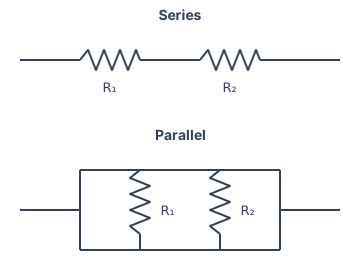
Equivalent series resistance equals the sum of all individual resistances: R sub eq equals R sub 1 plus R sub 2 plus through R sub n.
Equivalent Resistance (Series) =
2 resistors counted
Show Your Work
R_eq = R₁ + R₂ + … + Rₙ
R_eq = 100 + 200
R_eq = 300 Ω
Final answer: 300 Ω
Both Configurations
Series total
300 Ω
Parallel total
66.666667 Ω
Resistors counted
2
Share:
Resistors in Series
Series resistors share the same current and add directly. The equivalent resistance is the simple sum, so adding more resistors in series always increases total resistance — and the largest individual resistor dominates the chain.
R_eq = R₁ + R₂ + R₃ + … + Rₙ
Resistors in Parallel
Parallel resistors share the same voltage and provide multiple paths for current. The reciprocals of the resistances sum to the reciprocal of the equivalent — the equivalent is always smaller than the smallest branch, and adding more branches lowers it further.
1/R_eq = 1/R₁ + 1/R₂ + … + 1/Rₙ
How It Works
Two resistors can be wired two fundamental ways. In series they sit end-to-end on a single current path: the same electrons flow through every resistor, voltage drops add up across each one, and the resistances simply add. In parallel they sit across the same two nodes: every resistor sees the same voltage, current splits between them inversely proportional to resistance, and the reciprocals add. This calculator takes any number of resistor values, applies the series sum or parallel reciprocal-sum, and reports the single equivalent resistance you could swap in to replace the whole network without changing the circuit's external behavior. The math falls out of Kirchhoff's voltage and current laws and is the bedrock of every basic DC circuit analysis.
Example Problem
You have two resistors, R₁ = 100 Ω and R₂ = 200 Ω. Find the equivalent resistance when they are wired in series and when they are wired in parallel.
Invert to get the equivalent resistance: R_parallel = 1 / 0.015 = 200/3 ≈ 66.67 Ω.
Sanity check: parallel resistance (66.67 Ω) is less than the smallest individual resistor (100 Ω), which is true for every parallel combination of positive resistors.
The two answers — 300 Ω in series, 66.67 Ω in parallel — differ by a factor of 4.5 from exactly the same two resistors. The wiring topology controls the equivalent resistance every bit as much as the component values.
Key Concepts
Three rules of thumb make resistor networks much faster to reason about. First, parallel resistance is always less than the smallest individual resistor: if you have a 100 Ω and a 1 MΩ resistor in parallel, the equivalent is essentially 100 Ω because the high-value branch barely conducts. Second, series resistance is always greater than the largest individual resistor: stacking resistors only adds. Third, identical resistors in parallel give R/N, where N is how many you have — four 1 kΩ resistors in parallel make a 250 Ω equivalent. Real circuits frequently mix series and parallel sub-networks (ladder networks, voltage dividers, R-2R DAC ladders); analyze them by collapsing one cluster at a time, replacing each collapsed cluster with its single equivalent, until the whole network reduces to one resistance.
Applications
LED current limiting — a series resistor sized by Ohm's law caps the diode current to its rated forward value (e.g., 220 Ω in series with a 20 mA LED on 5 V).
Voltage dividers — two resistors in series across a supply produce a fractional output voltage at the midpoint, the building block of bias networks and analog sensor scaling.
Resistor combinations on a benchtop — stocking the E12 series and pairing two off-the-shelf parts (in series for higher, in parallel for lower) hits almost any target value within 1%.
Power dissipation in parallel — splitting a high-power load across N identical parallel resistors divides the heat by N, which is why high-wattage shunts use multiple parallel low-ohm chips.
Wheatstone bridges and balanced networks — strain gauges, RTDs, and many sensor circuits depend on the predictable behavior of resistors in series-parallel topologies.
Audio crossovers and signal padding — passive attenuators (L-pads, T-pads, π-pads) use carefully picked series and parallel resistors to attenuate signal without changing source or load impedance.
Multimeter ranging — a multimeter's voltage ranges are set by a series multiplier resistor; its current ranges are set by a parallel shunt resistor.
Common Mistakes
Using simple addition for parallel — the most frequent error. Series resistors add; parallel resistors require the reciprocal-sum formula. Adding 100 + 200 in parallel and getting 300 Ω is off by more than 4×.
Forgetting the final reciprocal — computing 1/100 + 1/200 = 0.015 and stopping there. That 0.015 is the conductance in siemens; you have to invert it once more to get the resistance in ohms (1 / 0.015 = 66.67 Ω).
Mixing up which formula goes with which wiring — series resistors share one current path; parallel resistors share two common nodes. If you cannot trace a single loop through every resistor without branching, you are not in series.
Treating a 0 Ω resistor as just another row in parallel — a true 0 Ω branch is a short circuit that bypasses every other branch, collapsing the equivalent to zero. This calculator flags it rather than silently computing.
Ignoring tolerance — real carbon-film resistors carry 5% tolerance, so an 'exact' parallel combination still drifts a few percent. Critical analog work uses 1% metal-film parts or trim networks.
Confusing equivalent resistance with power rating — combining two resistors in parallel halves the resistance but also lets each share roughly half the load; the equivalent's power rating is roughly the sum of the individual ratings only if both halves dissipate equally.
Frequently Asked Questions
How do you calculate resistors in series?
Add the individual resistances directly: R_eq = R₁ + R₂ + R₃ + … + Rₙ. Each resistor carries the same current, voltage drops sum across the chain, and the total resistance is always larger than the largest individual resistor. Two 100 Ω resistors in series make 200 Ω.
How do you calculate resistors in parallel?
Sum the reciprocals of each resistance and then invert the result: 1/R_eq = 1/R₁ + 1/R₂ + … + 1/Rₙ, so R_eq = 1 / (1/R₁ + 1/R₂ + … + 1/Rₙ). Each resistor sees the same voltage, current splits between the branches, and the equivalent is always smaller than the smallest individual resistor.
What is the formula for parallel resistance?
1/R_eq = 1/R₁ + 1/R₂ + … + 1/Rₙ. For the two-resistor case there is a shortcut: R_eq = (R₁ · R₂) / (R₁ + R₂), often called the product-over-sum formula. The general reciprocal-sum form works for any number of resistors.
Why is parallel resistance less than any single resistor?
Adding a second path for current to flow can never reduce the total current at a given voltage — it can only add to it. Since R = V/I, a higher total current at the same voltage means a lower equivalent resistance. Each extra parallel branch is another route for charge to take, so the more branches you add, the easier it is for current to flow, and the lower R_eq drops.
Can I mix series and parallel resistors in one network?
Yes — most real circuits do. Identify the smallest series or parallel sub-cluster, replace it with its single equivalent, redraw, and repeat until the whole network collapses to one resistance. This calculator handles a single homogeneous group; for mixed networks (e.g., (R₁ + R₂) ∥ R₃) collapse the inner cluster first, then feed its equivalent into the outer one.
How does adding more resistors in parallel affect current?
Each additional parallel branch adds another path, so total current from the source increases (the equivalent resistance drops). If the supply voltage stays the same, total current = V / R_eq, and R_eq shrinks as you add branches. Individual branch currents stay the same — the new branch simply draws extra current of its own without affecting the others.
What is the equivalent resistance of two equal resistors in parallel?
It is half of one of them. Two 100 Ω resistors in parallel give R_eq = 100/2 = 50 Ω; in general, N identical resistors of value R in parallel give R/N. This is one of the most useful shortcuts in circuit design: a 250 Ω equivalent from a stock of 1 kΩ parts is four 1 kΩ in parallel.
Does a 0 Ω resistor in parallel short out the circuit?
Yes. A 0 Ω branch is a perfect short across the two nodes — all the current flows through that wire and none flows through the other branches, so the equivalent resistance is 0 Ω regardless of what else is connected in parallel. This calculator flags a 0 Ω row in parallel mode rather than silently computing an answer.
Reference:
Kirchhoff's voltage and current laws (Robert Kirchhoff, 1845). Series sum and parallel reciprocal-sum formulas appear in every introductory circuit-analysis text, including Sedra and Smith's Microelectronic Circuits and Horowitz and Hill's The Art of Electronics.
Series and Parallel Resistance Formulas
Two formulas cover every linear resistor combination — every other network reduces to repeated applications of these:
Series
Req = R₁ + R₂ + R₃ + … + Rₙ
Parallel
1 / Req = 1/R₁ + 1/R₂ + … + 1/Rₙ
Where:
Req — the single equivalent resistance you could swap in for the whole network without changing the rest of the circuit
R₁, R₂, … Rₙ — the individual resistor values
1/R — the conductance of a branch, in siemens. Conductances add in parallel the way resistances add in series.
For exactly two resistors in parallel there is a useful shortcut: Req = (R₁ · R₂) / (R₁ + R₂), the “product over sum” form. Beyond two resistors, fall back to the general reciprocal-sum.
Worked Examples
Canonical Pair
What is the equivalent resistance of 100 Ω and 200 Ω?
Combine R₁ = 100 Ω and R₂ = 200 Ω in both configurations and compare.
Invert the conductance: R = 1/0.015 = 200/3 ≈ 66.67 Ω.
Ratio: series is 4.5× the parallel result — same two resistors, very different equivalents.
Series = 300 Ω, Parallel ≈ 66.67 Ω.
Parallel resistance (66.67 Ω) is below the smaller of the two individual resistors (100 Ω), as it must be for any pair of positive resistors in parallel.
LED Current Limiting
What is the limiting resistance for a typical red LED on 5 V?
A red LED (Vf ≈ 2 V, If = 20 mA) on 5 V drops 3 V across the series resistor; pair two common E12 values, 220 Ω + 470 Ω, to land at ~690 Ω.
Voltage across the resistor: V = 5 − 2 = 3 V.
Target resistance for 20 mA: R = V / I = 3 / 0.020 = 150 Ω (minimum).
Designers often run LEDs below max for longer life — pair 220 Ω + 470 Ω = 690 Ω in series.
Series formula: R = 220 + 470 = 690 Ω.
Current: I = 3 / 690 ≈ 4.3 mA — comfortably below the 20 mA rating.
Series equivalent = 690 Ω, LED current ≈ 4.3 mA (safe).
Real LED Vf shifts with current; this is the textbook first-order sizing. For a brighter LED, halve the series resistor or move to a constant-current driver.
Parallel Divider
What is the equivalent of five 1 kΩ resistors in parallel?
Five identical 1 kΩ chips in parallel — the equivalent is R/N = 1000/5.
Identical-resistors-in-parallel rule: R_eq = R / N.
Substitute: R_eq = 1000 / 5 = 200 Ω.
Verify with the reciprocal-sum: 5 × (1/1000) = 0.005 S, R = 1/0.005 = 200 Ω. ✓
Each 1 kΩ branch carries 1/5 of the total current, so the 1/4-watt parts share heat — the network handles ≈ 5 × 0.25 = 1.25 W versus 0.25 W for one part.
Equivalent resistance = 200 Ω, power capability ≈ 1.25 W.
Splitting load across N parallel resistors is the standard way to extend power-handling without paying for a high-wattage part.