Capacitor Design Calculator
Capacitance equals charge divided by voltage
The basic capacitance relationship ties capacitance to charge and voltage. A capacitor stores electrical energy by holding opposite charges on two conductive plates separated by an insulator.
C = Q / V
Stored energy depends on capacitance and voltage squared. Doubling the voltage quadruples the stored energy.
U = ½CV²
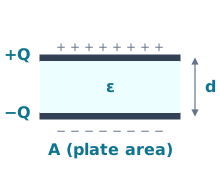
Two flat conducting plates of area A separated by distance d with a dielectric of permittivity ε form the simplest capacitor. Larger plates and thinner gaps increase capacitance.
C = εA / d
A cylindrical capacitor consists of two coaxial conductors used for coaxial cables and cylindrical sensor geometries.
C = 2πεL / ln(b/a)
A capacitor stores electrical energy by holding opposite charges on two conductive plates separated by an insulator. The basic relationship C = Q/V ties capacitance to charge and voltage. For specific geometries, dedicated formulas (parallel plate, cylindrical) account for physical dimensions and dielectric properties. Three stored-energy forms (U = ½CV², U = Q²/2C, U = QV/2) let you solve with whichever pair of variables you know.
A 470 µF capacitor is charged to 25 V. How much energy does it store?
If the same capacitor held 0.01 coulombs of charge, the voltage would be Q/C = 0.01/0.00047 ≈ 21.3 V.
Capacitance is the ability to store electric charge per unit voltage. Three equivalent energy formulas (U = 1/2 CV^2, U = Q^2/2C, U = QV/2) let you work with whichever pair of variables you know. Physical capacitance depends on geometry: for parallel plates, it scales with plate area and inversely with gap distance; for cylindrical capacitors, it scales with length and inversely with the logarithm of the radius ratio. The dielectric material between conductors multiplies capacitance by its relative permittivity.
One farad is an enormous amount of capacitance. Most practical capacitors are measured in microfarads (1 µF = 10⁻⁶ F), nanofarads (10⁻⁹ F), or picofarads (10⁻¹² F). Supercapacitors can reach several thousand farads.
In parallel, capacitances add directly: Ctotal = C1 + C2. In series, reciprocals add: 1/Ctotal = 1/C1 + 1/C2, so the total is always less than the smallest individual capacitor.
As voltage rises, each additional increment of charge requires more work against the growing electric field. The result is a quadratic relationship: doubling the voltage quadruples the stored energy.
A parallel plate capacitor is two flat conductive plates separated by an insulating material (dielectric). Its capacitance depends on the plate area, the gap between plates, and the dielectric’s permittivity: C = εA/d. It is the most common theoretical model for understanding capacitance.
Capacitors are used for power supply filtering, signal coupling, timing circuits (RC), motor starting, camera flashes, defibrillators, and power factor correction. Decoupling caps near ICs stabilize voltage and reduce electromagnetic interference.
All three give the same answer; pick the one matching the variables you have. Use U = ½CV² when you know capacitance and voltage, U = Q²/2C when you know charge and capacitance, and U = QV/2 when you know charge and voltage. They are algebraic rearrangements of each other via Q = CV.
A dielectric multiplies the vacuum capacitance by its relative permittivity εᵣ. Air is ≈ 1, paper ≈ 3.5, polyester ≈ 3.3, ceramic X7R ≈ 1,000–4,000, and tantalum oxide ≈ 25. Higher εᵣ means more capacitance for the same plate area and gap, which is how miniature ceramic and electrolytic capacitors pack microfarads into millimeter-scale parts.
Equivalent series resistance (ESR) is the small parasitic resistance in series with an ideal capacitance — caused by leads, foils, and electrolyte conduction losses. Higher ESR means more self-heating under ripple current and less effective filtering at high frequencies. Power-supply electrolytics rated for switching converters typically advertise low-ESR construction to limit ripple losses.
Power Electronics
Aluminum-electrolytic capacitors on a DC bus typically run at a derated voltage well below their 35 V or 50 V rating. Find the stored charge for a 470 μF cap sitting at a steady 25 V.
Q = 0.01175 C (11.75 mC)
This is the static charge at the operating voltage; ripple current and equivalent series resistance still matter for thermal sizing and lifetime, which Q alone does not capture.
Photography
A disposable-camera xenon flash typically charges an 800 μF capacitor to about 300 V before dumping the energy through the flash tube. Find the stored energy that drives the bulb.
U = 36 J
Stored energy scales with the square of voltage, so derating from 300 V down to 240 V (e.g., as the cap ages and ESR drifts) drops the available flash energy from 36 J to 23 J — a noticeable underexposure.
Sensor Design
A capacitive touch sensor uses two parallel copper pads of 1 cm² area separated by a 0.1 mm air gap. The vacuum permittivity ε₀ = 8.854 × 10⁻¹² F/m sets the baseline capacitance before any finger or stylus changes the dielectric.
C ≈ 8.854 pF
Touch sensors detect the small permittivity change when a fingertip enters the fringing field; the baseline pF-range capacitance is what the sensor IC measures against to set its threshold.
The capacitor calculator covers five related equations spanning basic capacitance, three equivalent stored-energy forms, and two common geometries:
Where:
The basic relation C = Q/V holds for any two-terminal capacitor. The parallel-plate and cylindrical forms assume the dielectric fills the gap uniformly and edge effects (fringing fields) are small relative to the active region. At very high frequency, all real capacitors deviate from these ideal formulas due to ESR and lead inductance — see the FAQ for how to account for parasitics in RF and switching designs.
