Ohm's Law Calculator
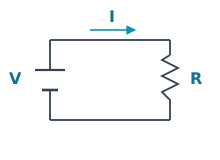
Voltage equals current multiplied by resistance
Ohm's Law states that voltage equals current multiplied by resistance. Combined with the power equation (P = V × I), you can derive 12 formulas to find any one of four electrical quantities from any two of the others.
V = I × R
Current equals voltage divided by resistance. You can also find current from power and voltage (I = P/V) or from power and resistance (I = √(P/R)).
I = V / R
Resistance equals voltage divided by current. Alternatively, R = P/I² or R = V²/P when power is one of the known quantities.
R = V / I
Electrical power equals voltage times current. You can also compute power from I²R or V²/R depending on which two values you know.
P = V × I
Ohm's Law (V = I × R) and the power equation (P = V × I) together produce 12 formulas that let you find any one of four electrical quantities — voltage, current, resistance, or power — from any two of the others. Select what you want to solve for, choose which two values you know, and the calculator does the rest.
A 120 V circuit powers a 60 W light bulb. Find the current draw and resistance of the filament.
This is the cold-start resistance. A tungsten filament at operating temperature (2,700 °C) has roughly 10× the resistance of a cold bulb.
Ohm's Law (V = IR) and the power equation (P = VI) combine to produce 12 formulas relating voltage, current, resistance, and power. Any single quantity can be calculated from any two of the other three. These relationships assume a linear (ohmic) resistor at constant temperature; non-ohmic devices like diodes and transistors do not follow V = IR.
Voltage, current, and resistance are linked by Ohm's Law: V = I × R. Voltage is the electrical pressure that pushes charge through a conductor, current is the rate of charge flow, and resistance is the opposition to that flow. Doubling the voltage across a fixed resistance doubles the current; doubling the resistance at the same voltage halves the current.
Start by identifying which two of the four quantities (V, I, R, P) you know. Then pick the formula that solves for the unknown — for example, if you know voltage and resistance, use I = V/R to find current. For power problems, combine Ohm's law with P = VI to get derived formulas like P = I²R or P = V²/R.
Yes, but in AC circuits you replace resistance with impedance (Z), which includes both resistance and reactance. For purely resistive loads like heaters, V = I × R works directly. For circuits with capacitors or inductors, use V = I × Z where Z accounts for phase shifts.
Watts = Volts × Amps. A 1,500 W space heater on a 120 V circuit draws 1,500/120 = 12.5 A. This is why 15-amp circuits can barely handle one large heater.
A cold tungsten filament has about 1/10th the resistance of a hot filament. When you flip the switch, the low resistance causes a high inrush current (I = V/R with small R). As the filament heats up in milliseconds, resistance rises and current drops to its steady-state value. This thermal shock is why bulbs most often burn out at the moment of switching on.
Treat the wire as a resistor. Look up its resistance per unit length (e.g., 14 AWG copper is about 2.53 Ω per 1,000 ft), multiply by the round-trip distance, then use V = I × R. The NEC recommends keeping voltage drop below 3% for branch circuits — if your drop exceeds that, use a thicker gauge wire.
A short circuit has near-zero external resistance, so I = V/R produces an extremely large current limited only by the battery's internal resistance. A typical car battery (12V, ~0.01 Ω internal) can deliver over 1,000 A in a short circuit. This generates intense heat, can melt wires, and may cause the battery to vent or explode.
References:
Ohm, Georg Simon. 1827. Die galvanische Kette, mathematisch bearbeitet. Berlin: T. H. Riemann. See also Halliday, Resnick & Walker, Fundamentals of Physics.
Digitized original (1827): https://archive.org/details/diegalvanischek00ohmgoog
Ohm's law defines the linear relationship between voltage, current, and resistance in an electrical circuit:
Where:
Combined with the power equation P = V × I, these two formulas produce 12 derived equations that let you solve for any one of four electrical quantities — voltage, current, resistance, or power — from any two of the others.
The wheel organizes all 12 equations. Each quadrant solves for one variable using any combination of the other two.
Each quadrant shows three ways to calculate that variable from any two of the other three.
Electronics
A standard red LED needs 2V forward voltage and 20 mA of current. With a 5V supply, the resistor must drop the remaining 3V.
R = 150 Ω
Use the next standard resistor value up (150 Ω is standard). This limits LED current to exactly 20 mA, preventing burnout.
Home Electrical
A 100-foot run of 14 AWG copper wire (0.253 Ω per 100 ft, round trip = 0.506 Ω) carries 15 A to a workshop subpanel. What is the voltage drop?
V = 7.59 V drop
That's 6.3% of 120V — above the NEC-recommended 3% maximum. Upgrading to 12 AWG (lower resistance) would reduce the drop.
Automotive
A 12V car battery powers a starter motor with an internal resistance of 0.06 Ω. Estimate the starting current.
I = 200 A
Real starter current peaks even higher (200-300 A) because the motor's back-EMF is zero at initial crank. This is why starter batteries need high cold-cranking amps (CCA).
Reference: Ohm, Georg Simon. 1827. Die galvanische Kette, mathematisch bearbeitet. Berlin: T. H. Riemann. See also Halliday, Resnick & Walker, Fundamentals of Physics.
