Resistance Converter
Resistance Conversion =
Solution in Other Units
| Unit | Value |
|---|---|
| Ohm (Ω) | 1 |
| Kilohm (kΩ) | 0.001 |
| Milliohm (mΩ) | 1000 |
| Megohm (MΩ) | 1e-6 |
| Unit | Value |
|---|---|
| Ohm (Ω) | 1 |
| Kilohm (kΩ) | 0.001 |
| Milliohm (mΩ) | 1000 |
| Megohm (MΩ) | 1e-6 |
Each resistance unit is defined relative to the Ohm as the base unit, so conversions are straightforward power-of-ten multiplications. Enter a value and select a source unit to see all equivalent resistance values.
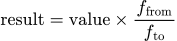
result = value × f_from / f_to
This converter transforms an electrical resistance value from one unit into all other supported resistance units. Each unit is defined relative to the Ohm as the base unit, so conversions are straightforward power-of-ten multiplications.
Convert 4,700 ohms (Ω) to kilohms (kΩ).
Electrical resistance is measured in ohms (Ω) and describes a material's opposition to current flow. Resistance unit conversions are straightforward power-of-ten multiplications: 1 kΩ = 1,000 Ω, 1 MΩ = 1,000,000 Ω. Resistance values span many orders of magnitude, from milliohms in power bus bars to gigaohms in insulation testing.
Resistance is the opposition to electric current flow in a conductor. It is measured in Ohms and determines how much current flows for a given voltage.
Multiply the kilohm value by 1,000. For example, 4.7 kΩ = 4,700 Ω.
A megohm (MΩ) is one million ohms. It is used for very high resistance values found in insulation testing and sensitive electronic circuits.