AJ Designer

Voltage Converter

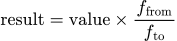
result equals value times from-factor divided by to-factor

Voltage Conversion =

1 Volt (V)

Solution in Other Units

UnitValue
Volt (V)1
Millivolt (mV)1000
Kilovolt (kV)0.001
Megavolt (MV)1e-6
Microvolt (µV)1000000
Share:

Voltage Unit Conversion

This converter transforms a voltage value from one unit into all other supported voltage units. Each unit is defined relative to the Volt (V) as the base unit, so conversions are simple power-of-ten multiplications.

result = value × (from factor / to factor)

How It Works

This converter transforms a voltage value from one unit into all other supported voltage units. Each unit is defined relative to the Volt (V) as the base unit, so conversions are simple power-of-ten multiplications.

Example Problem

Convert 240 millivolts (mV) to volts (V).

  1. 1 V = 1,000 mV.
  2. 240 ÷ 1,000 = 0.24 V.

Key Concepts

Voltage (electric potential difference) measures the energy per unit charge between two points in a circuit. The SI unit is the Volt (V), defined as one joule per coulomb. Sub-units like millivolts (mV) and microvolts (uV) are common in sensor and biomedical applications, while kilovolts (kV) and megavolts (MV) apply to power transmission and high-energy physics.

Applications

  • Electronics design: converting sensor output voltages (mV or uV) to standard ranges for ADC input
  • Power engineering: specifying transmission line voltages in kV for grid infrastructure planning
  • Biomedical instrumentation: interpreting EEG and ECG signals measured in microvolts
  • Automotive systems: working between 12V vehicle systems and millivolt-level sensor readings

Common Mistakes

  • Confusing voltage with current — voltage is the potential difference (pressure), while current is the flow of charge (amperes)
  • Dropping the metric prefix — 1 kV is 1,000 V, not 100 V; getting the power of ten wrong cascades through every downstream calculation
  • Assuming RMS and peak voltage are the same — AC voltage is typically quoted as RMS, which is about 0.707 times the peak value

Frequently Asked Questions

What is voltage?

Voltage is the electric potential difference between two points. It is measured in Volts (V) and drives current through a circuit.

How do you convert millivolts to volts?

Divide the millivolt value by 1,000. For example, 500 mV = 0.5 V.

What is a kilovolt used for?

Kilovolts (kV) are used for high-voltage applications such as power transmission lines, X-ray machines, and industrial equipment.

Related Calculators

Related Sites