AJ Designer

Current Unit Converter
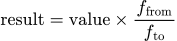
result equals value times from-factor divided by to-factor

Current Conversion =

1 Ampere (A) = 1000 Milliampere (mA); 1000000 Microampere (µA)

Solution in Other Units

UnitValue
Ampere (A)1
Milliampere (mA)1000
Microampere (µA)1000000
Kiloampere (kA)0.001

Show Your Work

Result = Value × (Source factor ÷ Target factor)
Base unit for this current family is Ampere (A).
1 Ampere (A) = 1 Ampere (A)
1 Ampere (A) = 1000 Milliampere (mA)
1 Ampere (A) = 1000000 Microampere (µA)
Share:

How It Works

This converter uses the ampere (A) as its base unit. Each supported current unit has a known factor relative to the ampere, so the calculator converts your source value into amperes first and then divides by each target-unit factor to populate the full current table.

Example Problem

Convert 1.8 A to milliamps and microamps for an electronics worksheet.

  1. Start with the source value: 1.8 A.
  2. Convert amperes to milliamps by multiplying by 1,000.
  3. 1.8 × 1,000 = 1,800 mA.
  4. Convert amperes to microamps by multiplying by 1,000,000.
  5. 1.8 × 1,000,000 = 1,800,000 µA.
  6. So 1.8 A is 1,800 mA and 1,800,000 µA.

Key Concepts

Electric current measures the rate of charge flow through a conductor. The SI base unit is the ampere, but practical electronics often use milliamps and microamps, while industrial systems may use kiloamperes. Since these are all scaled versions of the same quantity, most current conversions are simple factor conversions through the ampere.

Applications

  • Circuit design: checking current budgets and device ratings across A, mA, and µA scales
  • Instrumentation: converting sensor and measurement values into the unit scale used by the display or log
  • Industrial systems: translating larger current values into amperes for comparison and protection studies
  • Education and troubleshooting: verifying that the magnitude of a current reading makes physical sense

Common Mistakes

  • Confusing milliamps and microamps, which differ by a factor of 1,000
  • Treating current as if it were voltage or power, even though all three describe different electrical quantities
  • Dropping or misreading metric prefixes when a component or system specification changes scale

Frequently Asked Questions

How do you convert current units?

Convert the source current to amperes first, then divide by the target-unit factor. That is the base-unit method used by this calculator.

What is the formula for converting amps, milliamps, and microamps?

Use Result = Value × (source factor ÷ target factor), where each factor is defined relative to the ampere.

How many milliamps are in 1 amp?

One ampere equals 1,000 milliamps.

How many microamps are in 1 milliamp?

One milliamp equals 1,000 microamps.

What is a kiloampere?

A kiloampere is 1,000 amperes and is used for very large current values.

Why do current values use so many prefixes?

Because practical current readings range from tiny sensor leakage levels to very large industrial currents.

Can I use this for electronics and industrial systems?

Yes. Any true current value can be converted across the supported units here.

Current Conversion Formula

Current conversions use the ampere as the common base unit. The calculator converts your source current into amperes first, then reports the same electrical flow in every other supported unit below.

Result = Value × (Source factor ÷ Target factor)
  • Result — the converted measurement in the target current unit
  • Value — the original measurement you enter
  • Source factor — the factor that maps the source unit to the common base unit
  • Target factor — the factor used to express the same base-unit value in the target unit

Worked Examples

Electronics

How do you convert 500 mA to amperes?

A device rating is listed in milliamps, but your power calculation needs amps.

  • Start with the source value: 500 mA.
  • Use the relationship 1 A = 1,000 mA.
  • Divide: 500 ÷ 1,000 = 0.5 A.
  • That is also 500,000 microamperes.
  • So the current is half an ampere.
  • The same current is 0.5 A.

A current of 500 mA equals 0.5 A.

This is a standard conversion when checking power supplies, sensors, and device budgets.

Control Systems

What is 2.5 A in milliamps?

A controller output is in amps, but the connected component spec uses milliamps.

  • Start with the source value: 2.5 A.
  • Use the relationship 1 A = 1,000 mA.
  • Multiply: 2.5 × 1,000 = 2,500 mA.
  • That is also 2,500,000 µA.
  • So the same current is 2,500 mA.
  • The current is 2.5 A or 2,500 mA.

A current of 2.5 A equals 2,500 mA.

Scaling current into the unit used by datasheets makes it much easier to compare component limits.

Industrial Power

How do you convert 0.75 kA to amperes?

A high-current industrial or fault-analysis value is listed in kiloamperes and needs to be shown in amps.

  • Start with the source value: 0.75 kA.
  • Use the relationship 1 kA = 1,000 A.
  • Multiply: 0.75 × 1,000 = 750 A.
  • That is also 750,000 mA.
  • So the current is 750 amperes.
  • The same current is 750 A.

A current of 0.75 kA equals 750 A.

Converting high-current values to amps makes power and fault calculations easier to compare directly.

Related Calculators

Related Sites