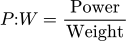
How It Works
Power-to-weight ratio (P:W) divides a vehicle's power output by its weight to give a single number that predicts acceleration potential and climbing ability. The formula is P:W = Power / Weight, expressed as HP/lb (US) or kW/kg (metric). A higher ratio means faster acceleration for the same gearing and traction. P:W is the single best back-of-envelope predictor of 0-60 mph times and lap times when other variables (aerodynamics, traction, transmission) are held constant.
Example Problem
A sports car produces 300 HP and weighs 3,000 lb with driver and fuel. Calculate the power-to-weight ratio.
- Identify the formula: P:W = Power / Weight.
- Substitute: P:W = 300 HP / 3,000 lb.
- Divide: P:W = 0.10 HP/lb.
- Express in common alternates: 100 HP per 1,000 lb, or 10 lb per HP.
- Compare to benchmarks: 0.10 HP/lb is sports-car territory (Mustang GT, Camaro SS); 0.20+ HP/lb is supercar (Lamborghini Aventador, Bugatti Chiron).
Key Concepts
P:W governs acceleration when traction is unlimited. Real-world acceleration is also limited by tire grip (limits the first ~30 mph), drag (limits top end), and gear ratios (limits the usable RPM range). Two cars with identical P:W but different drag coefficients will diverge above ~80 mph. P:W is most useful for comparing cars in the same class: a 0.10 HP/lb sedan and a 0.10 HP/lb track car accelerate similarly from a stop. For climbing, P:W maps directly to grade-climbing speed; a vehicle at 0.05 HP/lb maintains highway speed up a typical interstate grade, while a fully-loaded truck at 0.015 HP/lb crawls.
Applications
- Comparing vehicles across classes and brands on a level playing field.
- Predicting 0-60 mph times — rough rule: 0-60 (s) ≈ 6 / (P:W in HP/lb) for high-traction setups.
- Specifying engines for new builds — pick a target P:W, then size the powertrain.
- Aircraft performance: P:W (or T:W for thrust) determines climb rate and takeoff distance.
- Motorsports class rules: many series enforce minimum vehicle weight per HP to balance competitors.
Common Mistakes
- Using curb weight without driver and fuel. Race weight (curb + 200 lb driver + full fuel) is more honest for performance estimates.
- Mixing brake HP (at the crank) with wheel HP (at the tires). Use the same source for all comparisons. Wheel HP / weight is usually the more useful figure for real-world acceleration.
- Comparing P:W across different power units (PS, HP, kW) without converting. 100 PS ≠ 100 HP — PS is ~98.6% of mechanical HP.
- Forgetting that drag scales with velocity squared. Two cars with the same P:W but different frontal area diverge in top-speed and high-speed acceleration.
- Quoting P:W in kW/kg next to HP/lb without conversion — the numbers look wildly different but represent the same thing.
Frequently Asked Questions
How do you calculate power-to-weight ratio?
Divide the vehicle's power output by its weight: P:W = Power / Weight. Express in HP/lb (US) or kW/kg (metric). Example: 300 HP and 3,000 lb gives 0.10 HP/lb, or 100 HP per 1,000 lb.
What is the formula for power-to-weight ratio?
P:W = Power ÷ Weight. The units determine the output: HP ÷ lb gives HP/lb; kW ÷ kg gives kW/kg. To convert, 1 HP/lb ≈ 1.644 kW/kg.
What is a good power-to-weight ratio?
For street cars: 0.05 HP/lb is economy car, 0.10 HP/lb is sports car, 0.15 HP/lb is high-performance (Corvette, M3), 0.20+ HP/lb is supercar. Track cars and motorcycles push 0.30+ HP/lb. Top fuel dragsters exceed 1.0 HP/lb.
Does power-to-weight ratio determine top speed?
Indirectly. Top speed is set by where engine power balances aerodynamic drag, so P:W matters but vehicle drag coefficient and frontal area also dominate. Two cars with identical P:W but different aerodynamics will have noticeably different top speeds.
Should I use brake HP or wheel HP?
For real-world acceleration estimates, wheel HP (at the tires) is more honest — it already accounts for drivetrain losses. For comparing to factory specs, brake HP (at the crank) is what manufacturers publish. Be consistent: don't mix brake-HP-of-one-car with wheel-HP-of-another.
How does P:W compare for cars vs. motorcycles vs. planes?
Sport bikes routinely hit 0.40-0.50 HP/lb (Yamaha R1, Ducati Panigale). Light aircraft sit around 0.05-0.10 HP/lb but are limited by thrust-to-weight, not power-to-weight, because thrust depends on propeller and altitude. Top-fuel dragsters are extreme outliers at 1.0+ HP/lb.
Worked Examples
Marine Outboard
What is the power-to-weight ratio of a 250 HP fishing boat?
A 24-foot center-console fishing boat carries a 250 HP outboard and weighs about 4,800 lb with full fuel, two anglers, and a day's worth of gear. Compute the P:W ratio.
- Knowns: Power = 250 HP, Weight = 4,800 lb.
- P:W = Power / Weight
- P:W = 250 HP / 4,800 lb
- P:W ≈ 0.0521 HP/lb
P:W ≈ 0.052 HP/lb (≈ 52 HP per 1,000 lb)
Marine P:W governs planing performance and top speed. Boats in the 40–55 HP/1,000 lb range plane easily and cruise around 30–35 mph; under 30 HP/1,000 lb often struggles to climb onto plane with a full load.
Superbike
How does a Ducati Panigale V4 R compare on power-to-weight?
A Ducati Panigale V4 R produces 218 HP. With a 200 lb rider, full fuel, and fluids, total race weight is approximately 596 lb (366 lb dry + 30 lb fluids + 200 lb rider). Compute the P:W ratio.
- Knowns: Power = 218 HP, Weight = 596 lb (race-prepared with rider).
- P:W = Power / Weight
- P:W = 218 HP / 596 lb
- P:W ≈ 0.3658 HP/lb
P:W ≈ 0.366 HP/lb (≈ 366 HP per 1,000 lb)
Liter-class superbikes have the highest production P:W of any street vehicle — typically 3–4× a high-performance sports car. The Panigale V4 R's 0.36+ HP/lb easily out-accelerates a Bugatti Chiron to 100 mph on a straight road.
Commercial Trucking
Why do loaded semi-trucks slow down on steep highway grades?
A Class 8 semi-tractor with a 500 HP Cummins X15 hauls a fully loaded trailer at the legal 80,000 lb gross combined weight (GCW). Compute the P:W ratio and compare with passenger cars.
- Knowns: Power = 500 HP, Weight = 80,000 lb.
- P:W = Power / Weight
- P:W = 500 HP / 80,000 lb
- P:W ≈ 0.00625 HP/lb
P:W ≈ 0.00625 HP/lb (≈ 6.25 HP per 1,000 lb)
An 80,000 lb semi has about 1/16th the P:W of a basic sedan and 1/60th of a sports car. This is why fully loaded trucks crawl up steep grades at 25–35 mph in low range — gravity simply overwhelms available power. Fleet specs typically target ≥ 6 HP per 1,000 lb GCW for highway operations.
Power-to-Weight Ratio Formula
Power-to-weight ratio (P:W) is the single number that predicts a vehicle's acceleration potential when traction is not the limiting factor:
P:W = Power / Weight
Where:
- P:W — power-to-weight ratio in HP/lb (US) or kW/kg (metric)
- Power — engine output, typically in mechanical horsepower (HP) or kilowatts (kW)
- Weight — total vehicle race weight in pounds (lb) or kilograms (kg), including driver, fuel, and fluids
The same number appears in three common forms: HP per pound, HP per 1,000 lb (the popular automotive figure), and pounds per HP (its reciprocal). To convert between metric and US, 1 HP/lb ≈ 1.644 kW/kg. P:W governs acceleration and climbing ability, but top speed is set by aerodynamic drag — two cars with identical P:W but different drag coefficients diverge above ~80 mph. For consistent comparisons, use the same power reference (brake HP at the crank, or wheel HP at the tires) and race weight across all vehicles you're comparing.
Related Calculators
- Horsepower Equations Hub — all 5 horsepower equations on a single page
- Horsepower from Torque — HP = (T × RPM) / 5252 with unit conversion
- Dyno Correction Factor — SAE atmospheric correction for dyno HP
- ET Method HP Increase — change in HP from quarter-mile ETs
- Trap Speed HP Increase — change in HP from quarter-mile trap speeds
- Horsepower from Elapsed Time — estimate engine HP from ET and weight
Related Sites
- Dollars Per Hour — Weekly paycheck calculator with overtime
- Compare 2 Loans — Side-by-side loan comparison calculator
- InfantChart — Baby and child growth percentile charts
- Temperature Tool — Temperature unit converter
- LoanChop — Loan prepayment calculator
- Percent Off Calculator — Discount and sale price calculator