How It Works
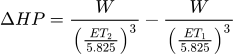
The ET method estimates the change in horsepower a vehicle gained (or lost) by comparing before-and-after quarter-mile elapsed times at the same race weight. The empirical formula is ΔHP = W / (ET₂ / 5.825)³ − W / (ET₁ / 5.825)³, where W is weight in pounds, ET₁ is the before time in seconds, and ET₂ is the after time in seconds. The constant 5.825 comes from Roger Huntington's quarter-mile drag-racing regression that links ET, weight, and rear-wheel HP — the same relationship powering the single-ET-to-HP formula. Useful for quantifying engine modifications (intake, exhaust, tune) when a chassis dyno isn't available.
Example Problem
A 3,000 lb car ran 13.0 seconds in the quarter mile before a tune, then 12.5 seconds after. Estimate the change in horsepower.
- Identify the formula: ΔHP = W / (ET₂ / 5.825)³ − W / (ET₁ / 5.825)³.
- Compute HP before: HP₁ = 3,000 / (13.0 / 5.825)³ = 3,000 / (2.232)³ = 3,000 / 11.118 ≈ 269.8 HP.
- Compute HP after: HP₂ = 3,000 / (12.5 / 5.825)³ = 3,000 / (2.146)³ = 3,000 / 9.886 ≈ 303.5 HP.
- Take the difference: ΔHP = 303.5 − 269.8 ≈ 33.6 HP gained.
- Sanity check: a 0.5 s improvement on a 3,000 lb car typically corresponds to 30-40 wheel HP, so the result is consistent with real-world tuning gains.
Key Concepts
The ET method works because ET is a strong function of power-to-weight ratio when traction is maintained throughout the run. Faster ETs require disproportionately more power because the formula scales with ET cubed: shaving the last few tenths takes far more HP than the first few. Compared to the trap speed method, ET is more sensitive to launch quality and 60-foot time, so the same engine modification can show different ΔHP via ET vs. trap-speed methods. Use the trap-speed method when the launch was inconsistent; use the ET method when the launches were similar before and after.
Applications
- Quantifying horsepower gains from bolt-on modifications (intake, exhaust, tune).
- Comparing tune-up before/after data when a dyno isn't accessible.
- Validating manufacturer 'gain' claims against actual track times.
- Heads-up bracket racing — predicting how much weight or power change is needed to hit a target ET.
- Cross-checking dyno HP gains against real-world track results.
Common Mistakes
- Comparing runs at different weights. The formula assumes the same W in both terms — if the car was lighter on the second run, the gain is overstated.
- Using inconsistent launch technique. ET is highly traction-sensitive in the first 60 feet; bad launches inflate ET disproportionate to engine power.
- Comparing different track conditions. Cool, dense air on the second run can show a 'gain' that's actually atmospheric, not mechanical. Use the dyno correction factor approach when weather differs.
- Treating the estimate as crank HP. The 5.825 formula calibrates against rear-wheel power; brake HP at the engine is typically 10-20% higher.
- Using fractional seconds without enough precision. ET differences of 0.05 s on a 12-second pass change HP estimates by ~3-4 HP, so round to two decimals.
Frequently Asked Questions
How do you calculate horsepower change from quarter-mile ETs?
Apply ΔHP = W / (ET₂ / 5.825)³ − W / (ET₁ / 5.825)³ where W is race weight in pounds and ET₁/ET₂ are the before/after times in seconds. The difference between the two HP terms is the estimated horsepower gain (or loss if ET went up).
What is the ET method formula for horsepower?
ΔHP = W / (ET₂ / 5.825)³ − W / (ET₁ / 5.825)³. The 5.825 constant comes from Roger Huntington's drag-racing regression linking quarter-mile ET, weight, and rear-wheel horsepower. It's the same formula used for single-pass HP-from-ET, evaluated at two ET values and subtracted.
How accurate is the ET method?
Typically ±5-15% for similar runs at the same track. ET is sensitive to launch quality and 60-foot time, so two runs with identical engine output but different launches can show 10-20 HP of spurious difference. Average several runs before and after the modification for better accuracy.
Why is ET method less accurate than trap speed method?
Trap speed (mph at the 1,320-foot mark) reflects the engine's pull through the second half of the run when traction has settled. ET integrates the launch, the shift points, and traction over the full 0-1320 ft, so launch variability adds noise. For the most reliable HP-change estimate, compare trap speeds; for the most relatable racer metric, compare ETs.
Does the formula work with metric units?
The 5.825 constant is calibrated for pounds and seconds. Convert kg to lb (× 2.20462) and use seconds as-is. This calculator handles unit conversion automatically when you choose 'kilogram' from the weight selector.
How much faster does each 0.1 s in ET represent in horsepower?
Very nonlinear. For a 3,000 lb car at 13.0 s, dropping to 12.9 s is ≈ 6 HP; at 11.0 s, the same 0.1 s drop is ≈ 10 HP; at 9.0 s, it's ≈ 18 HP. The cubic scaling means the last few tenths cost the most power.
Worked Examples
Motorcycle Drag Racing
How much HP did a sportbike tuner add if ET dropped from 11.5 s to 10.8 s?
A 600 lb sportbike + rider (typical 1000cc race weight) ran 11.5 s in the quarter mile bone-stock and 10.8 s after a tune-up with an ECU flash, slip-on exhaust, and air filter. Estimate the wheel HP gain.
- Knowns: W = 600 lb, ET₁ = 11.5 s, ET₂ = 10.8 s.
- HP before: HP₁ = 600 / (11.5 / 5.825)³ = 600 / (1.9742)³ = 600 / 7.695 ≈ 77.97 HP.
- HP after: HP₂ = 600 / (10.8 / 5.825)³ = 600 / (1.8541)³ = 600 / 6.372 ≈ 94.16 HP.
- ΔHP = 94.16 − 77.97.
ΔHP ≈ 16.2 HP gained
The ET method scales with mass, so light vehicles like motorcycles show smaller absolute HP gains for the same percentage improvement. The 16 HP gain here is about a 21% increase in wheel HP — consistent with a properly tuned ECU flash + bolt-ons.
Muscle Car Restoration
What HP gain did a cam swap deliver on a 4,200 lb big-block Mopar?
A restored 1970 Plymouth Road Runner (race weight 4,200 lb) ran a 14.5 s pass on the stock cam and 13.2 s after dropping in a hotter hydraulic-roller cam with matching springs. Estimate the HP picked up by the cam swap.
- Knowns: W = 4,200 lb, ET₁ = 14.5 s, ET₂ = 13.2 s.
- HP before: HP₁ = 4,200 / (14.5 / 5.825)³ = 4,200 / (2.4893)³ = 4,200 / 15.42 ≈ 272.4 HP.
- HP after: HP₂ = 4,200 / (13.2 / 5.825)³ = 4,200 / (2.2661)³ = 4,200 / 11.64 ≈ 360.9 HP.
- ΔHP = 360.9 − 272.4.
ΔHP ≈ 88.6 HP gained
Cam swaps on big-blocks routinely show 80–120 RWHP increases on a strong base — the cam unblocks the volumetric efficiency limit the stock grind imposes. Always run the same launch technique before and after; a heavy car like this is launch-sensitive even with sticky tires.
Tuner Import Build
How much HP did a turbo upgrade add to a 2,800 lb tuner car?
A 2,800 lb Honda Civic Si turbo build ran 12.2 s with a stock T25 turbo and 10.5 s after installing a larger GTX35R turbo with matching injectors and fuel system. Estimate the HP gain at the wheels.
- Knowns: W = 2,800 lb, ET₁ = 12.2 s, ET₂ = 10.5 s.
- HP before: HP₁ = 2,800 / (12.2 / 5.825)³ = 2,800 / (2.0944)³ = 2,800 / 9.187 ≈ 304.8 HP.
- HP after: HP₂ = 2,800 / (10.5 / 5.825)³ = 2,800 / (1.8026)³ = 2,800 / 5.857 ≈ 478.1 HP.
- ΔHP = 478.1 − 304.8.
ΔHP ≈ 173.3 HP gained
Turbo upgrades on import builds produce dramatic ET drops because the bigger turbo lifts the entire torque curve. The 1.7-second ET drop is more than a typical bolt-on tune (which yields ~0.3–0.5 s); always sanity-check large gains against a dyno or recompute with the trap-speed method to filter out a strong-launch confound.
ET Method Horsepower Formulas
The ET (elapsed-time) method estimates wheel horsepower from a vehicle's quarter-mile time using an empirically calibrated constant. The change in horsepower between two runs is the difference of two single-run estimates:
HP = W / (ET / 5.825)³Single-run horsepower estimate
ΔHP = W / (ET₂ / 5.825)³ − W / (ET₁ / 5.825)³Change in HP between two runs (same weight)
Where:
- HP — estimated wheel horsepower for a single run
- ΔHP — change in wheel horsepower between two runs (HP₂ − HP₁)
- W — race weight in pounds (vehicle + driver + fuel + any added ballast). Assumed identical for both runs
- ET — elapsed time for a full quarter-mile pass (seconds)
- ET₁, ET₂ — elapsed times before and after the modification
- 5.825 — Patrick Hale's empirical constant for quarter-mile ET. Pairs ET in seconds with weight in pounds and produces wheel HP
The formula assumes a clean launch on equal traction; a wheelspinning or bog launch inflates ET without reflecting engine output and will read low on HP. Always compare runs on similar tracks with similar air density, and sanity-check large ΔHP values against the trap-speed method (HP = W × (MPH / 234)³) — if both methods agree, confidence is high. Race weight must be the actual weight of the car the moment it crosses the line, not the curb weight from the spec sheet.
Related Calculators
- Horsepower Equations Hub — all 5 horsepower equations on a single page
- Horsepower from Torque — HP = (T × RPM) / 5252 with unit conversion
- Dyno Correction Factor — SAE atmospheric correction for dyno HP
- Power-to-Weight Ratio — HP per pound for performance comparison
- Trap Speed HP Increase — change in HP from quarter-mile trap speeds
- Horsepower from a Single ET — estimate HP from one ET and weight (not before/after)
Related Sites
- Dollars Per Hour — Weekly paycheck calculator with overtime
- Compare 2 Loans — Side-by-side loan comparison calculator
- Medical Equations — Hemodynamic, pulmonary, and dosing calculators
- Temperature Tool — Temperature unit converter
- LoanChop — Loan prepayment calculator
- BOGO Discount — Buy-one-get-one discount calculator