How It Works
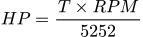
Engine horsepower from torque follows the rotating-power identity HP = (Torque × RPM) / 5252. Torque measures how hard the crankshaft twists (lb·ft); RPM measures how often it turns per minute; horsepower measures how fast that twist actually delivers work. The 5252 constant comes from defining 1 HP as 33,000 ft·lbf/min and converting RPM to radians per minute (2π rad per revolution): 33,000 ÷ 2π ≈ 5,252. The same formula rearranges to solve for torque (T = HP × 5252 / RPM) or RPM (RPM = HP × 5252 / T).
Example Problem
An engine produces 350 lb·ft of peak torque at 4,000 RPM. Calculate the horsepower at that operating point.
- Identify the formula: HP = (T × RPM) / 5252.
- Substitute: HP = (350 × 4,000) / 5,252.
- Multiply numerator: HP = 1,400,000 / 5,252.
- Divide: HP ≈ 266.6 horsepower at 4,000 RPM.
- Sanity check: at 5,252 RPM, HP and torque are numerically equal — 350 lb·ft would correspond to 350 HP at that RPM.
Key Concepts
Torque is rotational force; horsepower is the rate at which that force does work. An engine can have high torque but modest HP if it makes that torque only at low RPM (typical of large-displacement V8s and diesels). An engine can have moderate torque but high HP if it sustains that torque to very high RPM (typical of small high-revving inline engines). The 5,252 crossover is mathematical — it's where the conversion factor and the formula simply equate the two numbers; it has no engineering meaning beyond the unit system.
Applications
- Convert dyno torque readings to horsepower at every RPM data point.
- Estimate torque from a manufacturer's peak HP and the RPM at which it occurs.
- Find the RPM where two engines with different power curves would produce the same usable torque.
- Sanity-check engine spec sheets — HP and torque should cross at 5,252 RPM on any dyno graph.
Common Mistakes
- Mixing brake HP (at the crank) with wheel HP (at the tires). Drivetrain losses typically cost 10-20% — a 300 brake HP engine often shows ~240-270 at the wheels.
- Using metric horsepower (PS, CV) when the formula expects mechanical horsepower. 1 PS ≈ 0.9863 mechanical HP — small but it propagates through the calculation.
- Forgetting that peak HP and peak torque usually occur at different RPM. The formula gives HP at whatever RPM matches the torque value.
- Using Newton-meters with the 5252 constant. The constant is calibrated for pound-feet and RPM; for SI units the formula is Power (W) = Torque (N·m) × Angular velocity (rad/s).
Frequently Asked Questions
How do you calculate horsepower from torque?
Multiply torque (lb·ft) by RPM and divide by 5,252: HP = (Torque × RPM) / 5252. For example, 200 lb·ft at 5,252 RPM is exactly 200 HP — that's the crossover point. At 4,000 RPM, 200 lb·ft = (200 × 4,000) / 5,252 ≈ 152 HP.
What is the formula for HP, torque, and RPM?
HP = (T × RPM) / 5252, where T is in lb·ft. Rearranged: T = HP × 5252 / RPM, and RPM = HP × 5252 / T. All three forms describe the same identity.
Why is the constant 5,252?
1 mechanical horsepower equals 33,000 ft·lbf per minute. Each revolution sweeps 2π radians, so dividing 33,000 by 2π gives 5,252.113… The constant ties together pound-feet of torque, revolutions per minute, and mechanical horsepower in a single dimensionally-consistent formula.
Why do torque and HP cross at 5,252 RPM?
Because the formula HP = (T × RPM) / 5252 collapses to HP = T whenever RPM equals 5,252. The intersection isn't physics — it's the unit system. The crossover happens on every dyno chart that plots HP (mechanical) and torque (lb·ft) against engine speed.
What's the difference between torque and horsepower?
Torque is how hard the engine twists the crankshaft, measured in lb·ft or N·m. Horsepower is how fast that twist does work, computed by multiplying torque by rotational speed. A high-torque, low-RPM engine pulls heavy loads slowly; a moderate-torque, high-RPM engine matches the same HP at higher speeds.
How do I convert metric torque (N·m) to horsepower?
First convert torque from N·m to lb·ft (1 N·m = 0.7376 lb·ft), then apply HP = (T × RPM) / 5252. Or compute in SI throughout: Power (watts) = Torque (N·m) × 2π × RPM / 60, then divide watts by 745.7 to get mechanical horsepower.
Worked Examples
Heavy-Duty Pickup
How much horsepower does a 1,050 lb·ft Power Stroke diesel make at 1,800 RPM?
A Ford 6.7 Power Stroke produces peak torque of 1,050 lb·ft very low in the rev range. At its 1,800 RPM peak-torque point, how much horsepower is the engine generating?
- Knowns: T = 1,050 lb·ft, RPM = 1,800. Solve for HP.
- HP = (T × RPM) / 5,252
- HP = (1,050 × 1,800) / 5,252
- HP = 1,890,000 / 5,252
HP ≈ 359.9 horsepower
Diesel torque curves peak low — the rated 475 HP for this engine occurs higher up in the rev range (≈ 2,800 RPM with less torque). The 360 HP at peak torque is what actually pulls a 35,000 lb trailer up a grade because diesel torque holds flat across a wide RPM band.
Formula 1 Hybrid
What torque does an F1 V6 turbo produce at 850 HP and 12,000 RPM?
A modern Formula 1 1.6 L V6 turbo internal-combustion engine (excluding the MGU-K hybrid contribution) makes about 850 HP at its 12,000 RPM operating point. Solve for the engine torque at that operating point.
- Knowns: HP = 850, RPM = 12,000. Solve for T.
- T = (HP × 5,252) / RPM
- T = (850 × 5,252) / 12,000
- T = 4,464,200 / 12,000
T ≈ 372 lb·ft
F1 engines make their power through high RPM, not high torque — 372 lb·ft is similar to a stock V8 sports sedan. Multiplied by 12,000 RPM, that modest torque becomes 850 HP. The trick is the turbo + direct injection holding the torque curve flat all the way to 15,000 RPM.
Industrial Generator
What engine RPM does a 335 HP / 800 lb·ft genset run at?
A standby diesel generator set is rated for 250 kW continuous (≈ 335 HP mechanical) and uses a diesel making 800 lb·ft of peak torque. What crankshaft RPM holds that power output at the alternator coupling?
- Knowns: HP = 335, T = 800 lb·ft. Solve for RPM.
- RPM = (HP × 5,252) / T
- RPM = (335 × 5,252) / 800
- RPM = 1,759,420 / 800
RPM ≈ 2,199
Industrial diesels target 1,800 RPM for 60 Hz applications (synchronous-locked alternator). To deliver 335 HP at 1,800 RPM the engine would need 978 lb·ft of torque — so this 800 lb·ft engine sits slightly above 60 Hz synchronous speed and uses a step-down coupling to the alternator.
Horsepower, Torque & RPM Formulas
One identity ties brake horsepower, crankshaft torque, and engine speed together. Solving for any of the three rearranges the same equation:
HP = (T × RPM) / 5252Solve for horsepower
T = (HP × 5252) / RPMSolve for torque
RPM = (HP × 5252) / TSolve for engine speed
Where:
- HP — mechanical horsepower (1 HP = 33,000 ft·lbf/min ≈ 745.7 W)
- T — crankshaft torque in pound-feet (lb·ft)
- RPM — engine speed in revolutions per minute
- 5252 — unit constant: 33,000 ÷ 2π ≈ 5,252.113, which converts torque (lb·ft) and angular speed (RPM) into mechanical HP
The 5,252 constant is unit-system bookkeeping, not physics — dyno plots of HP and torque always cross at exactly 5,252 RPM because the formula collapses to HP = T at that speed. For SI inputs use Power (W) = Torque (N·m) × 2π × RPM / 60, then divide by 745.7 to recover mechanical HP. The calculator handles metric, imperial, and PS/CV inputs through the unit selectors.
Related Calculators
- Horsepower Equations Hub — all 5 horsepower equations on a single page
- Dyno Correction Factor Calculator — atmospheric correction for dyno HP readings
- Power-to-Weight Ratio Calculator — HP per pound for vehicle performance comparison
- ET Method HP Increase — change in HP from quarter-mile ETs
- Trap Speed HP Increase — change in HP from quarter-mile trap speeds
- Torque Calculator — calculate torque from force and lever arm
- Power Unit Converter — convert between HP, watts, kW, and BTU/hr
Related Sites
- Dollars Per Hour — Weekly paycheck calculator with overtime
- Compare 2 Loans — Side-by-side loan comparison calculator
- Medical Equations — Hemodynamic, pulmonary, and dosing calculators
- InfantChart — Baby and child growth percentile charts
- Temperature Tool — Temperature unit converter
- LoanChop — Loan prepayment calculator