Vacuum Load per Linear Foot
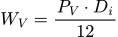
When a pipe operates under internal vacuum, atmospheric pressure pushes inward on the pipe walls. The vacuum load per linear foot equals the vacuum pressure times the inside diameter divided by 12.
Wv = Pv × Di / 12
External Vacuum Pressure
Rearranging the vacuum load equation to solve for the external vacuum pressure acting on the pipe, given the vacuum load and inside diameter.
Pv = 12 × Wv / Di
Inside Diameter from Vacuum
Solve for the inside diameter of a pipe given the vacuum load per linear foot and the vacuum pressure acting on the pipe walls.
Di = 12 × Wv / Pv
How It Works
When a pipe operates under internal vacuum (e.g., during rapid drainage or pump suction), atmospheric pressure pushes inward on the pipe walls. The vacuum load per linear foot equals the vacuum pressure times the inside diameter divided by 12. This load adds to external soil and wheel pressures in the total design check.
Example Problem
A 24-inch pipe experiences 200 lb/ft² vacuum pressure. What is the vacuum load per linear foot?
- Identify the known values: vacuum pressure Pv = 200 lb/ft², inside diameter Di = 24 inches.
- Determine what we are solving for: the vacuum load Wv per linear foot of pipe.
- Write the vacuum load formula: Wv = Pv × Di / 12.
- Substitute the known values: Wv = 200 × 24 / 12.
- Perform the multiplication: 200 × 24 = 4,800.
- Divide by 12: Wv = 4,800 / 12 = 400 lb/ft. This vacuum load is added to soil and wheel loads for total wall stress analysis.
When to Use Each Variable
- Solve for Vacuum Load — when you know the vacuum pressure and inside diameter, e.g., checking total wall loading during rapid drainage events.
- Solve for Vacuum Pressure — when you know the vacuum load and pipe diameter, e.g., back-calculating the pressure that caused observed deformation.
- Solve for Inside Diameter — when you know the vacuum load and pressure, e.g., selecting a pipe size that can withstand the design vacuum.
Key Concepts
Internal vacuum creates an inward-acting pressure differential between the atmosphere and the pipe interior. The vacuum load per linear foot converts this distributed pressure into a line load for structural comparison with soil and wheel loads. Full atmospheric vacuum is about 14.7 psi (2,116 lb/ft²), though most transient events produce partial vacuums.
Applications
- Sewer force mains: checking collapse resistance during pump shutdown and water column separation events
- Vacuum sewer systems: designing pipe walls to withstand continuous internal vacuum during normal operation
- Industrial piping: evaluating thin-wall pipe under suction from blowers, vacuum pumps, or rapid drainage
- Water transmission: analyzing transient vacuum pressures caused by sudden valve closures (water hammer)
Common Mistakes
- Forgetting to add vacuum load to external soil and wheel loads — vacuum pressure acts simultaneously with other external forces and must be combined in the total design check
- Using outside diameter instead of inside diameter — the vacuum acts on the internal surface, so the inside diameter determines the distributed load
- Ignoring transient vacuum events — steady-state operation may show no vacuum, but pump trips and rapid valve closures can create brief but severe vacuum spikes
Frequently Asked Questions
What causes vacuum conditions in a pipeline?
Rapid drainage of a full pipe, pump suction, water column separation after a valve closure, and siphon action can all create internal vacuum. The pressure difference between atmosphere and the partial vacuum pushes the pipe walls inward, creating collapse risk.
How do you prevent pipe collapse from vacuum pressure?
Install air-release valves and vacuum breakers at high points to admit air during vacuum events. Use thicker pipe walls or stiffer materials (steel vs. PVC) for pipes subject to frequent vacuum. Design the system to avoid rapid flow changes that trigger transient vacuums.
What is the maximum possible vacuum pressure?
Full atmospheric vacuum is about 14.7 psi (101.3 kPa or 2,116 lb/ft²). In practice, most buried pipe systems experience partial vacuums of 100–500 lb/ft² during transient events like pump shutdowns or rapid valve closures.
How do you calculate vacuum load on a pipe?
Use the formula Wv = Pv × Di / 12, where Pv is the vacuum pressure and Di is the inside diameter. This gives the vacuum load per linear foot, which is added to soil and wheel loads for total wall stress analysis.
What is the difference between vacuum load and vacuum pressure?
Vacuum pressure (Pv) is the inward-acting pressure differential in units like psi or lb/ft². Vacuum load (Wv) is the resulting line force per unit length of pipe (lb/ft or N/m), calculated by multiplying pressure by diameter and dividing by 12.
How does pipe diameter affect vacuum collapse risk?
Larger-diameter pipes have higher vacuum loads for the same pressure because the inward force acts over a wider area. A 36-inch pipe at the same vacuum pressure as a 12-inch pipe experiences three times the vacuum load per linear foot.
When should you add vacuum load to buried pipe design?
Always include vacuum load when the pipe may experience internal vacuum from pump shutdowns, rapid drainage, siphon action, or water hammer. The vacuum load is additive with soil pressure and wheel loads — all three must be combined for the total design check.
Reference:
National Resources Conservation Service. National Engineering Handbook. 1995. USDA.
Pipe Vacuum Load Formula
The vacuum load per linear foot on a pipe wall relates the external vacuum pressure to the pipe's inside diameter:
Wv = Pv × Di / 12
Where:
- Wv — vacuum load per linear foot (lb/ft or N/m)
- Pv — external vacuum pressure acting on the pipe (psi, Pa, or lb/ft²)
- Di — inside diameter of the pipe (inches, meters, or feet)
- 12 — conversion factor (inches to feet when using imperial units)
This formula converts the distributed vacuum pressure into a line load per unit length, which can be directly compared with soil pressure and wheel loads in buried pipe design.
Worked Examples
Water Distribution
What vacuum load acts on a 24-inch water main during a water hammer event?
A 24-inch water main experiences a transient vacuum of 200 lb/ft² during a pump shutdown. Calculate the vacuum load per linear foot.
- Vacuum pressure: Pv = 200 lb/ft²
- Inside diameter: Di = 24 inches
- Wv = 200 × 24 / 12
Wv = 400 lb/ft
This vacuum load must be added to external soil and wheel loads to check total wall stress against the pipe's buckling resistance.
Sewer Design
What vacuum pressure caused a measured 150 lb/ft vacuum load on a 12-inch siphon line?
A 12-inch siphon line shows deformation consistent with 150 lb/ft vacuum loading. Back-calculate the vacuum pressure.
- Vacuum load: Wv = 150 lb/ft
- Inside diameter: Di = 12 inches
- Pv = 12 × 150 / 12
Pv = 150 lb/ft²
At 150 lb/ft² (about 1 psi), this is a moderate vacuum. Continuous siphon operation at this level requires wall thickness verification.
Industrial
What pipe diameter is needed for a vacuum conveying system with 500 lb/ft² vacuum and 250 lb/ft load limit?
A vacuum conveying system operates at 500 lb/ft² vacuum. The pipe wall can handle a maximum vacuum load of 250 lb/ft. What is the maximum allowable inside diameter?
- Vacuum load limit: Wv = 250 lb/ft
- Vacuum pressure: Pv = 500 lb/ft²
- Di = 12 × 250 / 500
Di = 6 inches
Using a pipe larger than 6 inches at this vacuum level would exceed the wall's load capacity without reinforcement.
National Resources Conservation Service. National Engineering Handbook. 1995. USDA.
Related Calculators
- Pipe Hydrostatic Pressure Calculator — external water pressure on buried pipe
- Buried Plastic Pipe Calculator — combined pressure, thrust, and wall area
- Pipe Soil Pressure Calculator — soil weight pressure and buoyancy factor
- Pipe Wheel Loading Calculator — wheel loads at various cover depths
- Fluid Pressure Calculator — calculate hydrostatic pressure at any depth
- Pressure Unit Converter — convert vacuum and pressure between different units
Related Sites
- Dollars Per Hour — Weekly paycheck calculator with overtime
- Compare 2 Loans — Side-by-side loan comparison calculator
- Medical Equations — Hemodynamic, pulmonary, and dosing calculators
- InfantChart — Baby and child growth percentile charts
- Temperature Tool — Temperature unit converter
- LoanChop — Loan prepayment calculator