Static Friction Calculator
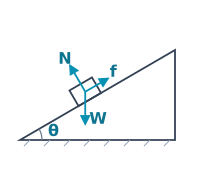
Maximum static friction force equals static friction coefficient multiplied by normal force
Static friction is the resistive force that prevents an object at rest from starting to slide. The maximum static friction force equals the static coefficient of friction multiplied by the normal force pressing the surfaces together.
f_max = μ_s × F_normal
The static coefficient is a dimensionless ratio that depends on the material pair and surface conditions. Measure it experimentally by dividing the force required to just start sliding by the normal force.
μ_s = f_max / F_normal
Given the maximum static friction force and the static coefficient, recover the normal force pressing the surfaces together.
F_normal = f_max / μ_s
Static friction is the force that resists the start of relative motion between two surfaces in contact. The equation f_max = μ_s × F_normal multiplies the static coefficient (a dimensionless number that depends on the material pair) by the normal force pressing the surfaces together. Static friction varies from zero up to a maximum value — only when the applied force exceeds f_max does the object actually begin to slide. The static coefficient is typically higher than the kinetic coefficient for the same surface pair, which is why it takes more force to start a box moving than to keep it sliding.
A 50 kg crate sits on a concrete floor (μ_s = 0.5). What is the maximum static friction force resisting motion before the crate starts to slide?
Static friction prevents relative motion between two surfaces in contact. Unlike kinetic friction, static friction is not a single value — it adjusts to match the applied force, up to a maximum given by f_max = μ_s × F_normal. The static coefficient μ_s is a dimensionless property of the material pair and surface conditions, and is typically higher than the kinetic coefficient μ_k for the same surface pair.
Multiply the static coefficient of friction by the normal force to get the maximum possible static friction: f_max = μ_s × F_normal. For μ_s = 0.5 and F_normal = 100 N, f_max = 50 N — the object starts to slide once the applied force exceeds 50 N.
The maximum static friction equation is f_max = μ_s × F_normal, where μ_s is the static coefficient (dimensionless) and F_normal is the perpendicular force the surface exerts on the object. Below this maximum, static friction equals whatever applied force is acting on the object.
When two surfaces are in static contact, microscopic asperities have time to settle and interlock, requiring more force to break free. Once sliding begins, the asperities skip over each other and the friction drops to the kinetic value. Typical ratios μ_s/μ_k are 1.1–1.4.
Apply a horizontal force to a stationary object and slowly increase it until the object just starts to slide. Divide that breakaway force by the normal force: μ_s = f_max / F_normal. Common values: rubber on dry concrete ~1.0, steel on steel ~0.74, ice on ice ~0.1.
No. Static friction equals whatever applied force is currently trying to move the object, up to a maximum of μ_s × F_normal. If you push a heavy box gently, the box exerts back only as much friction as your push — not the maximum.
For most dry contacts, static friction is independent of the apparent contact area — it depends only on the normal force and the materials in contact. This is one of the classical Amontons–Coulomb laws of friction.
Reference:
Tipler, Paul A. 1995. Physics For Scientists and Engineers. Worth Publishers. 3rd ed.
Automotive Engineering
A small car has a curb weight of 1500 kg sitting on dry asphalt. The published static friction coefficient between dry asphalt and rubber tires is roughly μ_s = 0.85. What is the maximum static friction force opposing a tow strap before the wheels finally break loose and slide?
f_max ≈ 12,508 N
This is the threshold before the locked wheels slide. Once they break loose the kinetic coefficient (~0.7 for dry asphalt) governs the dragging force, which is why a winch can keep pulling a car after the initial yank.
Structural Engineering
A friction-grip steel splice has to resist a 5,000 N service shear without slipping. AISC tables give a Class A faying-surface coefficient of μ_s = 0.30 for clean mill scale. What minimum bolt pretension (normal clamping force across the joint) keeps it from slipping?
F_normal ≈ 16,667 N
Real bolt pretension is normally specified well above this minimum to keep the joint slip-critical under load reversals and to account for relaxation. Higher-class blast-cleaned faying surfaces (μ_s ≈ 0.50) cut the required clamp roughly in half.
Sports Science
A climber presses one rubber shoe into a granite slab with a normal force of 350 N. The shoe holds until the climber drags a horizontal tension of 280 N across it, then breaks loose. What static friction coefficient does this implied pair of climbing-shoe rubber and dry granite exhibit?
μ_s ≈ 0.80
Modern sticky-rubber compounds like Vibram XS Grip routinely hit μ_s ≈ 0.8–1.2 on clean dry granite. Moisture, chalk dust, and lichen all drop the coefficient sharply — the same rubber can fall below μ_s = 0.4 on wet stone.
Dry-contact friction is modeled with a single proportional law that can be rearranged to solve for any of its three quantities:
Where:
The model assumes a flat, dry, unlubricated interface and a moderate normal load. It does not account for fluid films, adhesion at very light loads, or the velocity-dependence of friction at high sliding speeds — situations covered by the Stribeck curve and hydrodynamic lubrication theory. Published μ values are pair-specific (rubber on asphalt, steel on steel, PTFE on glass) and shift with surface finish, contamination, and temperature.
