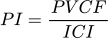
Profitability Index
The profitability index divides the present value of expected cash flows by the initial investment. A PI above 1.0 means the investment creates value; below 1.0 means it destroys value. Useful for ranking projects when capital is limited.
PI = PVCF / ICI
Present Value of Cash Flows
Solve for the present value of expected cash flows given the profitability index and initial cash investment. This tells you the total discounted value the project is expected to return.
PVCF = PI × ICI
Initial Cash Investment
Determine the initial investment required given the present value of cash flows and a target profitability index. Useful for budgeting and capital allocation.
ICI = PVCF / PI
How It Works
The profitability index divides the present value of expected cash flows by the initial investment. A PI above 1.0 means the investment creates value; below 1.0 means it destroys value. It is especially useful for ranking projects when capital is limited. Unlike NPV, which gives a dollar amount, PI expresses return as a ratio, making it easier to compare projects of different sizes.
Example Problem
A project requires $200,000 upfront and the present value of future cash flows is $260,000 at a 10% discount rate.
- Identify the present value of future cash flows (PVCF): $260,000 — this is the sum of all expected cash flows discounted back to today at the required rate of return.
- Identify the initial cash investment (ICI): $200,000 — this is the upfront capital outlay required to undertake the project.
- Write the profitability index formula: PI = PVCF / ICI.
- Substitute the values: PI = $260,000 / $200,000.
- Calculate the ratio: PI = 1.30.
- Interpret the result: a PI of 1.30 means every dollar invested generates $1.30 in present value, creating $0.30 of value per dollar. This project should be accepted because PI exceeds 1.0.
A PI of 1.30 means every dollar invested generates $1.30 in present value, creating $0.30 of value per dollar. This project should be accepted.
When to Use Each Variable
- Solve for PI — when you know the present value of cash flows and the initial investment, e.g., evaluating whether a project meets your return threshold.
- Solve for Present Value — when you know the PI and initial investment, e.g., determining the minimum discounted cash flow needed for a target return.
- Solve for Initial Investment — when you know the present value of cash flows and required PI, e.g., calculating the maximum you should invest for a given return target.
Key Concepts
The profitability index expresses investment return as a ratio rather than a dollar amount, making it ideal for ranking projects of different sizes when capital is limited. A PI of exactly 1.0 means the project breaks even at the discount rate. Unlike IRR, PI accounts for the scale of investment, and unlike NPV, it normalizes returns per dollar invested.
Applications
- Capital rationing: ranking competing projects when a firm cannot fund all positive-NPV opportunities
- Venture capital: comparing startup investments of vastly different sizes on a per-dollar-invested basis
- Real estate development: evaluating which property investments deliver the highest return per dollar of equity
- Government budgeting: prioritizing public infrastructure projects with limited funding
Common Mistakes
- Comparing PI across projects with different discount rates — PI is only meaningful when all projects use the same required rate of return
- Using undiscounted cash flows in the numerator — PVCF must be the present value of future cash flows, not the simple sum of nominal cash flows
- Ignoring PI when NPV is positive — a large project with positive NPV but low PI may be a worse use of scarce capital than a smaller project with higher PI
Frequently Asked Questions
When should you use the profitability index instead of NPV?
Use PI instead of NPV when capital is limited and you need to rank competing projects. NPV tells you the total dollar value created, but it doesn't tell you how efficiently capital is used. A $10M project with $1M NPV (PI = 1.10) uses capital less efficiently than a $1M project with $300K NPV (PI = 1.30). PI ranks by return per dollar, which is what matters under capital constraints.
What does a profitability index greater than 1 mean?
A PI greater than 1.0 means the present value of future cash flows exceeds the initial investment — the project creates value. For example, a PI of 1.25 means every dollar invested returns $1.25 in present-value terms, generating $0.25 of value per dollar. The higher the PI above 1.0, the more value per dollar invested.
How do you calculate the profitability index?
Divide the present value of expected future cash flows by the initial cash investment: PI = PVCF / ICI. First discount all future cash flows to present value using your required rate of return, then divide by the upfront cost. For example, if discounted cash flows total $390,000 and the initial investment is $300,000, PI = $390,000 / $300,000 = 1.30.
What is a good profitability index for a project?
Any PI above 1.0 creates value, but what counts as 'good' depends on context. In corporate capital budgeting, PIs of 1.1 to 1.3 are common for approved projects. Venture capital targets PIs of 1.5 or higher to compensate for high failure rates. Public infrastructure projects may accept PIs as low as 1.05 given social benefits not captured in cash flows.
Can the profitability index be negative?
PI cannot be negative as long as both the present value of cash flows and the initial investment are positive numbers. However, PI can be less than 1.0, which means the project destroys value — the discounted cash flows do not recover the initial investment at the required rate of return.
What is the difference between PI and benefit-cost ratio?
They are essentially the same concept applied in different contexts. PI is used in corporate finance and divides PV of cash flows by initial investment. Benefit-cost ratio (BCR) is used in public policy and divides PV of benefits by PV of costs. Both express return as a ratio, and both use a threshold of 1.0 to accept or reject.
How does discount rate affect the profitability index?
A higher discount rate reduces the present value of future cash flows (the numerator), which lowers the PI. Conversely, a lower discount rate increases PVCF and raises the PI. This is why you must use the same discount rate when comparing PI across projects — otherwise the comparison is meaningless.
Reference:
Brealey, Richard A., Myers, Stewart C. & Allen, Franklin. Principles of Corporate Finance. McGraw-Hill Education.
Profitability Index Formula
The profitability index measures investment efficiency by comparing the present value of future cash flows to the initial outlay:
PI = PVCF / ICI
Where:
- PI — profitability index (dimensionless ratio)
- PVCF — present value of expected future cash flows, measured in dollars ($)
- ICI — initial cash investment (the upfront cost), measured in dollars ($)
A PI above 1.0 indicates the project creates value beyond the required rate of return. A PI below 1.0 means the project destroys value. When capital is limited and multiple projects compete for funding, rank them by PI to maximize total value per dollar invested.
Worked Examples
Capital Budgeting
Should the company approve a factory expansion?
A manufacturer considers expanding a production line. The expansion requires $500,000 upfront, and the present value of incremental cash flows over 10 years is $675,000 at a 10% discount rate.
- PI = PVCF / ICI
- PI = $675,000 / $500,000
PI = 1.35
A PI of 1.35 means every dollar invested returns $1.35 in present value. The project creates $0.35 of value per dollar and should be approved if capital allows.
Startup Investment
Is this early-stage startup worth the venture capital?
A VC fund considers a $2 million Series A investment in a SaaS startup. The expected present value of future cash flows (exit proceeds discounted at 25%) is $3,400,000.
- PI = PVCF / ICI
- PI = $3,400,000 / $2,000,000
PI = 1.70
A PI of 1.70 is strong for venture capital. The fund earns $1.70 per dollar invested in present-value terms. Compare against other deal-flow opportunities by PI to allocate the fund efficiently.
Infrastructure
Which public works project should a city prioritize?
A city has $10 million in bond funding and must choose between projects. A water treatment plant upgrade costs $8 million with PV of benefits (avoided health costs, efficiency gains) of $9,600,000 at a 4% social discount rate.
- PI = PVCF / ICI
- PI = $9,600,000 / $8,000,000
PI = 1.20
With limited bond funding, the city should rank all candidate projects by PI. A PI of 1.20 is acceptable for public infrastructure, but a competing project with PI = 1.45 would deliver more value per tax dollar.
Reference: Brealey, Richard A., Myers, Stewart C. & Allen, Franklin. Principles of Corporate Finance. McGraw-Hill Education.
Related Calculators
- Present Worth Calculator — discount future cash flows
- Return on Equity Calculator — measure equity returns
- Cash on Cash Rate Calculator — evaluate real estate cash returns
- Compounding & Discount Factors Calculator — compute discount factors for cash flows
- Rule of 72 Calculator — quickly estimate investment doubling time
Related Sites
- Dollars Per Hour — Weekly paycheck calculator with overtime
- OptionsMath — Options trading profit and loss calculators
- Percent Off Calculator — Discount and sale price calculator
- CameraDOF — Depth of field calculator for photographers
- Medical Equations — Hemodynamic, pulmonary, and dosing calculators
- InfantChart — Baby and child growth percentile charts